Jacques Augustin Catherine Pajou
1766 – 1828
In short
Jacques Augustin Catherine Pajou (1766–1828) was a French painter working in the Classical style, active in Paris, best known for his portraiture including works such as the 1805 "Okänd kvinna" and the 1808 portrait of Marshal Louis‑Alexandre Berthier.
Notable works

_-_P250_-_Mus%C3%A9e_Carnavalet.jpg)

Early life Jacques‑Augustin‑Catherine Pajou was born in Paris in 1766 into a family with artistic connections; his father, the sculptor Pierre Pajou, was a member of the Académie royale de peinture et de sculpture. Growing up in the capital during the final decades of the Ancien Régime, Pajou was exposed to the flourishing neoclassical currents that dominated French art education. While precise records of his apprenticeship are lacking, it is reasonable to infer that he received formal training in drawing and painting within the Parisian ateliers that catered to the children of artists. The political turbulence of the French Revolution coincided with his early adulthood, shaping both his personal circumstances and the subjects for which he would later be commissioned.
Career and style Pajou emerged as a professional painter in the 1780s, a period marked by the consolidation of the Classical style in French visual culture. His work reflects the hallmarks of French Classicism: balanced composition, restrained colour palettes, and an emphasis on idealised yet realistic human anatomy. Throughout his career, he primarily produced portraiture for aristocratic, military, and bourgeois patrons, aligning his practice with the demand for representational art that celebrated status and achievement. The upheavals of the Napoleonic era provided opportunities for artists to document the new elite, and Pajou secured several high‑profile commissions, most notably from members of the imperial administration and the military.
Signature techniques Pajou’s technique is characterised by a meticulous draftsmanship that underscores the classical emphasis on line. He employed a smooth, almost invisible brushstroke to render flesh tones, creating a polished surface that evoked the marble statues of antiquity. Light is handled with subtle chiaroscuro, modelling the faces and drapery without dramatic contrast, thereby preserving a sense of calm dignity. His palette favours muted earth tones—ochre, umber, and a restrained use of cadmium red—to avoid the flamboyance of the earlier Rococo style. In composition, he often placed his sitters against a neutral or lightly indicated background, allowing the figure to dominate the visual field.
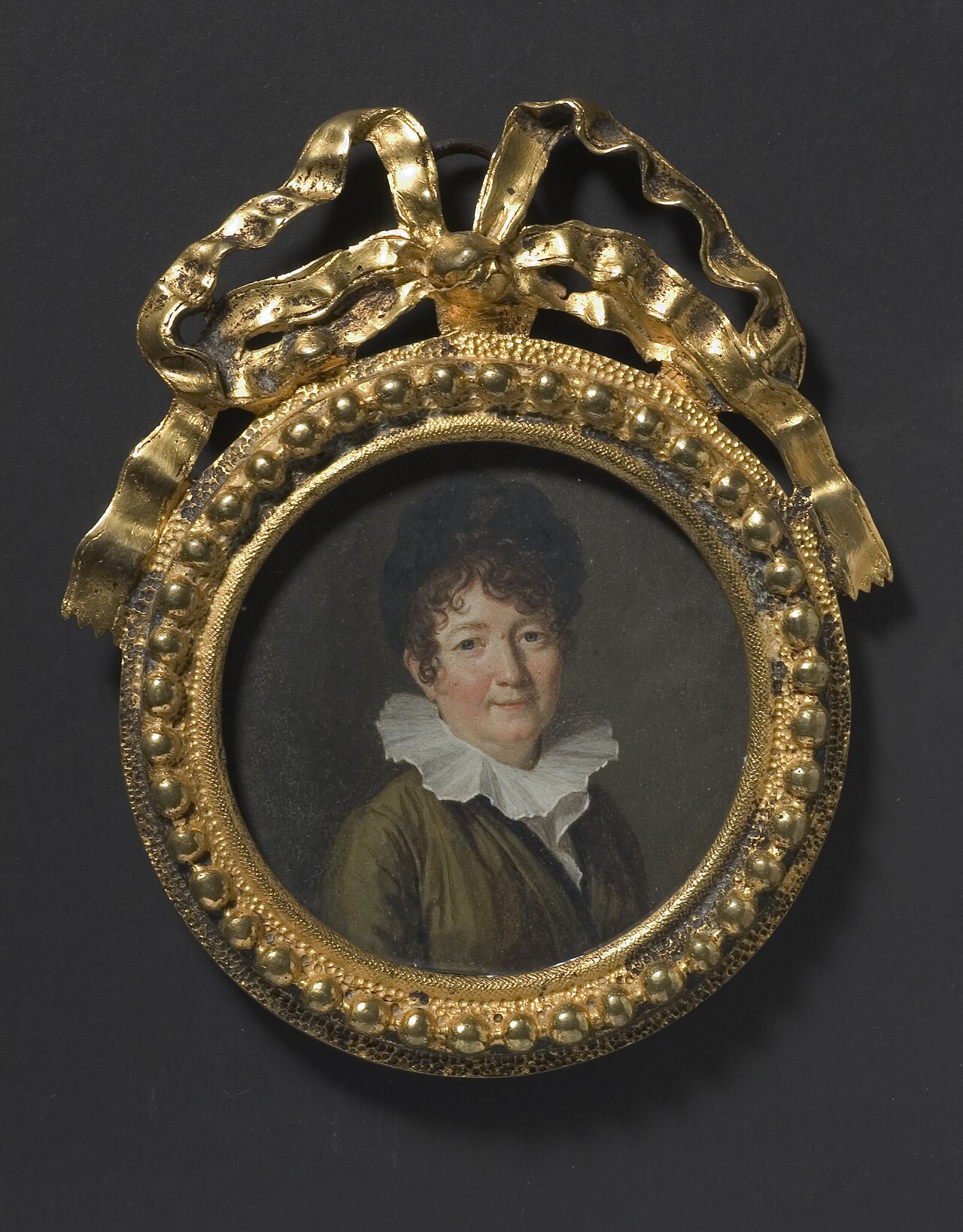
Major works - **Okänd kvinna (1805)** – This portrait, whose title translates from Swedish as “Unknown Woman,” demonstrates Pajou’s capacity to convey personality through restrained expression. The sitter is presented in three‑quarter view, her gaze directed slightly off‑canvas, a compositional choice that invites contemplation. The subdued colour scheme and delicate modelling of skin exemplify his classical approach. - **Louis‑Alexandre Berthier, Prince of Neufchâtel and de Wagram, Marshal of France (1808)** – Commissioned during the height of Napoleonic power, this work captures the marshal in his military regalia. Pajou renders the intricate details of Berthier’s uniform with exacting precision, while the background remains neutral, ensuring the emphasis remains on the figure’s authority and poise. - **Portrait de Louis‑Jérome Gohier (1746‑1830) (1802)** – Gohier, a noted jurist and political figure, is depicted seated, his posture dignified yet relaxed. Pajou’s handling of the fabric’s texture—particularly the subtle sheen of the silk—reveals his technical skill. The portrait’s composition reflects the Enlightenment ideals of rationality and civic virtue. - **Men Studies (1785)** – An early work, this series of male studies explores the anatomy and posture of the male figure. Executed with a focus on anatomical accuracy, the studies serve both as academic exercises and as a foundation for his later portraiture. The drawings display a clear line, minimal shading, and a keen observation of musculature.
Influence and legacy Although not as widely celebrated as some of his contemporaries, Pajou contributed to the perpetuation of the Classical aesthetic during a period of rapid political change. His portraits provide valuable visual documentation of the French elite in the transitional years from the Revolution through the Napoleonic Empire. The precision of his technique and his adherence to neoclassical ideals influenced younger artists who continued to work within the academic tradition into the early nineteenth century. Modern scholarship regards his oeuvre as a modest yet informative example of French portraiture that bridges the late eighteenth‑century classicism with the emerging Romantic sensibilities.
Overall, Jacques‑Augustin‑Catherine Pajou remains a representative figure of the French Classical school, whose works, though relatively few, offer insight into the stylistic preferences and social networks of his time.
Frequently asked questions
Who was Jacques Augustin Catherine Pajou?
He was a French painter (1766–1828) working in the Classical style, known primarily for portraiture produced in Paris.
What artistic style or movement is Pajou associated with?
Pajou is associated with French Classicism, a movement that emphasized balanced composition, restrained colour, and idealised realism.
What are his most famous works?
His most noted works include the portrait "Okänd kvinna" (1805), the 1808 portrait of Marshal Louis‑Alexandre Berthier, the 1802 portrait of Louis‑Jérome Gohier, and a series of male studies from 1785.
Why does he matter in art history?
Pajou provides a clear example of Classical portraiture during the turbulent Revolutionary and Napoleonic periods, documenting the visual culture of France’s elite and influencing subsequent academic painters.
How can I recognise a painting by Pajou?
Look for smooth, almost invisible brushwork, a muted palette, careful modelling of flesh, and a neutral background that places the sitter prominently in the composition.