Jacopo da Sellaio
1442 – 1493
In short
Jacopo da Sellaio (1442–1493) was a Florentine painter of the early Renaissance, recognised for an eclectic style that blends influences from Botticelli, Filippino Lippi and Ghirlandaio, and for works such as The Banquet of Ahasuerus and various depictions of Saint Jerome.
Notable works


Early life Jacopo da Sellaio was born in Florence around 1442, the son of a saddle maker – a trade that gave him the nickname *Sellaio* (Italian for "saddler"). His birth name was Jacopo di Arcangelo, but the workshop environment of Renaissance Florence often led artists to be identified by family trades or patronymics. Little is recorded about his childhood education, but the Florentine artistic milieu of the mid‑15th century provided ample opportunity for apprenticeship. It is probable that he trained within a local workshop, absorbing the techniques of the city’s leading masters.
Career and style By the 1460s Jacopo was active as an independent painter in Florence. His output reflects the transitional nature of the period: he worked in a style that combined the graceful linearity of Botticelli, the narrative vigor of Filippino Lippi and the compositional clarity of Domenico Ghirlandaio. This eclecticism was typical of many Florentine workshops, where collaboration and the sharing of motifs were common. Jacopo’s paintings often display a bright colour palette, delicate modelling of figures, and a careful attention to decorative detail, especially in textiles and architectural settings.
Signature techniques Jacopo’s technique can be distinguished by several recurring elements. He favoured tempera on panel, a medium that allowed for fine brushwork and luminous colour. His figures are frequently outlined with a subtle, yet precise, hatching that gives a sense of three‑dimensionality without heavy chiaroscuro. In the background he often employed a shallow, gilded architectural framework that situates the narrative within a sacred or courtly space. Decorative motifs such as foliage scrolls, intricate patterns on clothing, and the occasional use of gold leaf are hallmarks of his workshop’s ornamental approach.
Major works The most securely attributed works include **The Banquet of Ahasuerus** (c. 1490), a large panel that depicts the biblical banquet where Queen Esther intercedes for the Jews. The composition demonstrates Jacopo’s skill in arranging multiple figures within a confined interior, each rendered with distinctive facial expressions and sumptuous garments.
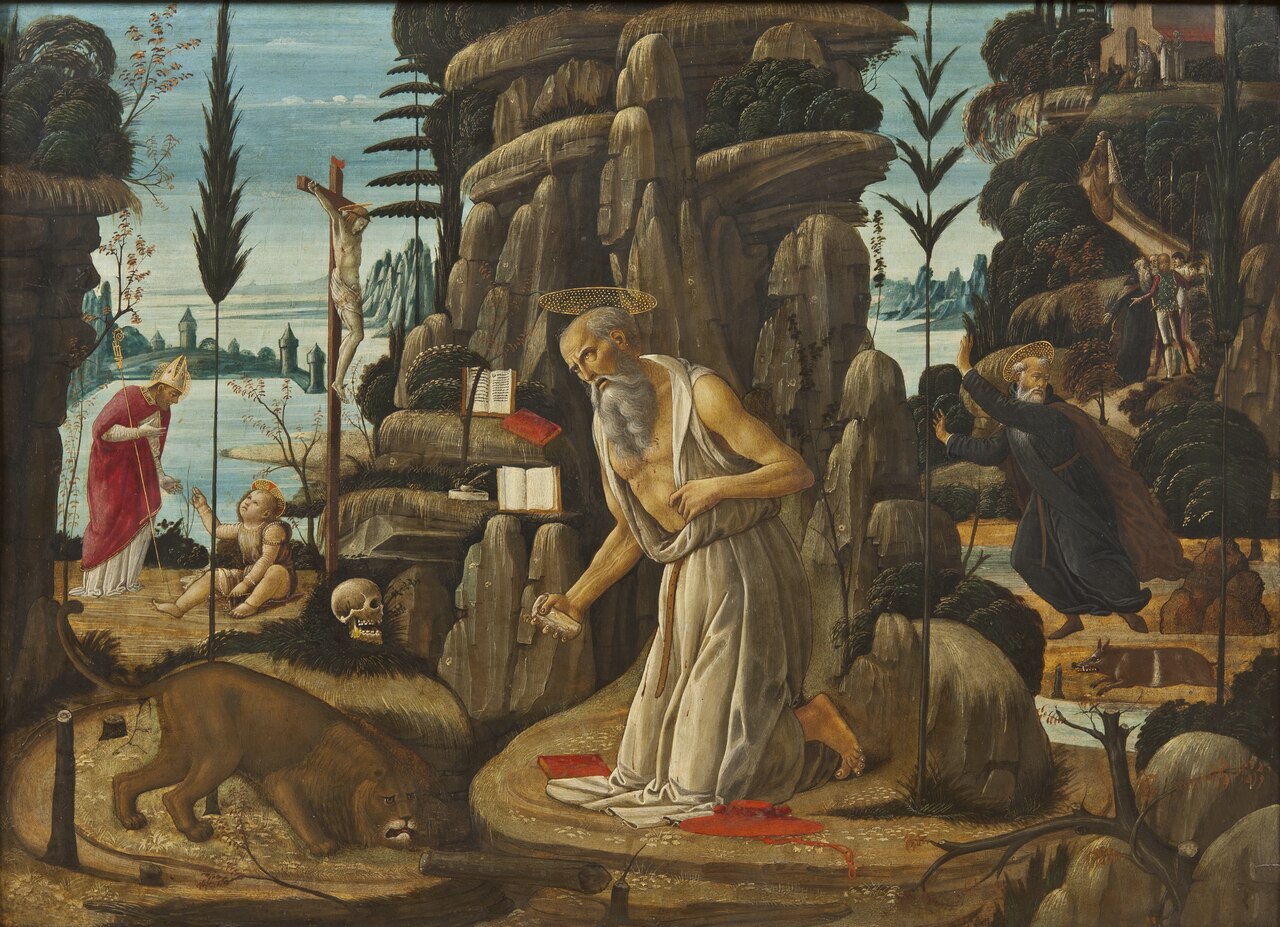
Another important group of works concerns Saint Jerome, traditionally shown in penance. While the titles *Penitent Saint Jerome* and *The Penitent St Jerome* appear in catalogues, both refer to a single composition that portrays the saint in a hermitic setting, absorbed in scriptural study. The painting’s muted palette and the emphasis on the saint’s ascetic posture illustrate Jacopo’s ability to convey spiritual contemplation.
*Christ with Instruments of the Passion* (c. 1485) is a devotional panel that presents Christ surrounded by the tools of his crucifixion. The work is notable for its careful rendering of the objects—crown of thorns, nails, and the cross—each depicted with realistic texture, a testament to Jacopo’s observational skill.
Two later attributions, *Adoration of the Christ Child* and a second version of *Penitent Saint Jerome* dated to 1500, fall after his death in 1493. These are generally regarded as workshop pieces or later copies that follow Jacopo’s compositional formulas. Their inclusion in his oeuvre reflects the lasting influence of his designs on subsequent Florentine artists.
Influence and legacy Jacopo da Sellaio’s legacy lies in his role as a conduit for the major stylistic currents of mid‑15th‑century Florence. Though he never achieved the fame of Botticelli or Ghirlandaio, his workshop contributed to the diffusion of their visual language across the city’s artistic production. He also trained several younger painters, passing on his decorative sensibility and his method of integrating narrative and ornamental detail. Modern scholarship regards him as a representative figure of the Florentine school’s collaborative environment, illustrating how artists of the period negotiated personal style within a shared visual culture.
His works continue to be studied for their insight into workshop practices, the transmission of motifs, and the interplay between religious devotion and secular patronage in Renaissance art. Exhibitions of Florentine painting often include a Jacopo panel to demonstrate the breadth of artistic expression beyond the canonical masters, underscoring his importance as a bridge between the early and high Renaissance in Florence.
Frequently asked questions
Who was Jacopo da Sellaio?
Jacopo da Sellaio was a Florentine painter of the early Renaissance (1442–1493) known for his eclectic style that blends influences from leading artists like Botticelli and Ghirlandaio.
What artistic movement or school did he belong to?
He worked within the Florentine School, a vibrant artistic community that combined humanist themes with refined decorative techniques.
What are his most famous works?
His most recognised pieces include *The Banquet of Ahasuerus* (c. 1490), *Christ with Instruments of the Passion* (c. 1485), and the *Penitent Saint Jerome* composition.
Why is Jacopo da Sellaio important in art history?
He serves as a key example of how Florentine workshops transmitted and adapted the styles of major masters, helping to spread Renaissance visual ideas throughout the city.
How can I recognise a painting by Jacopo da Sellaio?
Look for tempera panels with delicate line work, rich decorative textiles, modest use of gold leaf, and an emphasis on narrative detail that echoes the styles of Botticelli and Ghirlandaio.