Jacobus Josephus Eeckhout
1793 – 1861
In short
Jacobus Josephus Eecknout (1793–1861) was a Belgian‑born Flemish painter, sculptor, pastellist, water‑colourist and lithographer who worked mainly in the Netherlands and France, and served as Director of the Royal Academy of Art in The Hague.
Notable works

._Vice-admiraal_en_bevelhebber_van_het_Nederlandse_eskader_voor_Algiers_in_1816_Rijksmuseum_SK-A-4058.jpeg)
._Echtgenote_van_Jonkheer_Theodorus_Frederik_van_Capellen_Rijksmuseum_SK-A-4059.jpeg)

Early life Jacob Josephus Eeckhout was born in 1793 in Antwerp, a city long celebrated for its vibrant artistic community. He grew up amid the lingering influence of the Flemish Baroque tradition, while the political landscape of the Low Countries was undergoing rapid change after the French Revolutionary wars. Details of his family background are sparse, but archival records indicate that he received a thorough artistic apprenticeship in his native city, where he would have been exposed to both the techniques of the old masters and the emerging practices of the early nineteenth‑century academy system.
In his early twenties Eeckhout moved to The Hague, attracted by the city’s growing reputation as a centre for academic art and its proximity to the Dutch royal patronage network. The relocation marked the beginning of his professional integration into the Dutch art world, where he would eventually assume a leading role at the Royal Academy of Art.
Career and style Eeckhout’s career unfolded across three national contexts—Belgium, the Netherlands, and France. As a versatile artist, he worked in oil, pastel, water‑colour, and lithography, and also produced sculpture, reflecting the broad training typical of academy‑educated painters of his era. While no single movement claims him as a canonical member, his oeuvre exhibits hallmarks of the late‑Classicist and early‑Romantic currents that dominated European academic circles in the first half of the 19th century. His compositions are generally characterised by meticulous draftsmanship, a restrained colour palette, and an emphasis on narrative clarity.
In the 1820s and 1830s Eeckhout became known for his portraiture, which combined an accurate likeness with a dignified, often slightly idealised representation of his sitters. His portrait of Jonkheer Theodorus Frederik van Capellen (1835) and the companion portrait of Petronella de Lange demonstrate his skill in rendering both the individual’s character and the social status implied by their attire and setting. These works were well received by the Dutch elite, securing further commissions and enhancing his reputation as a court‑connected portraitist.
Around the same period he began to receive larger historical commissions, a genre that allowed him to explore more complex compositions and elaborate costuming. The marriage scene of Jacqueline, Countess of Hainaut, and John IV, Duke of Brabant (1839) exemplifies his capacity to blend historical research with a narrative sensibility that appealed to a 19th‑century audience fascinated by medieval and early‑modern subjects.
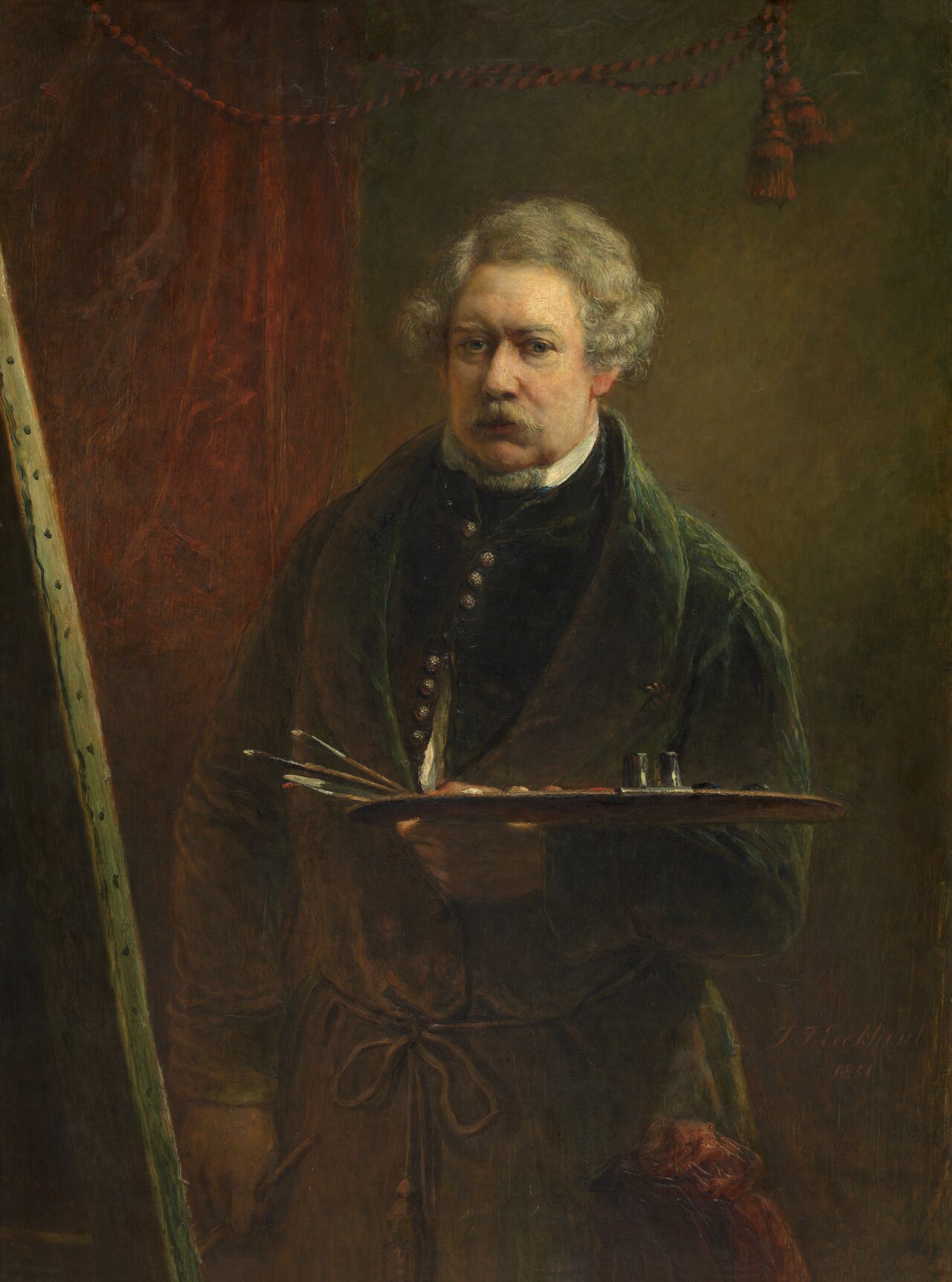
Eeckhout’s later years saw a shift toward genre scenes and self‑portraiture, suggesting a personal engagement with the everyday and with his own artistic identity. His self‑portrait (1851) offers insight into his self‑perception as a mature artist, presenting himself with the calm confidence of a seasoned academic.
Signature techniques Eeckhout’s technical versatility is a defining feature of his practice. In oil paintings he employed a layered approach, beginning with a precise underdrawing followed by thin glazes that created depth without sacrificing detail. His pastels are notable for their delicate handling of light; he built colour through successive, translucent strokes that produced a luminous surface akin to the works of French pastellists such as Jean‑Baptiste Regnault.
His water‑colours reveal an economy of brushwork, where washes of pigment are combined with fine ink outlines to delineate form. This method allowed him to capture atmospheric effects while retaining the structural clarity required for academic subjects. As a lithographer, Eeckhout made use of fine line work and cross‑hatching to achieve tonal variation, a skill that proved valuable for reproducing his own paintings and for creating prints that could reach a broader market.
Across media, Eeckhout favoured a restrained colour scheme dominated by earth tones, muted blues and ochres, punctuated by richer reds or golds to highlight focal points such as a garment’s trim or a regal insignia. This palette reinforced the dignified, historic character of his larger narrative works.
Major works - **The Marriage of Jacqueline, Countess of Hainaut (Jacoba of Bavaria), and John IV, Duke of Brabant, on 10 March 1418 (1839)** – This large‑scale history painting depicts the ceremonial union of two prominent medieval figures. Eeckhout rendered the scene with careful attention to period costume and architectural detail, situating the couple within a vaulted hall that emphasises their regal stature. The composition balances a central couple with attendant figures, creating a sense of formal procession.
- Portrait of Jonkheer Theodorus Frederik van Capellen, Vice‑Admiral and Commander of the Dutch Squadron at Algiers in 1816 (1835) – In this portrait, Eeckhout captures the naval officer’s confidence through a poised stance, precise rendering of the uniform, and a subtle background that hints at maritime themes. The work underscores the sitter’s authority while maintaining a personal, almost intimate expression.
- Portrait of Petronella de Lange, Wife of Theodorus Frederik van Capellen (1835) – Complementary to the previous portrait, this piece presents Petronella with a gentle demeanor, her attire reflecting contemporary fashion. Eeckhout’s handling of the fabric’s texture and the delicate modelling of the face demonstrate his skill in achieving both realism and idealisation.
- Household troubles (1844) – This genre painting portrays a domestic interior where a family appears engaged in a moment of mild conflict. The scene is rendered with a warm palette and careful observation of interior furnishings, offering insight into 19th‑century middle‑class life.
- Self Portrait (1851) – Executed later in his career, the self‑portrait shows Eeckhout seated before a canvas, palette in hand. The work reflects his self‑awareness as an artist and his continued commitment to the academic standards that shaped his training.
Influence and legacy During his lifetime Eeckhout held a prominent position within the Dutch academic establishment, most notably as Director of the Royal Academy of Art in The Hague. In that capacity he influenced a generation of painters by promoting rigorous drawing, compositional structure, and a respect for historical subject matter. Although his name is less widely recognised today than some of his contemporaries, his contributions to portraiture and historical painting helped to sustain the academic tradition in the Netherlands during a period when Romanticism and later Realism were gaining ground.
His works are held in several public collections across Belgium, the Netherlands, and France, where they serve as exemplars of early‑19th‑century academic practice. Scholars of Flemish art regard Eeckhout as a bridge between the rich Baroque heritage of his native Antwerp and the emerging, more restrained aesthetic of the post‑Napoleonic era. Moreover, his lithographs contributed to the diffusion of academic styles beyond the confines of elite patronage, making his visual language accessible to a broader audience.
In contemporary art‑history discourse, Eeckhout is often cited when discussing the transnational networks of artists who moved between the Southern and Northern Low Countries and France, illustrating how artistic ideas circulated across political borders. His legacy endures in the pedagogical frameworks he helped to shape and in the enduring visual quality of his surviving paintings, which continue to be studied for their technical mastery and historical narrative content.
Frequently asked questions
Who was Jacobus Josephus Eeckhout?
Jacobus Josephus Eeckhout (1793–1861) was a Belgian‑born Flemish painter, sculptor, pastellist, water‑colourist and lithographer who worked mainly in the Netherlands and France and served as Director of the Royal Academy of Art in The Hague.
What artistic style or movement is Eeckhout associated with?
Eeckhout is not tied to a single movement, but his work reflects the late‑Classicist and early‑Romantic academic style that dominated European art academies in the first half of the 19th century.
What are his most famous works?
His most recognised pieces include the history painting *The Marriage of Jacqueline, Countess of Hainaut and John IV, Duke of Brabant* (1839), the portraits of Jonkheer Theodorus Frederik van Capellen and his wife Petronella de Lange (both 1835), the genre scene *Household troubles* (1844) and his self‑portrait (1851).
Why is Eeckhout important in art history?
He helped sustain and transmit academic painting techniques in the Netherlands, influenced students as Director of the Hague Academy, and exemplifies the cross‑border artistic exchange between Belgium, the Netherlands and France during a transformative period.
How can I recognise an Eeckhout painting?
Look for precise draftsmanship, a restrained earth‑tone palette, careful rendering of historic costumes, and a balanced composition that combines narrative detail with a calm, dignified presentation of figures.