Jacob Vrel
1630 – present
In short
Jacob Vrel (c.1630–?) was a Dutch Golden Age painter born in Friesland and later active in Amsterdam, best known for interior domestic scenes and urban street views such as View of a Town (1658) and Woman at the Hearth (1658). His work is distinguished by careful perspective and a quiet, observational style.
Notable works


Early life Jacob Vrel was born around 1630 in the province of Friesland, a region in the northern part of the Dutch Republic. Little is recorded about his family background or formal training, and the documentary record of his early years is sparse. It is probable that he received an apprenticeship typical of the period, learning the fundamentals of drawing, oil painting, and the handling of perspective from a local master. Friesland produced several itinerant artists who travelled to larger urban centres in search of patronage, and Vrel appears to have followed a similar path.
Career and style Vrel’s active period is generally placed between the mid‑1650s and the early 1660s, a time when the Dutch Golden Age was at its height. He settled in Amsterdam, the commercial and artistic hub of the Republic, where he would have been exposed to the flourishing market for genre paintings, cityscapes and interior scenes. His oeuvre, although limited in number, demonstrates a clear affinity with the domestic‑interior tradition of Dutch painters such as Pieter de Hooch and Gerard ter Borch, while also sharing compositional concerns with urban‑view specialists like Jan van der Heyden.
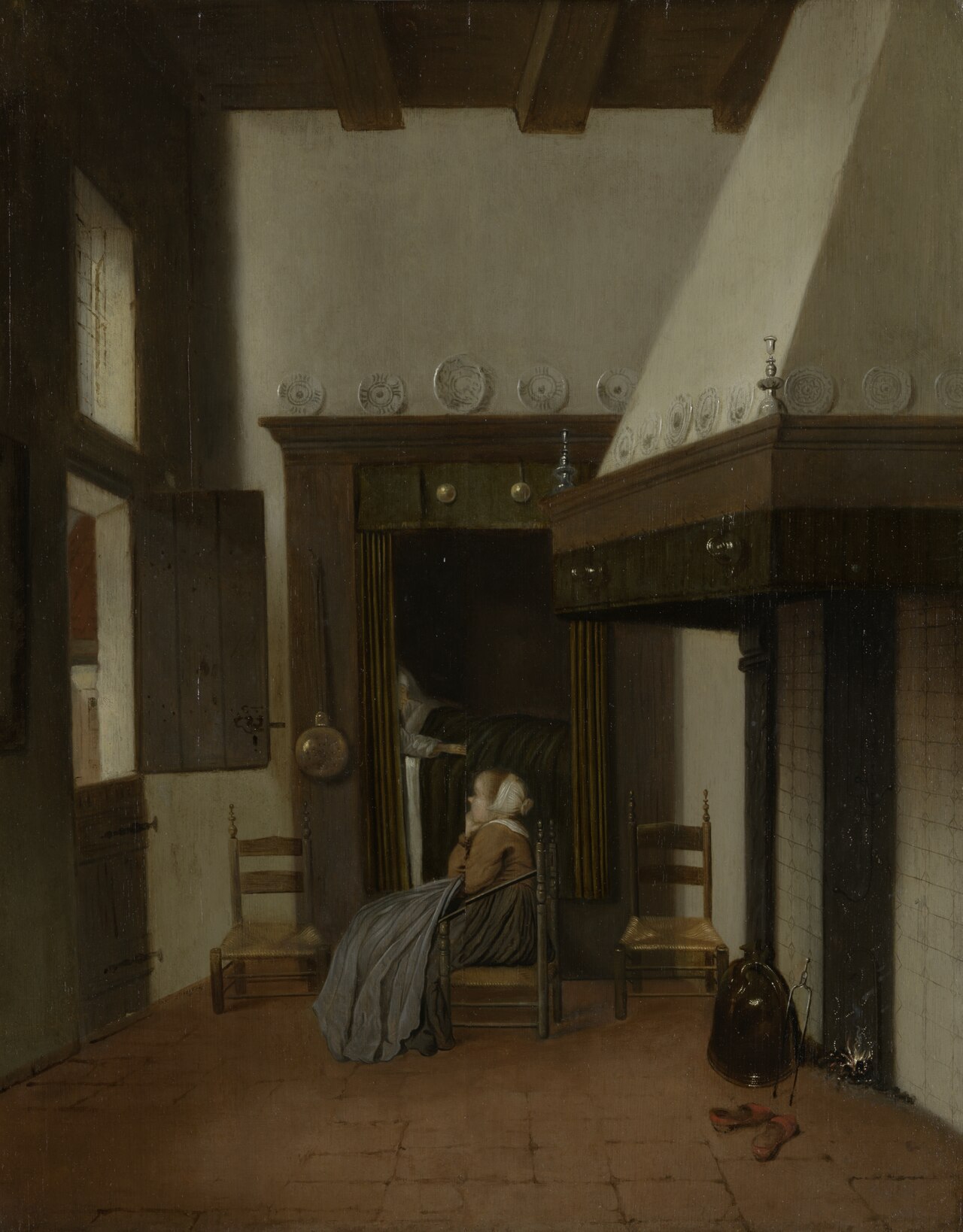
Vrel’s paintings are characterised by a restrained palette of warm earth tones, muted blues and ochres, which lend his interiors a sense of calm and realism. The figures he depicts are often engaged in modest, everyday activities – a woman tending a hearth, a child at play, a nurse caring for an infant – and they are rendered with a gentle naturalism that avoids overt dramatisation. In his street scenes, Vrel focuses on the built environment rather than bustling crowds, emphasising architecture, light, and the geometry of the streetscape.
Signature techniques Vrel’s technical hallmarks include:
1. Linear perspective – he employs a precise, almost mathematical use of vanishing points to create depth, especially in interior spaces where floor boards, doorways and windows recede convincingly. 2. Light modulation – natural daylight entering from windows is rendered with subtle gradations, allowing shadows to define form without harsh contrast. This creates a quiet, contemplative atmosphere. 3. Detail rendering – objects such as copper pots, wooden chairs, and textiles are painted with careful attention to texture, giving the viewer a tactile sense of the environment. 4. Limited colour harmonies – Vrel favours a limited range of pigments, often relying on lead white, vermilion, ochre, and earth greens, which helps unify the composition. 5. Sparse narrative – rather than telling a moral story, his works present a snapshot of daily life, inviting viewers to infer the routine behind the scene.
Major works - **View of a Town (1658)** – This oil painting depicts a compact Dutch town viewed from an elevated position, with a network of canals and tightly packed houses. The composition is anchored by a central canal that draws the eye inward, while the sky is rendered in a soft, overcast tone. - **Woman at the Hearth (1658)** – A domestic interior where a woman is shown tending a fire. The warm glow from the hearth contrasts with cooler light from a window, highlighting Vrel’s skill in balancing multiple light sources. - **Young Woman in an Interior (1660)** – The subject, a young woman, is seated near a window, engaged in a quiet activity such as reading or mending. Vrel’s use of perspective allows the viewer to feel present in the room, with the floorboards and wall panels receding into the background. - **Street Scene (1658)** – This work captures a quiet street lined with timber‑framed houses. The composition is notable for its precise rendering of brickwork and the subtle suggestion of movement through the placement of a few passing figures. - **The Little Nurse (1650)** – Though dated slightly earlier than his main period of activity, this painting shows a nurse caring for a child. The tender interaction, combined with a softly lit interior, exemplifies Vrel’s ability to convey intimacy without sentimentality.
Each of these works demonstrates Vrel’s consistent approach to composition, light, and subject matter, reinforcing his reputation as a meticulous observer of everyday Dutch life.
Influence and legacy Jacob Vrel remains a relatively obscure figure compared with more celebrated Dutch masters, largely because few signed works survive and his name appears sporadically in contemporary inventories. Nonetheless, his paintings contribute valuable insight into mid‑17th‑century Dutch interior and urban genre painting. Art historians regard his precise perspective and subdued narrative as a bridge between the domestic intimacy of de Hooch and the more architectural focus of van der Heyden.
In recent decades, Vrel’s work has attracted interest from collectors and museums seeking to fill gaps in the understanding of Dutch genre painting. Several of his paintings have entered public collections, and scholarly articles have begun to reassess his place within the broader context of the Dutch Golden Age. While his influence on subsequent artists is difficult to trace directly, the qualities he exemplified – balanced composition, careful light handling and a quiet observation of daily life – continue to inform contemporary interpretations of the period.
Overall, Jacob Vrel offers a modest yet distinct voice within the rich tapestry of 17th‑century Dutch art, and his surviving works remain a testament to the nuanced realism that characterised the era.
Frequently asked questions
Who was Jacob Vrel?
Jacob Vrel (c.1630–?) was a Dutch Golden Age painter from Friesland who worked mainly in Amsterdam, known for interior domestic scenes and quiet urban street views.
What style or movement is Jacob Vrel associated with?
He is linked to the Dutch Golden Age genre tradition, combining elements of interior‑scene painting with precise city‑scape perspectives, though no specific movement is recorded for him.
What are Jacob Vrel’s most famous works?
His best‑known paintings include View of a Town (1658), Woman at the Hearth (1658), Young Woman in an Interior (1660), Street Scene (1658) and The Little Nurse (1650).
Why does Jacob Vrel matter in art history?
Vrel provides a clear example of mid‑17th‑century Dutch realism, illustrating everyday life with meticulous perspective and light, thereby enriching our understanding of genre painting in the Golden Age.
How can I recognise a Jacob Vrel painting?
Look for calm domestic interiors or modest street scenes rendered with precise linear perspective, a restrained colour palette, subtle light from windows, and an emphasis on quiet, everyday activities.