Hyacinthe Collin de Vermont
1693 – 1761
In short
Hyacinthe Collin de Vermont (1693–1761) was a French painter born in Versailles and active in Paris. He produced works such as Moses and Aaron at the Ark (1738), Anointing of a bishop (1743) and the allegorical piece Autumn, reflecting the academic style of his era.
Notable works


Early life Hyacinthe Collin de Vermont was born in 1693 in the royal town of Versailles, a centre of courtly culture and artistic patronage. Details of his family background are scarce, but his upbringing in a milieu close to the French monarchy provided early exposure to the visual arts. As a young man he moved to Paris, the hub of the French art world, where he would receive formal training in the prevailing academic system. The rigorous curriculum of the Royal Academy of Painting and Sculpture, which dominated artistic education in the capital, shaped his technical foundation and introduced him to the classical ideals that underpinned French art in the early eighteenth century.
Career and style Collin de Vermont began his professional career in the 1720s, a period when the French court continued to commission grand historical and religious canvases. He worked primarily for royal and ecclesiastical patrons, producing altarpieces and mythological scenes that adhered to the academic hierarchy of genres. His style is characterised by a clear compositional logic, balanced figural arrangements and a restrained palette that favours muted earth tones punctuated by brighter accents for emphasis. The influence of the French Classical tradition—particularly the legacy of Poussin and the academic teachings of Charles Le Brun—can be discerned in his careful rendering of narrative drama and his commitment to idealised anatomy. While no single movement claims him as a leading figure, his oeuvre aligns with the broader currents of French Rococo classicism, where decorative elegance coexisted with the gravitas of historical painting.
Signature techniques Collin de Vermont employed several techniques that mark his hand. First, his draftsmanship displays a confident, fluid line that outlines figures with a subtle chiaroscuro, allowing modelling without excessive cross‑hatching. Second, he favoured a layered glazing method, applying thin translucent pigments over a toned ground to achieve depth and luminosity, a practice common among French academicians of his generation. Third, his handling of drapery reveals an attention to the interaction between fabric and light; he rendered folds with soft, graduated shading that suggests the weight of cloth while maintaining the underlying anatomical structure. Finally, his compositional planning often involved a central focal point surrounded by secondary groups, creating a narrative hierarchy that guides the viewer's eye through the scene.
Major works Collin de Vermont’s most documented works illuminate his thematic range and technical skill.
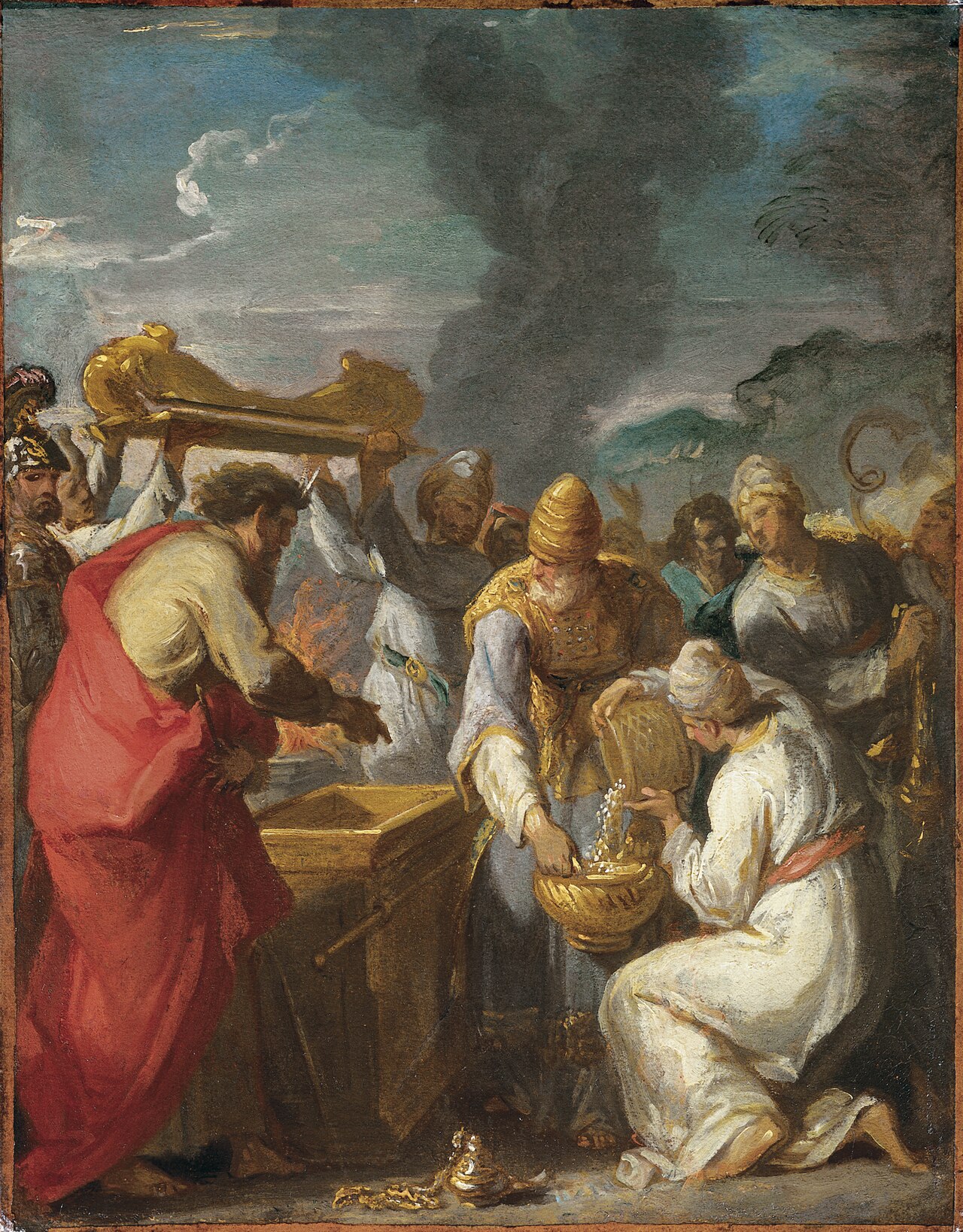
- Moses and Aaron at the Ark (1738) – This canvas depicts the biblical episode in which Moses and Aaron present the Ark of the Covenant before the Israelites. The painting is notable for its solemn atmosphere; the figures are arranged in a semi‑circular grouping that emphasises the sacred object at the centre. Collin de Vermont’s use of muted blues and golds enhances the reverence of the scene, while his careful rendering of the characters’ expressions conveys a sense of awe and devotion.
- Anointing of a bishop (1743) – In this religious commission, the artist captures the ceremonial moment of a bishop’s consecration. The composition centres on the bishop receiving holy oils, surrounded by clergy and onlookers. Here, Collin de Vermont demonstrates his skill in portraying hierarchical relationships: the bishop is illuminated by a soft light that distinguishes him from the surrounding figures, whose garments are rendered in richer, darker tones. The work reflects the liturgical solemnity expected of ecclesiastical art in the period.
- Autumn – An allegorical representation of the season, this piece illustrates the personification of Autumn amid a landscape of harvest. The figure, often depicted as a mature woman holding a sheaf of wheat, is rendered with a gentle warmth that conveys the season’s abundance. The background features a softened horizon, allowing the central figure to dominate the visual field. Although the exact date of this work is not recorded, its style aligns with the decorative tendencies of the Rococo, where allegory and nature were frequently combined.
These three works, together with other lesser‑known canvases, illustrate Collin de Vermont’s ability to navigate both sacred and secular subjects while maintaining a consistent visual language.
Influence and legacy Hyacinthe Collin de Vermont did not found a distinct school, yet his contributions exemplify the steady craftsmanship of French academic painters in the early‑mid eighteenth century. His paintings were part of the visual fabric that reinforced religious and royal narratives, serving both devotional and decorative purposes. By adhering to the rigorous standards of the Academy, he helped perpetuate the classical ideals that would later be challenged by the emerging Neoclassical and Romantic movements.
Although his name is less prominent than that of contemporaries such as François Boucher or Jean‑Antoine Watteau, Collin de Vermont’s works remain valuable for scholars studying the transitional period between the high Baroque grandeur and the lighter Rococo sensibility. Surviving canvases, particularly those housed in French churches and private collections, continue to be referenced in exhibitions that explore the evolution of French religious art. His technique, especially the delicate glazing and disciplined composition, provides a reference point for conservators and art historians seeking to understand the material practices of the era.
In recent decades, art‑historical research has renewed interest in lesser‑known artists like Collin de Vermont, recognising that the broader narrative of French art includes the contributions of many competent painters who fulfilled the demands of patronage without attaining celebrity status. Consequently, his oeuvre is increasingly cited in academic publications that aim to present a more nuanced picture of eighteenth‑century French painting, illustrating how the collective output of artists shaped the visual culture of the time.
Frequently asked questions
Who was Hyacinthe Collin de Vermont?
He was a French painter (1693–1761) born in Versailles who worked mainly in Paris, producing religious and allegorical canvases for royal and ecclesiastical patrons.
Which style or movement is he associated with?
His work aligns with the French academic tradition of the early eighteenth century, combining Classical composition with the decorative elegance of Rococo classicism.
What are his most famous works?
The best‑known pieces are *Moses and Aaron at the Ark* (1738), *Anointing of a bishop* (1743) and the allegorical painting *Autumn*.
Why does he matter in art history?
Collin de Vermont exemplifies the skilled, court‑appointed painters who sustained the academic standards of French art before the rise of Neoclassicism, offering insight into the period’s religious and decorative visual culture.
How can I recognise a Collin de Vermont painting?
Look for balanced, narrative compositions, a restrained colour palette with subtle glazing, precise draughtsmanship, and a focus on dignified figures illuminated by soft, directional light.