Henri Zuber
1844 – 1909
In short
Henri Zuber (1844–1909) was a French landscape painter from Alsace who served in the French navy before establishing a career depicting natural scenes across Europe. He is best known for works such as Sunset at the Banks of the Loing (1896) and Entrance to the Port of Genoa (1876).
Notable works


Early life Henri Zuber was born on 30 September 1844 in the small town of Rixheim, situated in the Haut‑Rhin département of the Alsace region. His family were modest artisans, and his early exposure to the rural countryside of eastern France left a lasting impression on his visual sensibility. In 1863, at the age of nineteen, Zuber entered the French Navy, a decision that would broaden his horizons far beyond the Alsatian hills. He served until 1868, taking part in the 1866 French campaign against Korea, an experience that introduced him to diverse maritime environments and the dramatic interplay of light on water.
Career and style After leaving the navy, Zuber returned to civilian life and pursued an artistic path, enrolling in drawing classes in Paris. He gravitated towards landscape painting, a genre that was flourishing in mid‑nineteenth‑century France under the influence of the Barb Barbizon School and the emerging Impressionist movement. Although Zuber never aligned himself formally with a specific artistic group, his work reflects a synthesis of academic training and a personal fascination with atmospheric effects. He painted en plein air whenever possible, seeking to capture the fleeting qualities of weather, season, and time of day.
Zuber’s oeuvre is characterised by a restrained palette, careful compositional balance, and an emphasis on natural light. He often preferred modest, quiet settings—riverbanks, pastoral fields, and coastal harbours—over grand historical subjects. This focus placed him within the broader French tradition of landscape painting that valued the poetic representation of the countryside as a means of expressing national identity and personal reflection.
Signature techniques Zuber employed several techniques that became hallmarks of his style. First, he used a layered approach to oil paint, applying thin glazes to build depth and luminosity, particularly in sky and water surfaces. Second, his brushwork combined delicate, almost invisible strokes for distant foliage with more confident, broader strokes for foreground elements, creating a sense of spatial hierarchy. Third, Zuber paid meticulous attention to atmospheric perspective, subtly altering colour temperature and value to convey distance. Finally, he often incorporated a limited yet harmonious colour scheme, favoring earthy greens, muted ochres, and soft blues, which reinforced the calm mood of his scenes.
Major works Among Zuber’s most celebrated paintings are four works that illustrate the range of his subjects and his evolving technique. **Entrance to the Port of Genoa (1876)** captures the bustling harbour of the Italian city with a balance of industrial structures and natural light. The composition places the harbour’s mouth in the centre, framed by distant hills, while the shimmering water reflects the late‑afternoon sun, demonstrating Zuber’s skill in rendering reflective surfaces.
The herd of Vieux‑Ferrette (1883) returns to his Alsatian roots, depicting a pastoral scene of cattle grazing near the village of Vieux‑Ferrette. The painting’s muted earth tones and soft, diffuse lighting convey a sense of timeless tranquility, and the careful rendering of the herd’s movement showcases Zuber’s observational acuity.
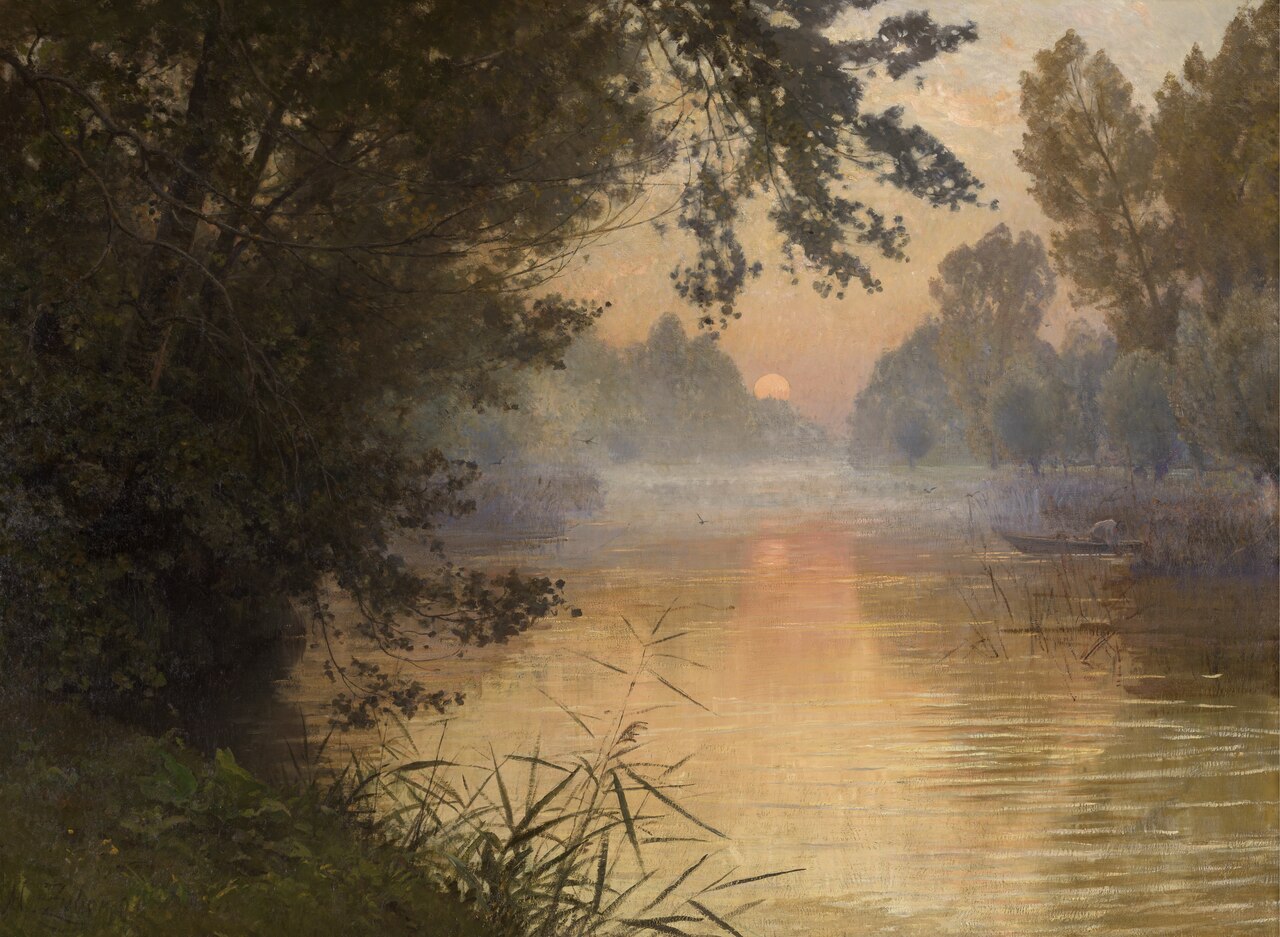
Sunset at the Banks of the Loing (1896) is perhaps Zuber’s most lyrical work. The Loing River, a tributary of the Seine, is shown bathed in the golden glow of sunset, with the water’s surface mirroring the sky’s fiery hues. The composition’s diagonal sweep leads the eye downstream, while the delicate handling of clouds and reflections exemplifies his mature technique.
Le Passé, Versailles (1898) reflects a more contemplative side of Zuber’s practice. Set in the gardens of the Palace of Versailles, the painting juxtaposes the grandeur of the historic site with a quiet, almost nostalgic atmosphere. The muted palette and subtle play of light across the manicured lawns suggest a meditation on history and memory.
These works collectively demonstrate Zuber’s ability to translate diverse locales—Italian ports, French rivers, Alsatian pastures, and royal gardens—into cohesive, atmospheric compositions that prioritize mood over narrative.
Influence and legacy Henri Zuber did not achieve the celebrity of some of his contemporaries, but his paintings contributed to the sustained appreciation of landscape as a legitimate artistic subject in France at the turn of the century. By maintaining a disciplined approach to light and atmosphere, he influenced younger artists who sought a middle ground between academic realism and the more experimental tendencies of Impressionism. His works are held in several regional museums, particularly in Alsace, where he is recognised as a native son who brought the region’s scenery to a broader audience.
Zuber’s legacy endures through the continued exhibition of his paintings and the scholarly attention given to his role in the development of French landscape painting. While not a revolutionary figure, his consistent quality, technical mastery, and dedication to representing the natural world ensure his place in the canon of nineteenth‑century French art.
Frequently asked questions
Who was Henri Zuber?
Henri Zuber (1844–1909) was a French landscape painter from Alsace who served in the French navy before establishing a career depicting natural scenes across Europe.
What artistic style or movement is Henri Zuber associated with?
Zuber worked within the French landscape tradition of the late nineteenth century, blending academic techniques with a personal focus on light and atmosphere rather than aligning with a specific movement.
What are Henri Zuber's most famous works?
His most celebrated paintings include Sunset at the Banks of the Loing (1896), The herd of Vieux‑Ferrette (1883), Entrance to the Port of Genoa (1876) and Le Passé, Versailles (1898).
Why is Henri Zuber important in art history?
Zuber helped sustain the popularity of landscape painting in France at a time when new avant‑garde movements were emerging, and his careful treatment of light influenced later artists seeking a balance between realism and impressionistic effects.
How can I recognise a painting by Henri Zuber?
Look for calm, atmospheric scenes with a restrained palette, subtle atmospheric perspective, and meticulous rendering of water or sky that captures the fleeting quality of light.