Henri Evenepoel
1872 – 1899
In short
Henri Evenepoel (1872–1899) was a Belgian painter born in Nice who became a leading figure of early Fauvism. His brief career, cut short by his early death in Paris, produced vibrant works such as Charles in a Striped Jersey and Orange Market at Blida.
Notable works


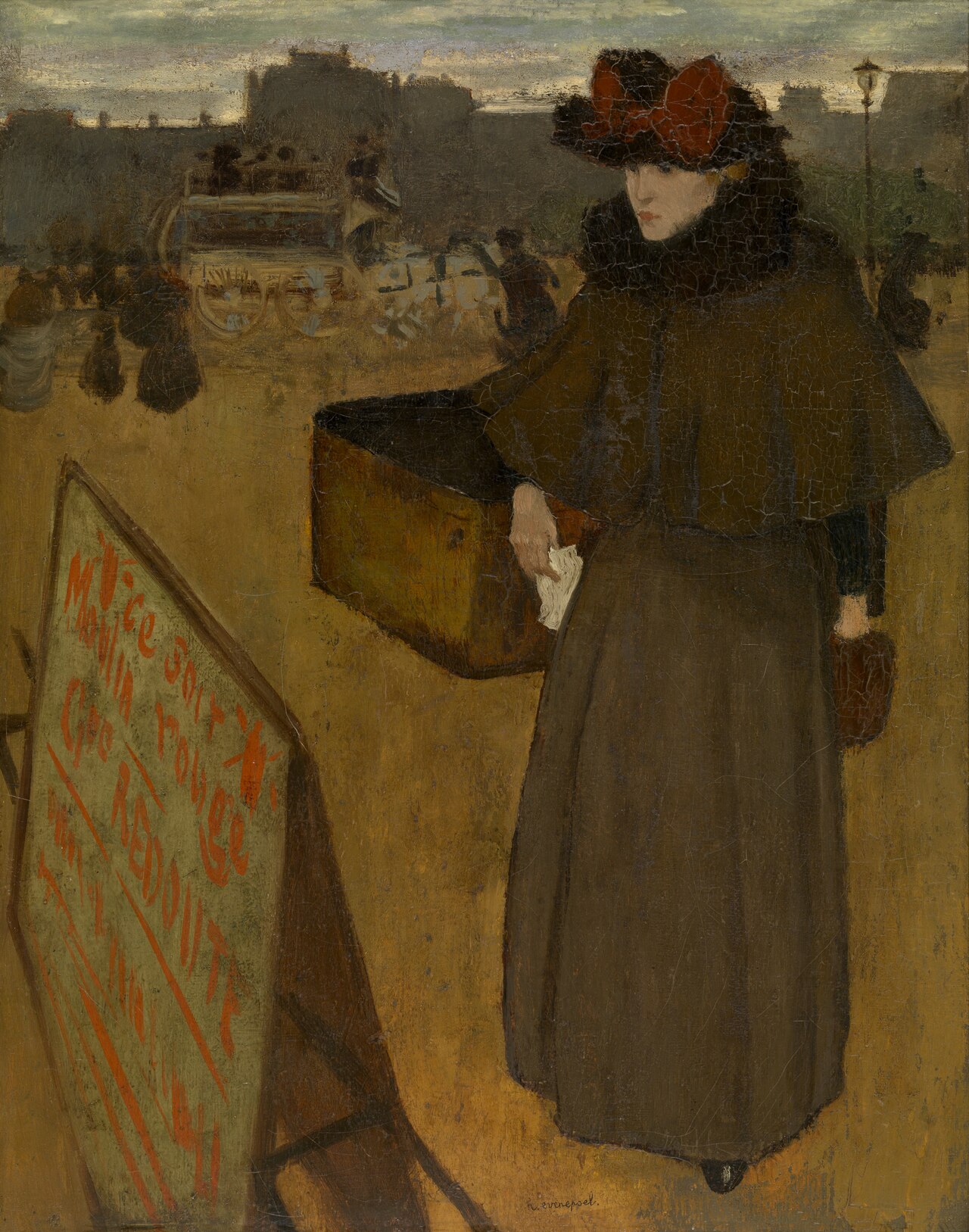


Early life Henri‑Jacques‑Edouard Evenepoel was born on 23 July 1872 in Nice, a coastal city that was then part of the French Riviera. Although his birthplace was French, his family was Belgian, and he spent much of his childhood in Belgium. From an early age he showed a strong attraction to drawing, and his parents encouraged his artistic inclinations by enrolling him in local drawing schools. By his teenage years Evenepoel was already producing sketches of everyday life, a habit that would later inform his interest in colour and spontaneity.
Career and style In the early 1890s Evenepoel moved to Brussels to study at the Académie Royale des Beaux‑Arts, where he received a solid grounding in academic drawing and composition. Seeking a more avant‑garde environment, he relocated to Paris in 1894, joining a circle of young artists who were reacting against the restrained palette of the Salon and the naturalism of Impressionism. It was in Paris that Evenepoel encountered the bold colour experiments of the Pont‑Aven group and the nascent ideas that would crystallise as Fauvism. His style merged the strong line work of his academic training with a liberated use of saturated hues, flat areas of colour, and an expressive brushstroke that foregrounded emotion over strict representation. By the late 1890s he was exhibiting alongside the first Fauves, and his works were recognised for their daring chromatic contrasts and psychological intensity.
Signature techniques Evenepoel’s paintings are characterised by three technical hallmarks: 1. **Intense, non‑naturalistic colour** – He often abandoned local colour in favour of vivid reds, oranges, and blues to convey mood rather than literal appearance. 2. **Simplified forms** – Figures and objects are rendered with a reduced, almost sculptural outline, allowing colour to become the primary visual element. 3. **Dynamic brushwork** – Quick, confident strokes create a sense of movement, especially in scenes depicting children or bustling markets. These techniques align him with the Fauvist manifesto of colour as an autonomous expressive force, while his disciplined drawing roots keep his compositions balanced.
Major works Evenepoel’s most celebrated pieces illustrate his rapid evolution toward Fauvism. **Charles in a Striped Jersey (1898)** portrays a young boy in a vivid striped shirt, his figure flattened against a bold, contrasting background, highlighting the painter’s fascination with pattern and colour harmony. **The Spaniard in Paris (1899)** captures a foreign visitor seated in a Parisian café, rendered with warm ochres and deep blues that suggest both cultural displacement and urban vibrancy. **The Running Girl (1895)** is an early example of his kinetic energy, where the subject’s swift motion is emphasized through slashing brushstrokes and a limited palette that conveys speed rather than detail. **Henriette with Large Hat (1899)** demonstrates his skill in portraiture; the oversized hat becomes a compositional anchor, while the surrounding space is reduced to blocks of colour, letting the sitter’s expression dominate. Finally, **Orange Market at Blida (1898)** reflects his brief but impactful travel to North Africa; the canvas bursts with sun‑lit oranges and turquoise shadows, turning a mundane market scene into a celebration of light and colour. Together these works mark Evenepoel as a pivotal link between late‑19th‑century realism and the explosive palette of early 20th‑century modernism.
Influence and legacy Although Evenepoel died at the age of 27 from a sudden illness in Paris, his contribution to the development of Fauvism was substantial. His daring colour experiments pre‑dated the 1905 Salon d’Automne exhibition that formally introduced Fauvism to the public, and his peers noted his willingness to push chromatic boundaries. After his death, his paintings were exhibited posthumously in Brussels and Paris, where they inspired younger artists such as André Derain and Maurice de Vlaminck, who would later be celebrated as the movement’s core figures. Today, Evenepoel is recognised as a bridge between the academic tradition of the 19th century and the avant‑garde impulses that reshaped modern art. His works are held in major European collections, and scholars cite his concise yet powerful visual language as a key reference when tracing the origins of Fauvist colour theory. The brevity of his career adds a poignant note to his legacy, underscoring how a brief burst of creative energy can leave an enduring imprint on art history.
Frequently asked questions
Who was Henri Evenepoel?
Henri Evenepoel was a Belgian painter (1872–1899) born in Nice who became an early exponent of Fauvism before his untimely death in Paris.
What artistic movement is he associated with?
He is linked to Fauvism, a short‑lived movement known for bold, non‑naturalistic colour and expressive brushwork.
What are his most famous works?
Key paintings include Charles in a Striped Jersey (1898), The Spaniard in Paris (1899), The Running Girl (1895), Henriette with Large Hat (1899) and Orange Market at Blida (1898).
Why does Henri Evenepoel matter in art history?
Evenepoel’s vivid colour experiments anticipated the Fauvist breakthrough of 1905, influencing later Fauves and helping to shift modern art toward expressive colour over realistic representation.
How can I recognise an Evenepoel painting?
Look for flat, simplified forms, striking, saturated colour palettes and energetic brushstrokes that convey mood rather than precise detail.