Henri Decaisne
1799 – 1852
In short
Henri Decaisne (1799–1852) was a Belgian painter known for his historical scenes and portraits. Based in Paris for much of his career, he produced works such as Maria Malibran as Desdemona (1830) and Guardian Angel (1836).
Notable works

_-_Portrait_of_a_Lady_in_Renaissance_Costume_-_RCIN_403684_-_Royal_Collection.jpg)

Early life Henri Decaisne was born in Brussels in 1799, at a time when the city was part of the United Kingdom of the Netherlands. Little is recorded about his family background, but contemporary accounts suggest that he displayed an aptitude for drawing from an early age. He received his first formal instruction in the ateliers of local artists, where the prevailing curriculum emphasized rigorous drawing from life and classical sculpture. By his late teens, Decaisne had moved to Paris, the centre of European artistic training, to continue his studies under the guidance of established French masters. This relocation placed him at the heart of the French Academy, exposing him to the dominant academic traditions that would shape his later output.
Career and style Decaisne established himself in Paris as a painter of both historical subjects and portraiture, a dual focus that was typical of many academic artists of the early‑to‑mid‑19th century. His work reflects the polished finish and clear narrative focus associated with the French Academy, while also revealing a sensitivity to the psychological depth of his sitters. He exhibited regularly at the Paris Salon, the most prestigious venue for contemporary art, and earned commendations for his ability to render fine fabrics, delicate skin tones, and dramatic chiaroscuro. Though he did not affiliate himself with a defined avant‑garde movement, Decaisne’s oeuvre aligns with the broader currents of Romantic historicism and the emerging Realist attention to individual character.
Signature techniques Decaisne’s paintings are distinguished by several recurring technical traits. First, he employed a restrained palette of earth tones, ivory whites, and deep blues, allowing the subjects’ features to emerge with subtle modelling. Second, his handling of light often involved a soft, diffused illumination that highlighted the central figure while gently receding the background—a technique that reinforced the narrative focus of his historical scenes. Third, he demonstrated meticulous brushwork in rendering textiles, particularly lace and brocade, which contributes to the sense of luxury in his portrait commissions. Finally, Decaisne occasionally used a limited compositional device of a single, dramatic gesture—such as a raised hand or an inclined head—to convey emotional tension without overcrowding the canvas.
Major works Among Decaisne’s most celebrated pieces is **Maria Malibran as Desdemona in Rossini’s *Otello*** (1830). This canvas captures the famed opera singer in the tragic role of Desdemona, combining a realistic portrait of Malibran with the dramatic ambience of the stage. The work is notable for its precise rendering of the singer’s expressive face and the sumptuous costume, illustrating Decaisne’s skill at merging portraiture with theatrical narrative.
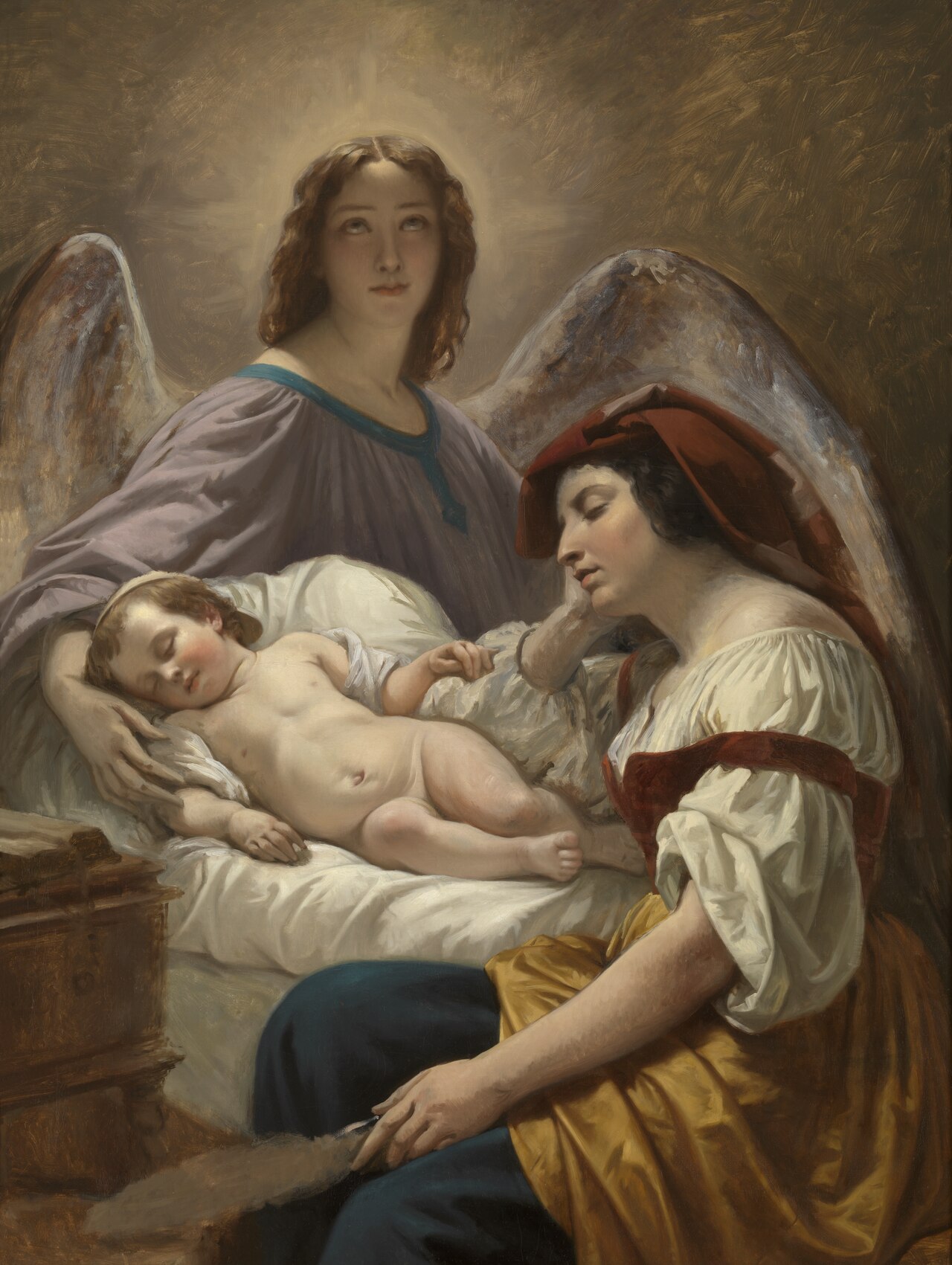
In Guardian Angel (1836), Decaisne turns to a more intimate, devotional subject. The painting depicts a youthful figure receiving protection from an ethereal angel, rendered with a luminous quality that highlights the contrast between the earthly and the celestial. The delicate handling of the angelic wings and the tender interaction between the figures exemplify Decaisne’s capacity for sentimentality within an academic framework.
Another portrait, Countess L.H., demonstrates his aptitude for aristocratic representation. Though the sitter’s full identity remains obscure, the composition emphasizes the countess’s refined attire and poised demeanor, reinforcing the social stature of the subject through careful detail.
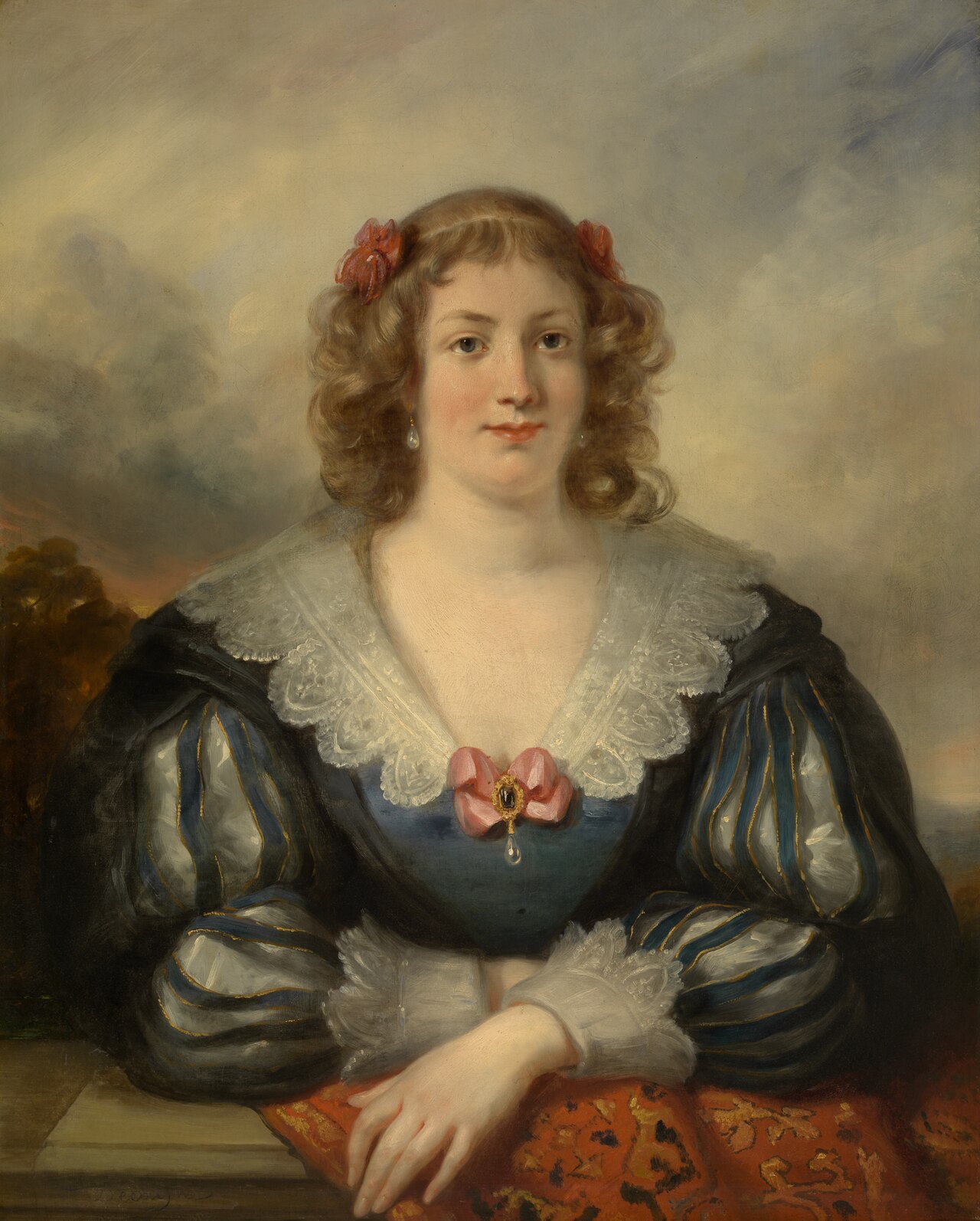
The Portrait of a Lady in Renaissance Costume (1836) showcases Decaisne’s fascination with historic dress. By placing a contemporary sitter in Renaissance garb, he creates a dialogue between past and present, a device frequently employed by academic painters to explore timeless elegance. The painting’s meticulous rendering of silk, velvet, and ornamental jewelry underscores his technical proficiency.
Finally, Decaisne contributed to the Salon of 1850 with *Le Chancelier de L’Hôpital pendant la Saint‑Barthélémy*. This historical tableau depicts Chancellor de L’Hôpital amidst the violent religious conflict of the St. Bartholomew’s Day Massacre. The work is characterised by its dramatic composition, the stark contrast between the chancellor’s calm resolve and the surrounding turmoil, and a palette that heightens the sense of danger. Though the piece was exhibited posthumously, it reflects Decaisne’s continued interest in pivotal historical moments.
Influence and legacy Henri Decaisne’s career coincided with a period of significant transition in French art, as Romanticism gave way to Realism and later to Impressionism. While he never achieved the fame of contemporaries such as Delacroix or Ingres, his paintings were well received by the Salon juries and by patrons seeking refined portraiture. His meticulous technique and ability to convey narrative within a restrained academic idiom influenced a generation of studio painters who continued to work for aristocratic and bourgeois clients throughout the mid‑19th century.
Decaisne’s works are now held in several European collections, where they serve as exemplars of the polished portrait and historical painting that dominated the French Academy’s official exhibitions. Scholars regard his oeuvre as a valuable reference point for understanding how Belgian artists integrated into the Parisian art world and how they negotiated the expectations of academic standards while injecting personal sensitivity into their subjects. Though his name may not appear in mainstream art histories, Decaisne’s paintings remain a testament to the craft of academic painting and continue to be studied for their compositional clarity, technical finesse, and subtle emotional resonance.
Overall, Henri Decaisne stands as a representative figure of the early‑to‑mid‑19th‑century academic tradition, bridging the worlds of historical narrative and intimate portraiture with a consistent dedication to skillful execution and aesthetic elegance.
Frequently asked questions
Who was Henri Decaisne?
Henri Decaisne (1799–1852) was a Belgian painter who specialised in historical scenes and portraiture, working mainly in Paris.
What style or movement is he associated with?
He worked within the French academic tradition, blending Romantic historicism with the precise draftsmanship of academic painting.
What are his most famous works?
His best‑known paintings include *Maria Malibran as Desdemona in Rossini’s Otello* (1830), *Guardian Angel* (1836), the *Portrait of a Lady in Renaissance Costume* (1836), and the historical canvas *Le Chancelier de L’Hôpital pendant la Saint‑Barthélémy* (exhibited in 1850).
Why is Decaisne important in art history?
He exemplifies the high‑level academic portrait and history painting of the early‑19th century, illustrating how Belgian artists integrated into Paris’s dominant art institutions.
How can I recognise a Decaisne painting?
Look for a polished finish, careful rendering of fabrics, a soft yet dramatic lighting scheme, and a compositional focus on a single, emotionally charged figure or gesture.