Hendrick van Balen the Elder
1570 – 1632
In short
Hendrick van Balen the Elder (1570–1632) was a Flemish Baroque painter and stained‑glass designer from Antwerp, known for small cabinet paintings on copper that often depicted mythological and allegorical subjects. He taught several prominent artists, most famously Anthony van Dyck, and played a key role in the early‑17th‑century renewal of Flemish painting.
Notable works

_-_Bacchus_and_Diana.jpg)
,_Hendrick_van_Balen_(I)_and_Gerard_Seghers_-_Allegory_of_Sight_and_Smell.jpg)
.jpg)
Early life Hendrick van Balen the Elder was born in 1570 in Antwerp, a thriving commercial centre of the Habsburg Netherlands. Little is recorded about his family background, but the city’s vibrant artistic environment provided ample opportunity for a budding painter. Antwerp’s guild system, particularly the Guild of Saint Luke, regulated artistic training, and van Balen would have entered an apprenticeship in his teens, learning the fundamentals of drawing, oil painting and, later, the specialised craft of stained‑glass design.
Career and style By the early 1590s van Balen had established himself as a competent painter, gaining admission to the Guild of Saint Luke. He worked primarily for the domestic market, producing small‑scale cabinet pictures that appealed to wealthy collectors who favoured intimate, finely detailed works. His style reflects the transition from late Mannerism to the emerging Baroque aesthetic in the Low Countries. While retaining the elegant elongation of Mannerist figures, van Balen introduced a greater sense of movement, dramatic lighting and emotional expressiveness that anticipated the high Baroque of Rubens and van Dyck.
Thematically, van Balen favoured mythological and allegorical subjects, drawing on classical literature and contemporary emblematic traditions. Religious commissions were rarer, but he did produce a few devotional images, often integrating his characteristic compositional balance and subtle colour harmonies. His work was also distinguished by a refined handling of texture, especially in the depiction of fabrics, foliage and metal objects.
Signature techniques Van Balen’s most distinctive technical hallmark was his frequent use of copper as a painting support. The smooth, non‑porous surface of copper allowed him to render exceptionally fine details and luminous colour transitions, qualities prized in cabinet pictures. He employed a layered glazing technique, building up thin translucent layers of oil paint to achieve depth and a near‑metallic sheen. This method also facilitated the delicate modelling of flesh tones and the subtle gradations of atmospheric perspective.
In addition to painting, van Balen was an accomplished stained‑glass designer. The precision required for glass work reinforced his meticulous approach to line and composition. His designs often featured intricate figural groupings and balanced diagonal arrangements, echoing the compositional logic seen in his panel paintings.
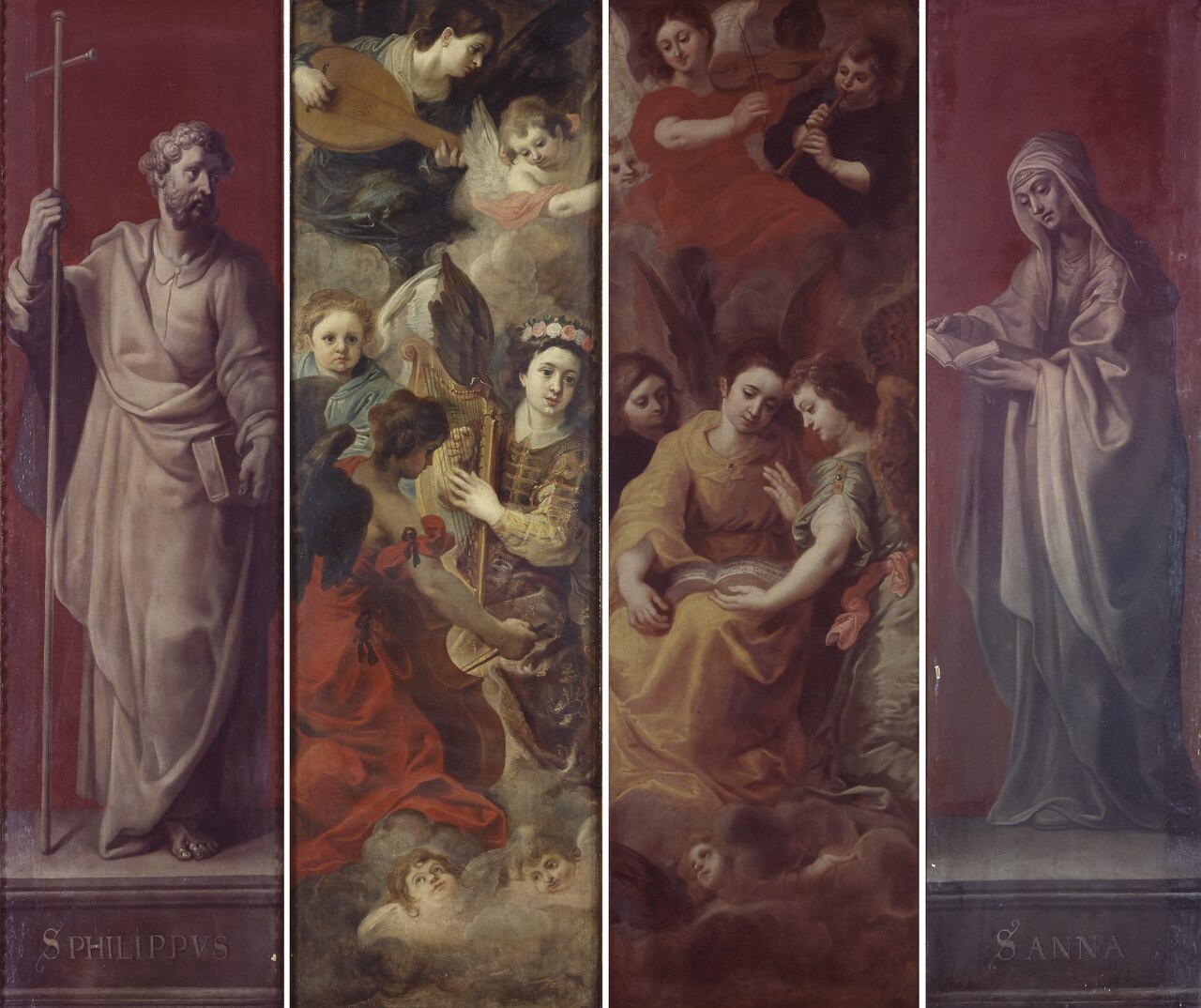
Major works - **Minerva Visits the Muses (1617)** – Executed on copper, this work exemplifies van Balen’s skill in rendering a learned, serene atmosphere. The goddess Minerva is portrayed entering a vaulted hall where the Muses are engaged in artistic pursuits, each figure rendered with careful attention to drapery and expressive gestures. - **Pan Pursuing Syrinx (1615)** – Another copper piece, this mythological scene captures the dynamic chase of the nymph Syrinx by the satyr Pan. Van Balen uses vigorous diagonal lines and a muted palette to convey motion while maintaining the compositional clarity typical of his cabinet works. - **Allegory of Sight and Smell (1620)** – Part of a series of sensory allegories, this painting juxtaposes symbols of visual perception—such as a mirror and a painted eye—with fragrant elements like blossoms and a perfumed vase. The work demonstrates van Balen’s capacity to encode complex iconography within a compact format. - **Diana Offered Wine and Fruit by the Young Bacchus and his Retinue (1632)** – Completed the year of his death, this canvas (or possibly copper) shows the huntress Diana receiving a celebratory offering from Bacchus’s entourage. The piece combines a graceful composition with subtle chiaroscuro, highlighting van Balen’s mature Baroque sensibility. - **Concert of Angels** – Though less precisely dated, this devotional image portrays a celestial choir of angels playing instruments. The work reflects van Balen’s occasional forays into religious subject matter, rendered with the same delicate modelling and luminous glazing as his mythological pieces.
Influence and legacy Hendrick van Balen the Elder occupied a pivotal position in the artistic network of early‑17th‑century Antwerp. His workshop trained several artists who would become leading figures of the Flemish Baroque, most notably Anthony van Dyck, who apprenticed with van Balen before moving to Rubens’s studio. Van Balen’s emphasis on refined cabinet pictures contributed to a market niche that encouraged collectors to value technical virtuosity on a small scale.
Through his teaching and collaborative projects, van Balen helped disseminate a hybrid style that merged Mannerist elegance with emerging Baroque dynamism. His stained‑glass designs also influenced ecclesiastical decoration in the region, marrying pictorial narrative with architectural light.
Although later art histories have tended to focus on Rubens and van Dyck, recent scholarship has reassessed van Balen’s role as a catalyst in the transition to the high Baroque. His surviving works, many preserved in European museum collections, continue to be studied for their compositional precision, refined glazing, and the way they encapsulate the intellectual and aesthetic currents of early modern Antwerp.
Today, van Balen is recognised as a consummate draftsman whose modestly scaled oeuvre offers insight into the tastes of Antwerp’s elite patrons and the evolving visual language that defined the Baroque period in the Low Countries.
Frequently asked questions
Who was Hendrick van Balen the Elder?
He was a Flemish Baroque painter and stained‑glass designer (1570–1632) from Antwerp, known for small cabinet pictures on copper that often depicted mythological and allegorical subjects.
What style or movement is he associated with?
Van Balen worked within the Baroque movement, bridging late Mannerist elegance with the emerging dramatic lighting and movement characteristic of early 17th‑century Flemish Baroque.
What are his most famous works?
Key works include *Minerva Visits the Muses* (1617), *Pan Pursuing Syrinx* (1615), *Allegory of Sight and Smell* (1620), *Diana Offered Wine and Fruit by the Young Bacchus and his Retinue* (1632), and the *Concert of Angels*.
Why does he matter in art history?
He played a crucial role in the renewal of Flemish painting, taught important artists such as Anthony van Dyck, and helped establish the refined cabinet picture as a valued genre in the early Baroque market.
How can I recognise a Hendrick van Balen painting?
Look for small‑scale works on copper with meticulous detail, smooth glazing, balanced compositions of mythological or allegorical scenes, and a delicate handling of fabrics and textures.