Hendrick Cornelisz. van Vliet
1611 – 1675
In short
Hendrick Cornelisz. van Vliet (1611–1675) was a Dutch Golden‑Age painter from Delft, best known for his precise, atmospheric interiors of churches. His work combines meticulous perspective with subtle lighting, making him a key figure in the tradition of Dutch architectural painting.
Notable works


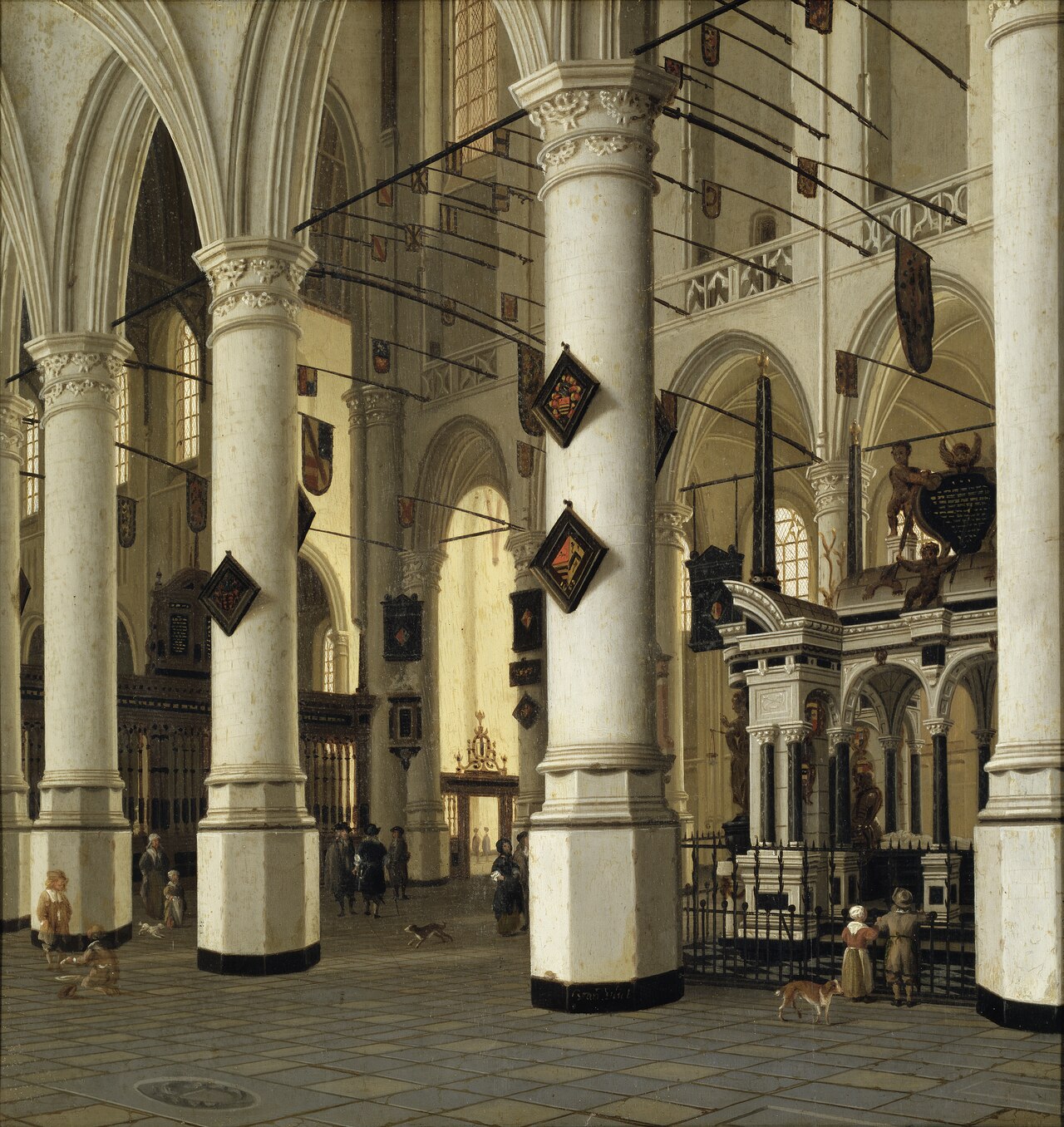
Early life Hendrick Cornelisz. van Vliet was born in Delft in 1611, a city that would remain his lifelong home and artistic centre. Little is recorded about his family background or formal apprenticeship, but his formative years coincided with the flourishing of the Dutch Golden Age, when Delft produced a remarkable concentration of painters, architects and craftsmen. The city’s thriving guild system and its close ties to the Delft Guild of Saint Luke would have provided the young van Vliet with exposure to the techniques of both genre and architectural painting. By the 1630s he was already working as a professional artist, developing a reputation for handling light and space with a calm, measured hand.
Career and style Van Vliet’s career is inseparable from the religious architecture of his native city. While many Dutch painters of his generation turned to portraiture, landscapes or still lifes, van Vliet specialised in the interior of churches, a niche that allowed him to explore the interplay of natural light, perspective and decorative detail. His style shows a clear affinity with the Flemish tradition of architectural painting, yet he adapts it to a distinctly Dutch sensibility—quiet, restrained, and attentive to the everyday function of sacred spaces. The compositions are often anchored by a single point of view, usually a centrally placed doorway or a vaulted aisle, guiding the viewer’s eye deep into the scene. Light enters through high windows or open doors, creating a gentle chiaroscuro that accentuates the stonework, stained glass, and occasional figures. The overall effect is both documentary and poetic, capturing the physicality of the interiors while hinting at their spiritual resonance.
Signature techniques Van Vliet’s technical approach rests on three pillars: linear perspective, colour modulation, and the nuanced rendering of light. He employed a strict orthogonal grid, often derived from the classical rules of Alberti, to achieve accurate spatial depth. This mathematical precision is balanced by a subtle colour palette—muted ochres, warm browns and cool blues—allowing the architecture to appear solid yet luminous. In his later works, van Vliet experimented with a softer, almost atmospheric wash, using thin glazes to suggest the diffusion of daylight through stained glass. His brushwork is typically fine and controlled; the texture of stone, wood and pews is suggested rather than over‑defined, giving his interiors a sense of immediacy. Occasionally, he includes small figures—clergy, congregants or musicians—rendered with a modest realism that provides scale without detracting from the architectural focus.
Major works - **Portrait of a Woman (1641)** – Although van Vliet is chiefly associated with church interiors, this early portrait demonstrates his competence in genre painting. The sitter is rendered with a restrained elegance, her attire reflecting contemporary Dutch fashion. The work is notable for its delicate handling of fabric and the subtle modelling of the face, hinting at van Vliet’s broader skill set. - **Girl Holding a Fan (1645)** – This small canvas offers a glimpse of van Vliet’s interest in everyday subjects. The girl’s pose is informal, and the fan serves as a compositional device that draws attention to the hand and the subtle play of light on skin. The painting’s calm atmosphere aligns with the artist’s later interior scenes. - **Interior of Nieuwe Kerk, Delft (1650)** – One of his most celebrated architectural works, this painting captures the soaring nave of the Nieuwe Kerk with an exacting perspective. Van Vliet places the viewer at the centre of the aisle, allowing the vaulted ceiling and the intricate tombs to dominate the composition. The subtle illumination from the high windows creates a warm glow that highlights the marble and gilded details. - **Interior of the Oude Kerk, Delft, with the tomb of Pieter Pietersz Heijn (1588‑1629), vice admiral of Holland (1650)** – In this interior, van Vliet juxtaposes the solemnity of the church space with the elaborate tomb of a notable civic figure. The tomb’s sculptural elements are rendered with meticulous detail, while the surrounding architecture is bathed in a diffused light that emphasizes the solemnity of the setting. - **View in the Oude Kerk, Delft (1654)** – This later work expands upon the earlier interior studies, presenting a wider view that includes the church’s nave and a glimpse of the surrounding cityscape through the windows. Van Vliet’s handling of perspective is particularly sophisticated, with converging lines that draw the eye toward a distant altar. - **Girl Holding a Fan (1645)** – Though listed among his genre pieces, this work demonstrates van Vliet’s ability to capture a moment of quiet introspection, a quality that also permeates his architectural paintings.
These works collectively illustrate van Vliet’s transition from portraiture to a concentrated focus on ecclesiastical interiors, reflecting both personal artistic development and the broader Dutch fascination with the built environment.
Influence and legacy Van Vliet’s paintings contributed to the Dutch tradition of architectural genre, influencing later artists such as Pieter Saenredam and Gerard Houckgeest, who also documented church interiors with an emphasis on spatial clarity. While his name is less prominent in popular art histories than that of his contemporaries, scholars recognise his meticulous perspective and his ability to convey a serene, almost meditative atmosphere within sacred spaces. His works serve as valuable historical records of Delft’s churches before later renovations, providing insight into the original appearance of the Oude and Nieuwe Kerk. In contemporary museum collections, van Vliet’s interiors are often displayed alongside those of Saenredam, illustrating the evolution of Dutch architectural painting from the early to the late seventeenth century. Today, his paintings continue to attract interest from both art historians and enthusiasts of architectural photography, confirming his lasting relevance in the study of Dutch visual culture.
Frequently asked questions
Who was Hendrick Cornelisz. van Vliet?
He was a Dutch Golden‑Age painter (1611–1675) from Delft, renowned for his precise interior views of churches.
What artistic style or movement is he associated with?
Van Vliet worked within the Dutch Golden Age, focusing on architectural painting that combines strict perspective with subtle lighting.
What are his most famous works?
Key works include Interior of Nieuwe Kerk, Delft (1650), Interior of the Oude Kerk, Delft with the tomb of Pieter Pietersz Heijn (1650), View in the Oude Kerk, Delft (1654), and portrait pieces such as Portrait of a Woman (1641).
Why does he matter in art history?
He documented the interior architecture of Delft’s churches with extraordinary accuracy, influencing later Dutch painters and providing valuable visual records of 17th‑century ecclesiastical spaces.
How can I recognise a van Vliet painting?
Look for a calm, central perspective of a church interior, precise linear perspective, muted colour tones, and a soft, diffused light that highlights stone and glass without dramatic contrast.