Hendrick Bloemaert
1601 – 1672
In short
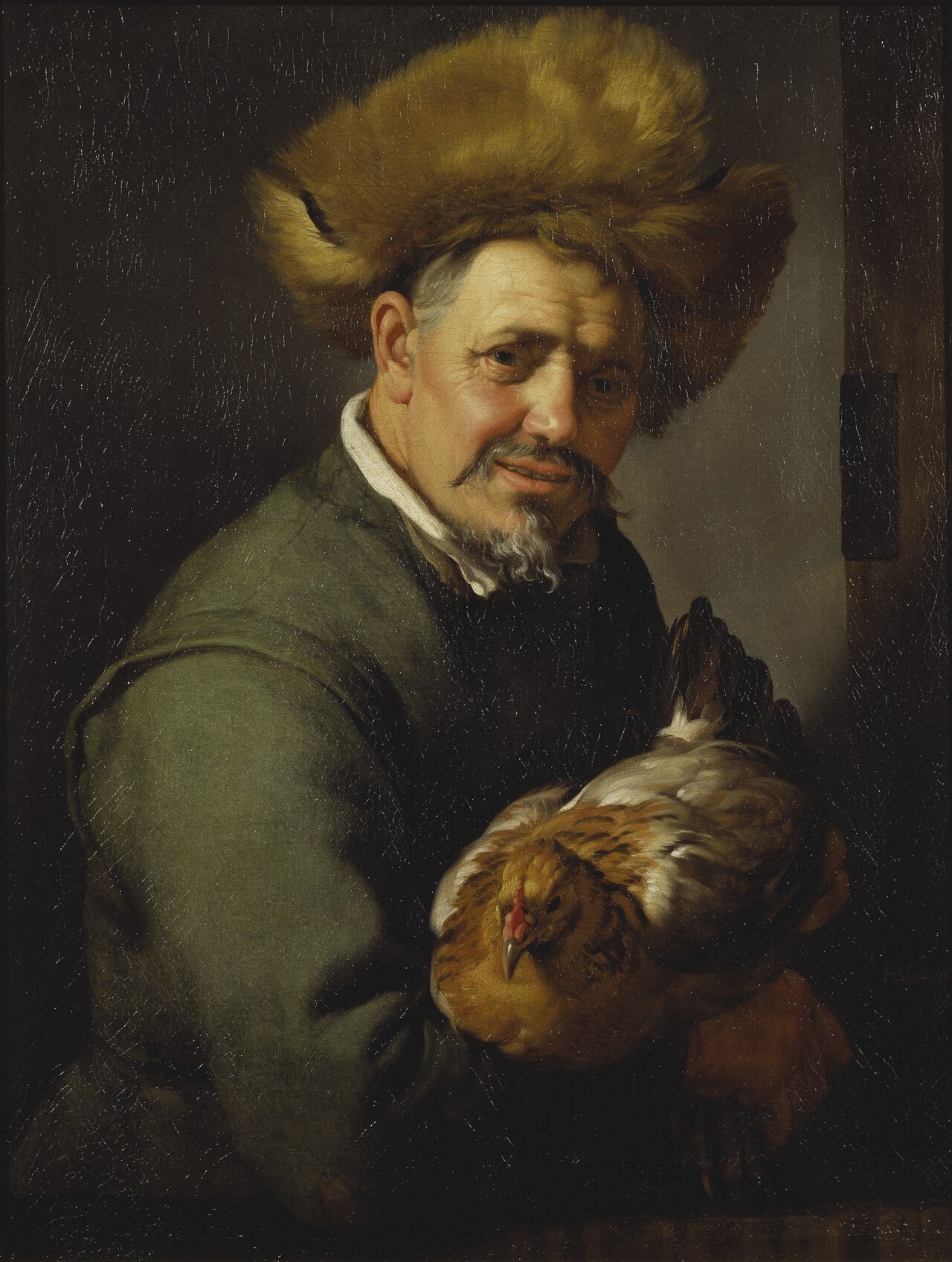
Hendrick Bloemaert (1601–1672) was a Dutch Baroque painter from Utrecht, active during the Dutch Golden Age. He is best known for his genre scenes and portraiture, including works such as Old Woman Selling Eggs (1632) and Old Man with a Hen (1630).
Notable works




Early life Hendrick Bloemaert was born in 1601 in Utrecht, a city that was a thriving artistic centre in the Dutch Republic. He grew up in a family deeply embedded in the visual arts; his father, Abraham Bloemaert, was a prominent painter and teacher who helped shape the early development of the Utrecht school. Hendrick received his first training in his father's workshop, where he learned the fundamentals of drawing, composition, and the use of chiaroscuro that would later become hallmarks of his own work. The Bloemaert household was also a cultural hub, exposing young Hendrick to the ideas of humanist scholars and the burgeoning market for portraiture and genre paintings.
Career and style By the 1620s Hendrick had established himself as an independent artist in Utrecht. He specialised in both portraiture and genre scenes, a dual focus that reflected the tastes of a prosperous mercantile class eager to commission personal likenesses as well as domestic narratives. Bloemaert’s style is firmly rooted in the Dutch Baroque tradition, characterised by a restrained colour palette, careful modelling of light, and a keen observation of everyday life. While his father’s influence is evident in the fluidity of line and the graceful handling of figures, Hendrick developed a more sober, realistic approach that aligned with the tastes of the mid‑17th‑century market. His works often feature a calm, almost intimate atmosphere, achieved through subtle lighting and a focus on the psychological presence of the sitter rather than overt drama.
Signature techniques Bloemaert’s paintings display a consistent technical repertoire. He employed a layered underpainting, typically in a warm earth tone, before building up flesh tones and textiles with thin glazes. This method allowed him to achieve depth and a luminous quality in skin and fabric. In genre scenes, he favoured a limited but carefully chosen colour scheme—deep browns, muted reds, and occasional touches of ochre—that heightened the sense of realism. His brushwork is generally smooth, with fine detailing in the rendering of objects such as eggs, poultry, and clothing accessories. Light is often directed from a single source, creating soft shadows that model the figures and give a three‑dimensional presence to the space.
Major works Among Bloemaert’s most recognised paintings is **Old Woman Selling Eggs (1632)**. This work depicts a mature woman seated at a simple wooden table, arranging a basket of eggs for sale. The composition balances the figure’s contemplative expression with the tactile quality of the eggs, rendered with delicate highlights that suggest a fresh, fragile surface. The painting exemplifies Bloemaert’s talent for capturing everyday commerce with dignity and quiet dignity.
Another notable piece is Old Man with a Hen (1630). Here an elderly gentleman is shown holding a small hen, the bird perched calmly on his hand. The portrait combines a study of age‑related features—wrinkled skin, weathered hands—with an unexpected moment of tenderness toward the animal. The lighting falls gently across the man’s face, illuminating his eyes and emphasizing the narrative of a life lived in close contact with the domestic world.
In 1647 Bloemaert produced a pair of companion portraits: Portrait of a Husband and Portrait of a Wife. The two works were likely commissioned as a marital set, reflecting the growing middle‑class desire to commemorate familial bonds. Both sitters are rendered with a restrained elegance; the husband is presented in sober dark attire, while the wife wears a modest yet finely detailed dress. The background in each painting is a muted, neutral space that directs focus toward the subjects’ faces and hands, underscoring their personal identity.
A further significant work is the portrait of Johannes Puttkammer (1600‑71). Puttkammer, a licentiate in theology at the University of Utrecht, is depicted on his deathbed in 1671. The painting conveys a solemn atmosphere, with the figure’s frail form illuminated against a dark interior. Bloemaert’s handling of the subject’s pallor and the subtle interplay of light and shadow creates a moving meditation on mortality, while still preserving the dignity of the scholar.
These works collectively illustrate Bloemaert’s ability to navigate both the intimate genre scene and the formal portrait, each executed with a consistent visual language that ties his oeuvre together.
Influence and legacy Hendrick Bloemaert’s career unfolded during the height of the Dutch Golden Age, a period when the market for paintings expanded dramatically. Though not as widely known today as some of his contemporaries, his contributions helped sustain the demand for realistic, narrative‑driven art in Utrecht and beyond. His careful observation of everyday life anticipated later developments in Dutch genre painting, influencing younger artists who sought to capture the moral and social dimensions of quotidian scenes.
Bloemaert also played a role in the transmission of his father’s workshop traditions. By maintaining a studio that catered to both portrait and genre commissions, he provided training opportunities for apprentices who would continue the Utrecht school’s stylistic lineage into the later 17th century. Modern scholarship acknowledges his work as a bridge between the more exuberant Caravaggist tendencies of early Utrecht Baroque and the restrained realism that characterised the later Dutch market.
Today, Bloemaert’s paintings are held in several Dutch museum collections, where they are valued for their technical finesse and their insight into 17th‑century domestic life. His ability to render texture, light, and character with subtlety ensures that his work remains a point of reference for scholars studying the evolution of Dutch portraiture and genre painting.
In summary, Hendrick Bloemaert exemplifies the quiet, observational spirit of Dutch Baroque art. His paintings continue to offer a window into the social fabric of his time, preserving both the individuality of his sitters and the broader cultural context in which they lived.
Frequently asked questions
Who was Hendrick Bloemaert?
Hendrick Bloemaert (1601–1672) was a Dutch Baroque painter from Utrecht, active during the Dutch Golden Age, known for genre scenes and portraiture.
What artistic style or movement is he associated with?
He worked within the Dutch Baroque tradition, creating realistic, light‑modulated works that reflect the domestic and moral concerns of the period.
What are his most famous works?
His most recognised paintings include Old Woman Selling Eggs (1632), Old Man with a Hen (1630), the companion Portrait of a Husband and Portrait of a Wife (both 1647), and the portrait of Johannes Puttkammer (1671).
Why does Hendrick Bloemaert matter in art history?
Bloemaert helped sustain the Utrecht school's blend of portrait and genre painting, influencing later Dutch artists and offering valuable insight into 17th‑century everyday life.
How can I recognise a Hendrick Bloemaert painting?
Look for smooth brushwork, a limited colour palette with warm earth tones, subtle chiaroscuro, and a focus on intimate, everyday subjects rendered with careful detail.