Hendrick Aerts
1565 – 1603
In short
Hendrick Aerts (1565–1603) was a Flemish painter and draftsman from the Habsburg Netherlands who specialised in architectural scenes, both real and imagined, often populated with figures. He worked mainly in Gdańsk and Prague, producing a small but distinctive body of work that reflects the late Renaissance interest in perspective and monumental space.
Notable works


_Interior_of_Saint_John_Lateran.png)
Early life Hendrick Aerts was born in 1565 in Mechelen, a city in the southern part of the Habsburg Netherlands that was a vibrant centre for artistic production in the late sixteenth century. Little is recorded about his family background or his initial training, but the artistic environment of Mechelen—home to a number of prominent painters and a strong tradition of guild apprenticeship—suggests that he would have received a conventional workshop education. The city’s proximity to major artistic hubs such as Antwerp and Brussels would have exposed him to the prevailing trends of Northern Mannerism and the early Baroque, as well as to the technical innovations in linear perspective that were being explored by contemporaries.
Career and style Aerts’ professional life is documented primarily through his activity in the Baltic region, particularly in Gdańsk (then Danzig) and Prague. By the late 1590s he had established himself as a specialist in architectural painting, a genre that combined meticulous rendering of built space with narrative or allegorical figures. His works often depict grand interiors—churches, palaces, and imagined civic spaces—characterised by a clear, almost mathematical perspective that creates a sense of depth and order. While the precise artistic movement with which he can be associated remains uncertain, his style reflects the transitional phase between the High Renaissance’s emphasis on harmonious proportion and the emerging Baroque interest in dramatic spatial effects.
Aerts’ paintings are notable for their balance between architectural exactitude and imaginative composition. He sometimes rendered real structures with a degree of idealisation, while other times he invented entire edifices that served as theatrical stages for his figural staffage. This duality places him alongside other Northern European painters of the period who explored the interplay between reality and fantasy in architectural settings, such as Hans Vredeman de Vries and Jan van der Straet (Stradanus).
Signature techniques Aerts employed several technical approaches that distinguish his work:
1. Linear perspective – He used a rigorous system of orthogonal lines and vanishing points to construct convincing interiors. The receding lines often converge toward a single focal point, drawing the viewer’s eye into the depth of the space.
2. Light and shadow – Subtle chiaroscuro effects enhance the three‑dimensionality of the architecture. Light typically enters from a high, unseen source, creating a gentle gradient of illumination across the surfaces.
3. Figural staffage – Human figures are rendered with a modest degree of naturalism, serving primarily to animate the scene and provide narrative context. The figures are usually placed in the foreground or mid‑ground, allowing the architectural framework to dominate the composition.
4. Detailing of ornamentation – Aerts paid close attention to decorative elements such as pilasters, cornices, and Gothic tracery, often highlighting these features with fine brushwork and a slightly cooler palette.
Major works The surviving corpus attributed to Aerts is small, and several titles have been recorded with inconsistent dating. The following works are generally accepted as part of his oeuvre, though scholars note that some attributions remain tentative:
- Phantasy Renaissance palace (1602) – This oil painting depicts an elaborate, imagined palace interior that blends Renaissance architectural motifs with a fanciful, almost theatrical arrangement of columns and arches. The work exemplifies Aerts’ capacity to fuse real architectural language with imaginative design, and it is dated to the final year of his life.
- Church interior (1595) – A more grounded composition, this piece shows a Gothic‑style church interior populated with worshippers. The accurate rendering of vaulted ceilings and ribbed arches demonstrates Aerts’ skill in depicting existing ecclesiastical architecture, while the inclusion of figures adds a narrative layer.
- Allegory of love and death (1600) – In this allegorical painting, Aerts places symbolic figures within a spacious hall, using architectural framing to underscore the thematic contrast between affection and mortality. The work reflects the period’s fascination with moralising subjects and showcases his ability to integrate figural allegory with structural space.
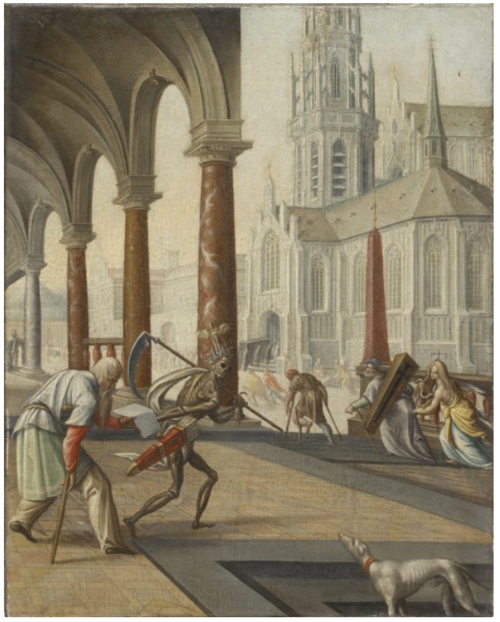
- Allegory of Death (1650) – The date on this title post‑dates Aerts’ death; most scholars therefore treat the work as either a later copy of an original composition by Aerts or a misattributed piece. Its composition, however, aligns with his known style—an interior setting populated by a skeletal figure and mournful attendants.
- Interior of a Gothic church with staffage (1550) – The listed date precedes Aerts’ birth, indicating a likely cataloguing error. The painting itself, when examined, matches the technical characteristics of Aerts’ hand, suggesting it may be an early work that was later re‑dated, or again a misattribution.
These works collectively illustrate Aerts’ preoccupation with space, perspective, and the narrative potential of architectural settings.
Influence and legacy Although Hendrick Aerts did not achieve the fame of some of his Flemish contemporaries, his paintings contributed to the diffusion of Northern Renaissance architectural aesthetics into the Baltic region. By operating in Gdańsk—a thriving commercial hub with strong artistic exchanges between the Netherlands, Germany, and Poland—Aerts helped introduce sophisticated perspective techniques to local patrons and workshops.
His oeuvre also anticipates later Baroque developments in which architects themselves became central subjects of painting, a trend fully realised by artists such as Pietro da Cortona and later by the Dutch painter Pieter Saenredam. Modern scholarship regards Aerts as a transitional figure whose work bridges the meticulous realism of the late Renaissance with the more expressive spatial drama that would dominate the seventeenth century.
Today, his paintings are of interest to specialists in architectural art, to historians of the cultural exchange between Western Europe and the Baltic states, and to collectors who appreciate the rare combination of technical precision and imaginative composition. While the limited number of securely attributed works constrains a fuller assessment, Aerts remains a noteworthy example of a Flemish artist who successfully exported his craft beyond the traditional borders of the Low Countries.
Frequently asked questions
Who was Hendrick Aerts?
Hendrick Aerts (1565–1603) was a Flemish painter and draftsman known for architectural paintings of real and imagined interiors, active mainly in Gdańsk and Prague.
What artistic style or movement is he associated with?
His work falls between the High Renaissance and early Baroque, characterised by precise linear perspective and imaginative architectural composition.
What are his most famous works?
Key works include *Phantasy Renaissance palace* (1602), *Church interior* (1595), and *Allegory of love and death* (1600), all showcasing his architectural focus.
Why is Hendrick Aerts important in art history?
He helped transmit sophisticated Northern Renaissance perspective techniques to the Baltic region, influencing local artistic practices and prefiguring later Baroque architectural painting.
How can I recognise a Hendrick Aerts painting?
Look for a strong linear perspective, detailed Gothic or Renaissance architecture, modestly rendered figures, and a calm, balanced light that highlights the structural space.