Harry Fenn
1845 – 1911
In short
Harry Fenn (1845–1911) was an English‑born American illustrator, landscape painter, etcher and wood‑engraver, best known for his vivid depictions of North American scenery and Oriental subjects. From the 1870s to the mid‑1890s he was the United States’ leading landscape illustrator, producing celebrated works such as Niagara Falls and the Ocklawaha River scene.
Notable works

_MET_DT9025.jpg)


Early life Harry Fenn was born in 1845 in Richmond, England, before moving to the United States as a young man. His early training combined traditional drawing techniques with the burgeoning commercial demands of illustration, a blend that would shape his later career. Settling in the United States, Fenn quickly established himself within the growing market for visual documentation of the American landscape and foreign locales, a niche that was expanding alongside the nation’s railways and publishing houses.
Career and style During the 1870s Fenn emerged as the pre‑eminent landscape illustrator in America. His work appeared in a range of popular travel books, atlases, and periodicals, where his ability to render atmospheric light and dramatic topography resonated with a public eager for visual accounts of distant places. While his subjects ranged from the wild rivers of Florida to the ancient ruins of the Levant, a consistent thread ran through his oeuvre: a meticulous attention to natural detail combined with a romantic sensibility that emphasized the sublime.
Fenn’s style sits comfortably within the Orientalist movement, especially in his illustrations of Egypt, Palestine and the Sinai. He presented these regions with a blend of documentary precision and exotic allure, aligning with contemporary Western tastes for the ‘mysterious East’. At the same time, his American landscapes were rendered with a naturalist eye, reflecting the influence of the Hudson River School while also anticipating later Impressionist interests in light and colour.
Signature techniques Fenn was proficient in several media, most notably wood‑engraving, etching and oil painting. His wood‑engravings were characterised by fine line work and careful cross‑hatching, which allowed him to convey texture in foliage, water and stone. In his etchings, he employed a restrained palette of ink tones, favouring subtle gradations that suggested depth without sacrificing clarity. When working in oil, he often built up layers of thin glazes to achieve luminous skies and reflective water surfaces, a technique that reinforced the atmospheric quality of his compositions.
A hallmark of his practice was the use of reference sketches made on site. Whether travelling by boat along the Ocklawaha River or accompanying archaeological expeditions in the Holy Land, Fenn produced quick studies that he later refined in the studio. This approach ensured that his published images retained both accuracy and artistic vitality.
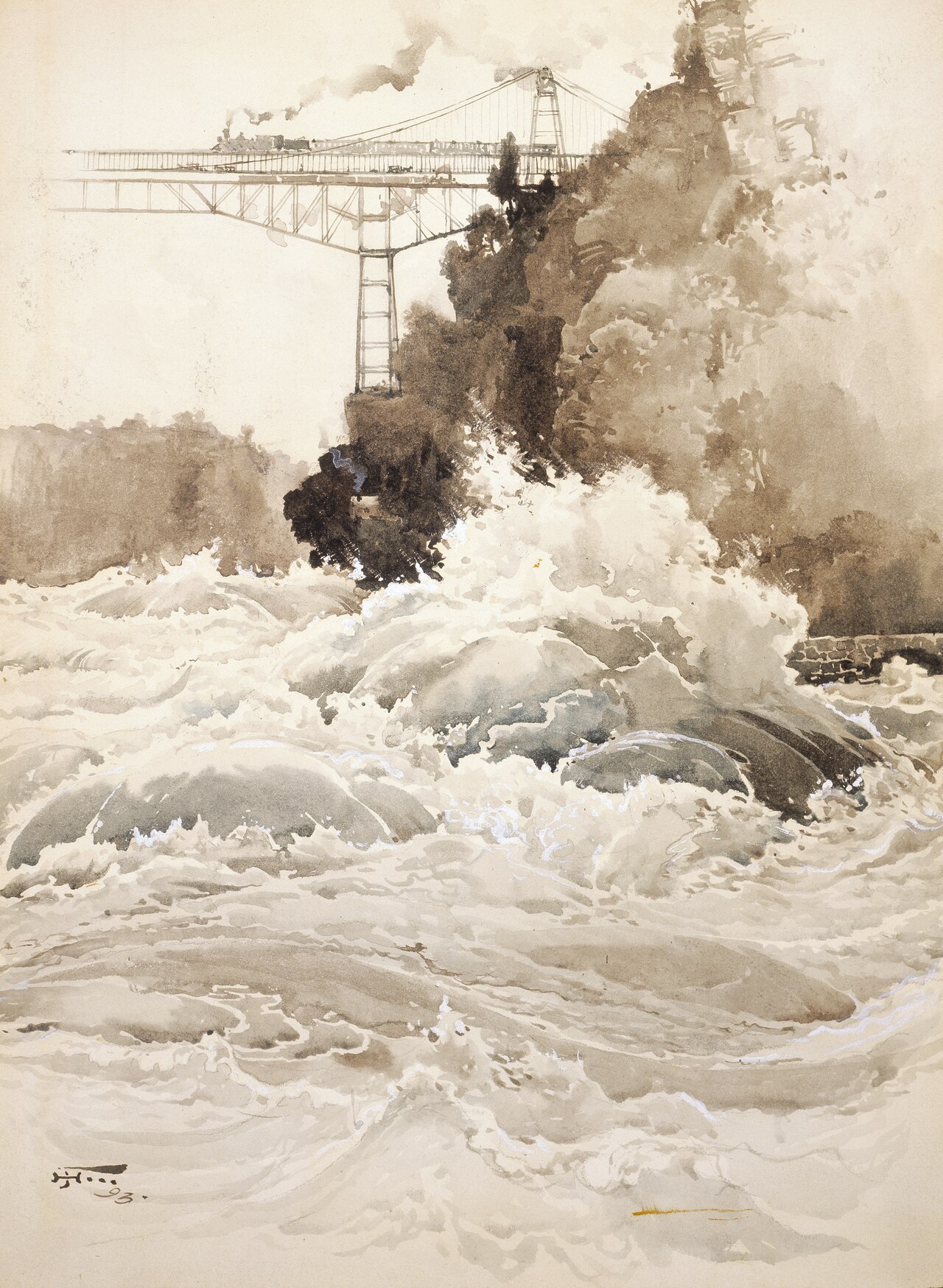
Major works - **The Cypress‑Shingle Yard, Ocklawaha River, Florida (1870)** – Produced from a field sketch made during a survey of Florida’s interior waterways, this work captures the interplay of cypress trees reflected in the still water of the river. The composition balances a tranquil foreground with distant, mist‑shrouded banks, illustrating Fenn’s skill at rendering humid, subtropical light. - **Caesarea Philippi (Banias)** – Part of a series on the biblical and archaeological sites of Palestine, this illustration presents the ruins of Caesarea Philippi with an emphasis on stone architecture against a rugged hillside. The drawing combines precise line work with a suggestive use of shadow to convey the ancient atmosphere of the site. - **The Town Hall, North Easton, Massachusetts** – This water‑colour rendering documents the civic architecture of North Easton, highlighting the building’s Romanesque details and its setting within a modest townscape. Fenn’s careful rendering of brickwork and the surrounding parkland demonstrates his versatility beyond natural scenery. - **Niagara Falls (1862)** – One of Fenn’s earliest celebrated images, this view of the falls captures the thunderous power of the water with dynamic brushstrokes and a dramatic sky. The piece was widely reproduced in travel guides, helping to cement Niagara’s reputation as a natural wonder for American audiences. - **The Whirlpool Rapids (1893)** – Rendered in a bold etching, this work depicts the turbulent currents of the Niagara River’s Whirlpool Rapids. Fenn’s use of dense cross‑hatching conveys the frothy turbulence, while the surrounding cliffs are rendered with clean, architectural lines, underscoring his mastery of both natural and structural forms.
These works collectively illustrate Fenn’s range: from the serene subtropics of Florida to the awe‑inspiring power of Niagara, and from the ancient stones of the Levant to the civic pride of a New England town.
Influence and legacy Harry Fenn’s influence on American visual culture was profound. By the mid‑1890s he had set the standard for landscape illustration, and his techniques were adopted by a generation of illustrators who followed. His publications contributed to the popular imagination of both domestic and foreign landscapes, reinforcing a sense of national identity tied to the natural environment. Moreover, his Orientalist images helped shape Western perceptions of the Near East, providing a visual complement to contemporary travel literature.
Although the rise of photography gradually reduced the demand for hand‑drawn illustration, Fenn’s work remains a valuable historical record. Museums and libraries preserve his original prints and sketches, and his images continue to be cited in scholarly studies of 19th‑century art and travel culture. In recent years, renewed interest in historic illustration techniques has led to exhibitions that reassess his contribution to both fine art and commercial illustration, reaffirming his status as a pivotal figure in the development of American visual storytelling.
Fenn died in 1911 in Montclair, New Jersey, leaving behind a prolific body of work that bridges the worlds of fine art, publishing and early documentary photography. His legacy endures in the continued appreciation of his ability to capture the sublime in both the familiar and the exotic.
Frequently asked questions
Who was Harry Fenn?
Harry Fenn (1845–1911) was an English‑born American illustrator, landscape painter, etcher and wood‑engraver best known for his vivid depictions of North American scenery and Oriental subjects.
What artistic movement is he associated with?
Fenn is linked to Orientalism for his illustrations of Egypt, Palestine and the Sinai, while his American landscapes reflect a romantic, naturalist style akin to the Hudson River School.
What are his most famous works?
His most celebrated images include Niagara Falls (1862), The Whirlpool Rapids (1893), The Cypress‑Shingle Yard on the Ocklawaha River (1870), Caesarea Philippi (Banias), and The Town Hall in North Easton, Massachusetts.
Why does Harry Fenn matter in art history?
He was the United States’ leading landscape illustrator from the 1870s to the mid‑1890s, shaping visual perceptions of both domestic and foreign landscapes and influencing successive generations of illustrators.
How can I recognise a Harry Fenn illustration?
Look for precise line work, meticulous detail, atmospheric light, and a balance of documentary accuracy with a romantic, almost sublime ambience, often rendered in wood‑engraving or etching.