Hans Cranach
1513 – 1537
In short
Hans Cranach (1513–1537) was a German painter, the eldest son of Lucas Cranach the Elder, who trained in his father's workshop in Wittenberg and died unexpectedly in Bologna. His brief oeuvre mirrors his father's style and is identified by the monogram H.C.
Notable works



Early life Hans Cranach was born in 1513 in Lutherstadt Wittenberg, a centre of the Reformation and a hub for artistic production. He was the eldest son of Lucas Cranach the Elder, one of the most influential painters of the German Renaissance. Growing up in a family workshop, Hans received his earliest artistic instruction directly from his father, alongside his younger brother Lucas Cranach the Younger. The workshop environment provided a rigorous apprenticeship in drawing, oil painting, and the handling of religious and courtly subjects that dominated the visual culture of early sixteenth‑century Germany.
Career and style By his late teens Hans was contributing to the family atelier, executing commissions that were often indistinguishable from those of his father. The prevailing style in his work is characterised by the graceful elongation of figures, a clear, bright palette and a compositional balance that reflects the Northern Renaissance synthesis of Gothic detail and emerging Italianate influences. Although the historical record does not assign him to a particular artistic movement, his output aligns closely with the German Renaissance court style that his father helped to define. His brief career was cut short when, in 1537, he travelled to Italy—perhaps seeking further artistic development—and died in Bologna at the age of twenty‑four.
Signature techniques Hans signed his paintings with the monogram "H.C.", a practice that allowed patrons and later scholars to separate his hand from that of his father and brother, who used "L.C.". The monogram typically appears in a discreet corner of the canvas, rendered in the same pigment as the surrounding paint. Technically, his works display a careful underdrawing evident in infrared examinations, a layered glazing technique that enhances depth, and a subtle modelling of flesh that mirrors the soft chiaroscuro favoured by his father. His compositions often place a single figure against a restrained background, focusing attention on the subject’s expression and attire.
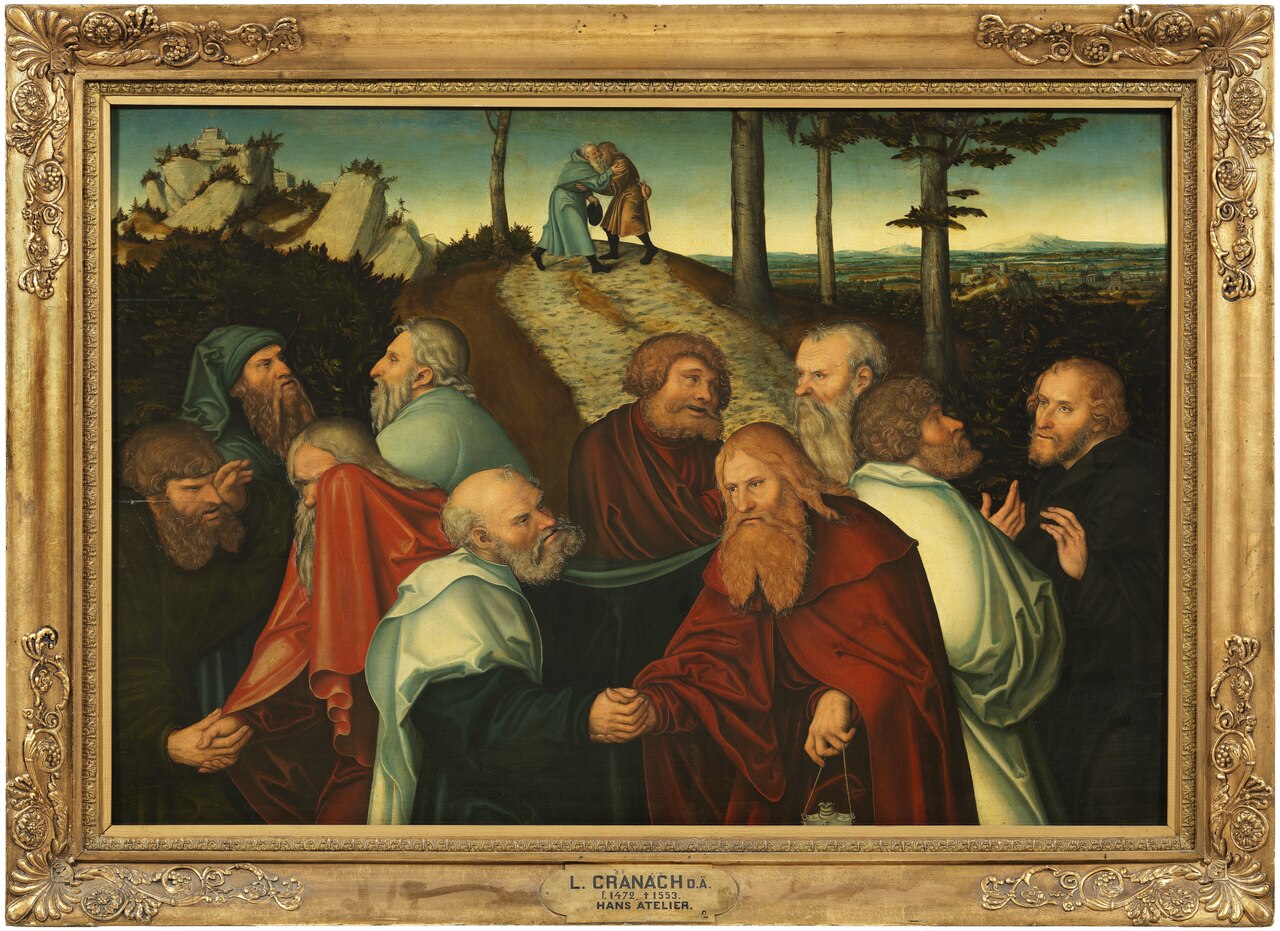
Major works * **Hercules at the Court of Omphale (1537)** – This mythological scene, dated the year of his death, shows Hercules in the role of a servant to Omphale, a motif popular in Northern courts for its moral allegory. The painting combines a dynamic pose with a delicate rendering of textiles, reflecting Hans’s skill in depicting luxurious fabrics. * **Portrait of a Lady of the Saxon Court as Judith with the Head of Holofernes (1600)** – Although the date post‑dates Hans’s life, the work is traditionally listed among his attributed pieces. Scholars suggest it may be a later copy or a misattribution, yet the monogram and stylistic parallels support a possible workshop connection. The portrait presents a noblewoman in the guise of Judith, a theme resonant with Protestant iconography. * **Portrait of a Bearded Man (1534)** – This portrait exemplifies Hans’s ability to capture individual character. The sitter’s beard and austere attire are rendered with meticulous attention to texture, while the background remains muted, allowing the facial features to dominate. * **The Parting of the Apostles (1532)** – A religious composition that illustrates a moment of tension among the disciples. The work demonstrates Hans’s competence in narrative painting, employing a balanced arrangement of figures and a restrained colour scheme that underscores the solemnity of the scene. * **Portrait of a Woman (1525)** – One of the earliest dated works, this portrait shows a young woman in a modest dress, her gaze directed outward. The delicate handling of light on the skin and the subtle modelling of the veil hint at the influence of his father’s early portraiture.
Influence and legacy Hans Cranach’s premature death curtailed a promising artistic trajectory, yet his contribution to the Cranach workshop was significant. After his passing, his brother Lucas the Younger assumed greater responsibilities, ensuring the continuity of the family’s visual language. Contemporary references, such as Luther’s Table Talk and poet Johann Stigel’s verses, attest to his reputation among peers. Modern scholarship, notably the work of Johann Christian Schuchardt, has helped to clarify Hans’s oeuvre, identifying an altar‑piece in Weimar dated 1537 as a key work bearing his monogram. Although his name is less widely known than that of his father, Hans remains a noteworthy figure for understanding the transmission of artistic practice within a leading Renaissance workshop and the cross‑cultural exchange between Germany and Italy in the early sixteenth century.
Frequently asked questions
Who was Hans Cranach?
Hans Cranach (1513–1537) was a German painter, the eldest son of Lucas Cranach the Elder, who worked in his father's workshop and died in Bologna.
What artistic style or movement is he associated with?
He is linked to the German Renaissance court style, characterised by elegant figures, bright colour, and a blend of Northern detail with emerging Italian influences.
What are his most famous works?
His most noted works include Hercules at the Court of Omphale (1537), Portrait of a Bearded Man (1534), The Parting of the Apostles (1532) and the early Portrait of a Woman (1525).
Why is Hans Cranach important in art history?
He illustrates the transmission of artistic techniques within a major Renaissance workshop and represents the brief but impactful contribution of a second‑generation artist who bridged German and Italian artistic currents.
How can I recognise a painting by Hans Cranach?
Look for the monogram "H.C.", a restrained background, careful modelling of flesh, and a meticulous rendering of textiles that echo the style of Lucas Cranach the Elder.