Gustaaf Vanaise
1854 – 1902
In short
Gustaaf Vanaise (1854–1902) was a Belgian painter who worked in history, portrait, genre, nude, landscape and still‑life subjects. He aimed to revive Belgian history painting with large, narrative canvases, while later adopting brighter colours and looser brushwork under contemporary influences.
Notable works


.jpg)
.jpg)
Early life Gustaaf Vanaise was born in 1854 in Ghent, a city with a long artistic tradition that shaped his early exposure to the visual arts. His family was middle‑class, and he received a conventional education before enrolling at the Royal Academy of Fine Arts in Ghent. There, he studied under teachers who emphasized academic drawing, anatomy, and the classical canon. The academy’s curriculum, which stressed historical and mythological subjects, left a lasting imprint on Vanaise’s artistic ambitions.
Career and style After completing his studies, Vanaise moved to Brussels, the cultural hub of Belgium, where he set up a studio and began to exhibit at the Salon of the Société des Beaux‑Arts. His early works adhered closely to the academic realism that dominated the Belgian art market in the late nineteenth century. He produced portraits, genre scenes, and still‑lifes that demonstrated meticulous draftsmanship and a restrained palette.
Vanaise’s most distinctive ambition was the revival of history painting in Belgium. He believed that large, narrative canvases could reinforce national identity and cultural pride. To that end, he painted a series of monumental works that depicted episodes from Flemish and Belgian history, often employing dramatic lighting and carefully staged compositions reminiscent of the great French academicians. Although his approach was commercially successful, critics increasingly regarded his style as dated as the avant‑garde movements of Impressionism and Symbolism gained momentum.
In the 1890s Vanaise’s palette began to lighten. Influences from contemporary French and Belgian painters—particularly the brighter hues of the Impressionists and the looser brushwork of the emerging Symbolists—can be seen in his later landscapes and genre pieces. This shift did not abandon his academic roots but rather blended them with a more modern sensibility, giving his late works a distinctive glow.
Signature techniques Vanaise’s technique combined rigorous drawing with a layered application of oil paint. He typically prepared his canvases with a toned ground, allowing him to model forms directly with thin glazes before building up richer colour. In his historical canvases, he employed chiaroscuro to emphasise the moral or heroic focus of the narrative, while in his landscapes he used a broader, more fluid handling of paint to capture atmospheric effects.
A recurring feature of his work is the careful rendering of textiles and architectural detail. Whether depicting the folds of a noblewoman’s gown or the stonework of a Flemish church, Vanaise demonstrated a keen eye for texture. In his later pieces he introduced subtle impasto in highlights, a technique that added tactile depth and accentuated the brighter colour scheme.
Major works - **Saint Livinus in Flanders (1882)** – This early historical canvas presents the martyr Saint Livinus amidst a Flemish landscape, using a subdued palette and precise linear drawing. The composition underscores Vanaise’s commitment to national themes, placing a saintly figure within a recognisable regional setting.
- View of the Lagoon in Venice (1883) – A departure from his historical focus, this landscape captures the shimmering water of the Venetian lagoon. The work demonstrates his growing interest in light effects, with softer brushstrokes and a more luminous colour range.
- Sakala and Jeanne De Raedt (1886) – A genre painting that depicts a domestic interior, this piece showcases Vanaise’s skill in rendering intimate scenes. The careful modeling of the figures and the delicate treatment of light on the interior surfaces reflect his academic training.
- Happiness (1888) – Often described as a celebration of everyday joy, the painting portrays a group of children at play. The composition is balanced, and the brighter tonalities hint at the painter’s gradual shift toward a more optimistic palette.
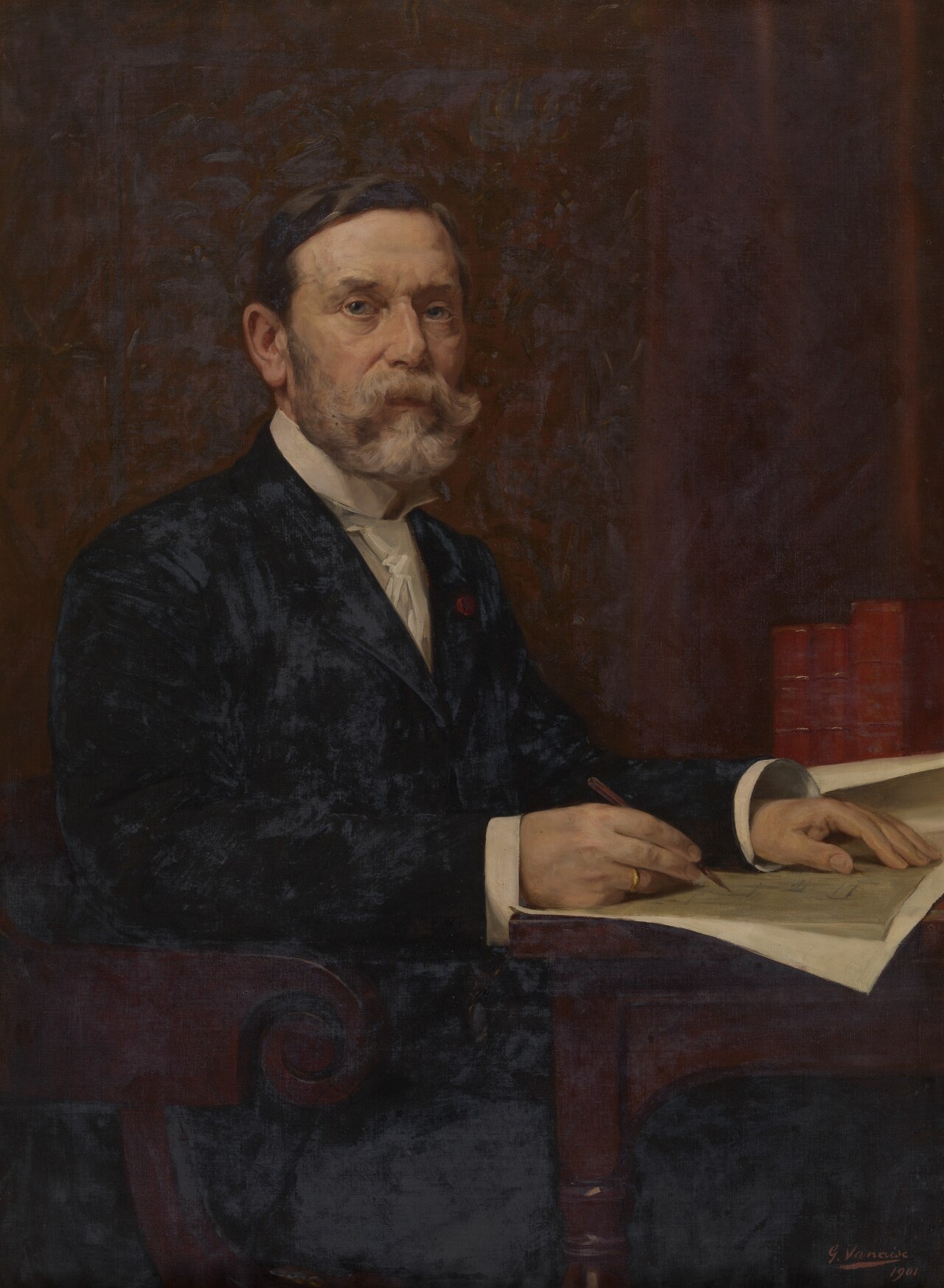
- The Architect Leonard Blomme (1901) – One of Vanaise’s final portraits, this work captures the eponymous architect in a studio setting. The portrait is notable for its luminous background and subtle impasto, indicating the influence of contemporary trends even as Vanaise remained faithful to his precise draftsmanship.
Influence and legacy Gustaaf Vanaise’s career straddles a transitional period in Belgian art. While his dedication to history painting reinforced a sense of national narrative during a time of burgeoning Belgian identity, his later adoption of brighter colours and looser brushwork anticipated the gradual acceptance of modernist aesthetics in Belgium. Though his name is less prominent than that of contemporaries such as James Ensor or Fernand Khnopff, Vanaise’s body of work provides valuable insight into the academic tradition’s response to changing tastes.
His paintings remain in public and private collections across Belgium and the Netherlands, often displayed in museums that focus on 19th‑century Belgian art. Scholars cite his meticulous technique and his willingness to adapt without abandoning his core principles as illustrative of the broader tensions that shaped the nation’s artistic development at the turn of the century. Vanaise died in 1902 in Saint‑Gilles, leaving behind a catalogue that continues to inform discussions of Belgian historical painting and its evolution toward modernity.
Frequently asked questions
Who was Gustaaf Vanaise?
Gustaaf Vanaise (1854–1902) was a Belgian painter known for history, portrait, genre, nude, landscape and still‑life works, who sought to revive national history painting in Belgium.
What artistic style or movement is he associated with?
He worked within an academic realist tradition, later incorporating brighter colours and looser brushwork influenced by Impressionism and Symbolism.
What are his most famous works?
Key works include *Saint Livinus in Flanders* (1882), *View of the Lagoon in Venice* (1883), *Sakala and Jeanne De Raedt* (1886), *Happiness* (1888) and *The Architect Leonard Blomme* (1901).
Why does he matter in art history?
Vanaise exemplifies the late‑19th‑century effort to sustain history painting in Belgium while subtly adapting to modern trends, offering a bridge between academic realism and emerging modernist sensibilities.
How can I recognise a painting by Vanaise?
Look for precise draftsmanship, careful rendering of fabrics and architecture, a balanced composition, and in later works, brighter palettes with looser brushwork and occasional impasto highlights.