Giuseppe Bazzani
1690 – 1769
In short
Giuseppe Bazzani (1690–1769) was a Mantuan painter who worked in the late Baroque style, incorporating early Rococo elements. He is best known for religious canvases such as *Jephthah's Daughter* and *The Massacre of the Innocents*, which display dramatic chiaroscuro and dynamic composition.
Notable works



Early life Giuseppe Bazzani was born in 1690 in Mantua, a city that had long been a centre of artistic patronage under the Gonzaga dukes. Little is recorded about his family background, but archival sources indicate that he entered the local workshop system at a young age, receiving training in the traditions of the Mantuan school, which traced its lineage back to the Renaissance masters of the region. The city's churches and palaces provided a steady flow of commissions, allowing young artists to develop a solid foundation in religious iconography and large‑scale fresco work.
Career and style By the early 1720s Bazzani had established himself as a leading painter in Mantua. His career unfolded during a transitional period in Italian art: the grandiosity of the high Baroque was giving way to the lighter, more decorative sensibilities of the Rococo. Bazzani remained rooted in the Baroque vocabulary—dramatic lighting, vigorous movement, and emotional intensity—while gradually softening his palette and incorporating a more graceful handling of figures. This synthesis placed him among the artists who bridged the two styles, making his oeuvre valuable for understanding the evolution of Italian painting in the eighteenth century.
Patronage came primarily from ecclesiastical institutions, but he also received commissions from private collectors who sought devotional images for their chapels. Bazzani’s works were characterised by a strong narrative thrust; he favoured subjects that allowed for the depiction of heightened drama, such as martyrdoms, biblical episodes, and saints’ legends. His paintings often feature a central group of figures illuminated against a darker background, a compositional device that heightens the immediacy of the scene.
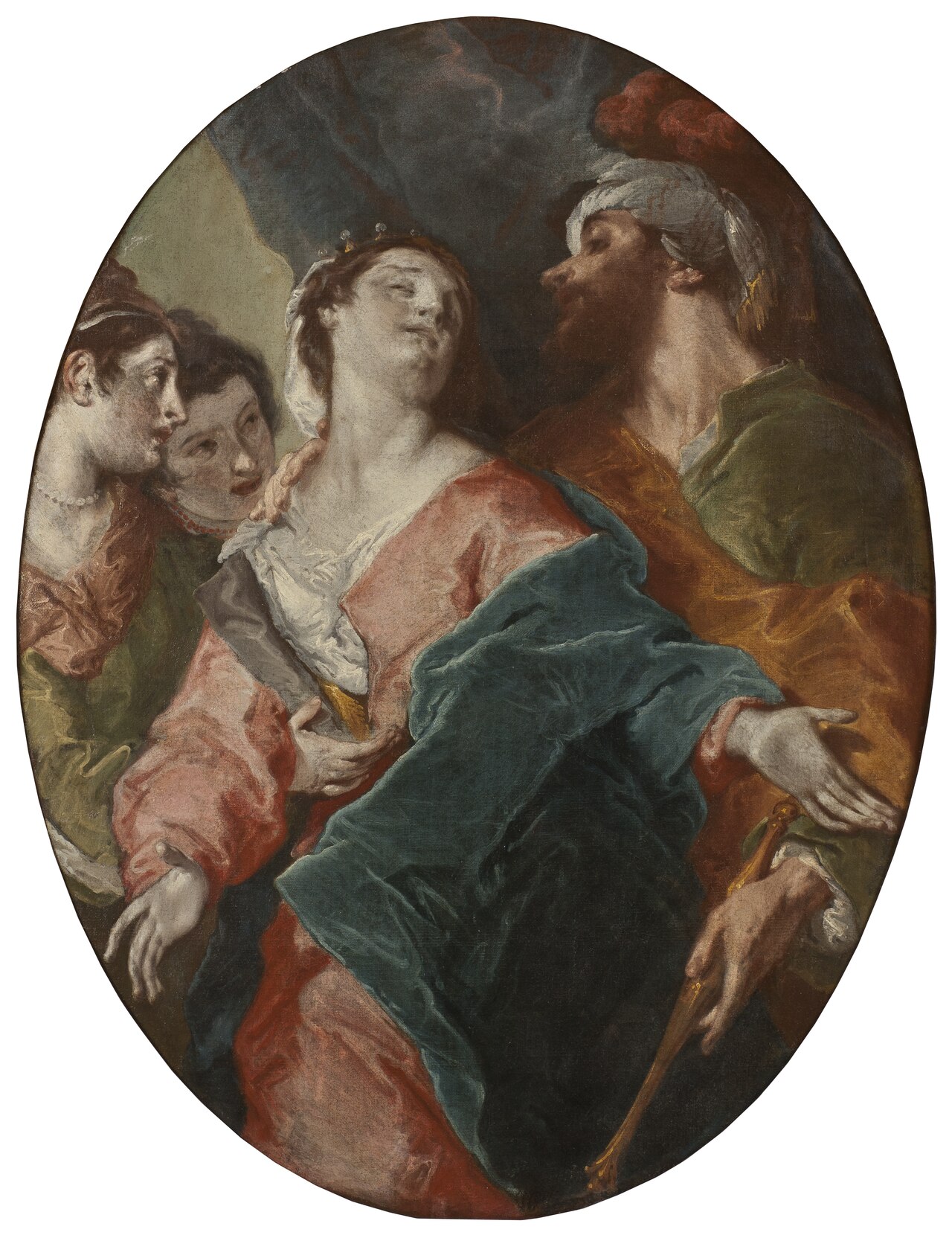
Signature techniques Bazzani’s technique combined several hallmarks of late Baroque painting. He employed a vigorous chiaroscuro, using deep shadows to model forms and to direct the viewer’s eye toward focal points of action. His brushwork, while generally controlled, becomes looser in peripheral details, hinting at the emerging Rococo taste for texture and movement. Colour is used strategically: warm reds and golds dominate the garments of central characters, while cooler blues and greens recede into the background, creating a sense of depth.
Another distinctive element is his handling of drapery. Bazzani rendered folds with a tactile realism that conveys both the weight of the fabric and the kinetic energy of the figure. In many of his compositions, the gestures of the hands and the glances of the eyes are exaggerated to communicate narrative tension without the need for extensive textual explanation. This visual economy made his works especially effective in the devotional contexts for which they were intended.
Major works - **Jephthah's Daughter (1701)** – One of Bazzani’s earliest recorded canvases, this painting depicts the biblical tragedy of Jephthah’s vow. The composition centres the young woman at the moment of sacrifice, her serene expression contrasting with the anguished faces of the surrounding figures. The work demonstrates Bazzani’s early mastery of chiaroscuro and his ability to convey pathos through subtle facial modelling.
- Saint Anthony of Padua with the Infant Christ (1740) – In this later piece, Bazzani portrays the saint in a tender interaction with the Christ Child. The warm, golden light enveloping the figures reflects the influence of the Rococo’s softer palette, while the dynamic placement of Saint Anthony’s arm creates a sense of movement that is typical of his Baroque roots.
- The Ascent to Calvary (1750) – This large‑scale canvas captures the moment when Christ is taken up the hill toward his crucifixion. Bazzani arranges the crowd in a spiralling composition that leads the eye upward, reinforcing the narrative’s spiritual ascent. The dramatic use of light, coupled with the emotional intensity of the onlookers, exemplifies his mature style.
- Esther and Ahasverus – Although the exact date of this work is uncertain, it belongs to Bazzani’s series of historical‑biblical subjects. The painting illustrates the pivotal scene in which Queen Esther approaches the Persian king, Ahasverus, to plead for her people. Bazzani’s handling of the regal attire and the delicate interplay of power and vulnerability showcases his skill in rendering courtly drama.
- The Massacre of the Innocents (1744) – Perhaps his most dramatic narrative, this canvas depicts the biblical massacre ordered by King Herod. Bazzani’s composition places the terrified mothers and children in the foreground, while soldiers loom ominously in the background. The stark contrast between light and shadow, together with the visceral expressions, underscores the painting’s emotional impact.
These works collectively illustrate Bazzani’s ability to navigate complex theological themes while maintaining a clear visual language that balances Baroque intensity with emerging Rococo elegance.
Influence and legacy Giuseppe Bazzani’s career remained largely centred in Mantua, and he did not achieve the widespread fame of some of his contemporaries in Rome or Venice. Nevertheless, his paintings exerted a lasting influence on the local artistic community. He trained a number of younger painters who continued to work in the hybrid Baroque‑Rococo idiom, ensuring the transmission of his compositional strategies and colouristic approach.
Art historians regard Bazzani as an important figure for understanding the regional variations of late Baroque art in northern Italy. His works provide insight into how religious institutions adapted visual narratives to the tastes of the eighteenth‑century faithful, favouring emotionally charged imagery that could engage viewers on both devotional and aesthetic levels. While his name may not appear in the most popular surveys of Italian art, Bazzani’s oeuvre is regularly examined in specialist studies of Mantuan painting and is featured in several museum collections that focus on Baroque and Rococo art.
In recent decades, renewed scholarly interest in lesser‑known Baroque artists has brought Bazzani’s paintings back into the spotlight. Exhibitions that juxtapose his canvases with those of contemporaries such as Giovanni Battista Tiepolo and Francesco Solimena highlight his unique contribution to the period’s visual vocabulary. Through these re‑evaluations, Bazzani is increasingly recognised as a bridge between the dramatic intensity of the Baroque and the decorative charm of the Rococo, a role that solidifies his place in the broader narrative of European art history.
Frequently asked questions
Who was Giuseppe Bazzani?
Giuseppe Bazzani (1690–1769) was a Mantuan painter who worked in the late Baroque style, incorporating early Rococo elements, and is known for dramatic religious canvases.
What artistic movement did Bazzani belong to?
He is primarily associated with the Baroque movement, though his later work shows the softer, decorative touches of the Rococo.
What are his most famous works?
Key works include *Jephthah's Daughter* (1701), *Saint Anthony of Padua with the Infant Christ* (1740), *The Ascent to Calvary* (1750), *Esther and Ahasverus*, and *The Massacre of the Innocents* (1744).
Why is Bazzani important in art history?
He exemplifies the transition from the high Baroque to the Rococo in northern Italy, influencing local artists and providing a vivid visual record of 18th‑century religious narrative art.
How can I recognise a Bazzani painting?
Look for dramatic chiaroscuro, dynamic compositions, richly coloured drapery, and emotionally charged figures that blend Baroque intensity with a subtly lighter Rococo palette.