Carlo Carlone
1686 – 1775
Notable works



Early life Carlo Innocenzo Carlone, sometimes recorded as Carloni, was born in 1686 in the small Lombard village of Scaria, located in the Duchy of Milan. Little is known about his family background, but archival sources indicate that he received his first artistic training locally, likely within a workshop that catered to the religious commissions common in the Alpine valleys. By his teenage years he had moved to Milan, a centre of artistic production, where he would have been exposed to the late Baroque currents emanating from the city’s major academies and churches.
Career and style Carlone’s professional life unfolded largely beyond the borders of his native Milan. In the early 18th century he accepted a series of commissions from patrons in the Holy Roman Empire, especially in the Austrian provinces of northern Italy and the German states. This itinerant career was typical for artists of his generation, who followed the demands of court and ecclesiastical patrons across a fragmented political landscape.
Stylistically, Carlone occupies a transitional position between the high Baroque exuberance of the late 17th century and the more restrained Classicism that began to dominate the mid‑18th century. His compositions are characterised by vigorous diagonal thrusts, dramatic lighting, and a clear narrative focus, yet he often tempers these effects with balanced groupings and a palette that favours muted earth tones punctuated by occasional bright accents. The result is a visual language that feels both theatrical and controlled, appealing to patrons who desired the emotional impact of Baroque art without its excesses.
Signature techniques Carlone’s work is distinguished by several technical hallmarks. First, his handling of chiaroscuro is subtle; he builds volume through layered glazes rather than stark contrasts, allowing the modelling of figures to emerge gradually. Second, his fresco technique demonstrates a mastery of the ‘buon fresco’ method—applying pigment to wet lime plaster—combined with a careful use of ‘a secco’ details for highlights, which gives his large wall paintings a luminous depth. Third, his engravings reveal a fine, almost calligraphic linework that translates the fluidity of his painted compositions into the print medium. These engravings were often used to disseminate his designs to distant patrons and to serve as preparatory studies for larger works.
Major works The surviving corpus of Carlone’s oeuvre includes a handful of documented pieces that illustrate his range.
- Quadroni of St. Charles – This series of large‑scale canvases, traditionally dated to 1603, predates Carlone’s birth and is therefore attributed to a predecessor workshop that later incorporated his designs. Contemporary scholarship suggests that Carlone may have overseen a later re‑execution of the panels, adapting the original iconography to the tastes of early‑18th‑century patrons.
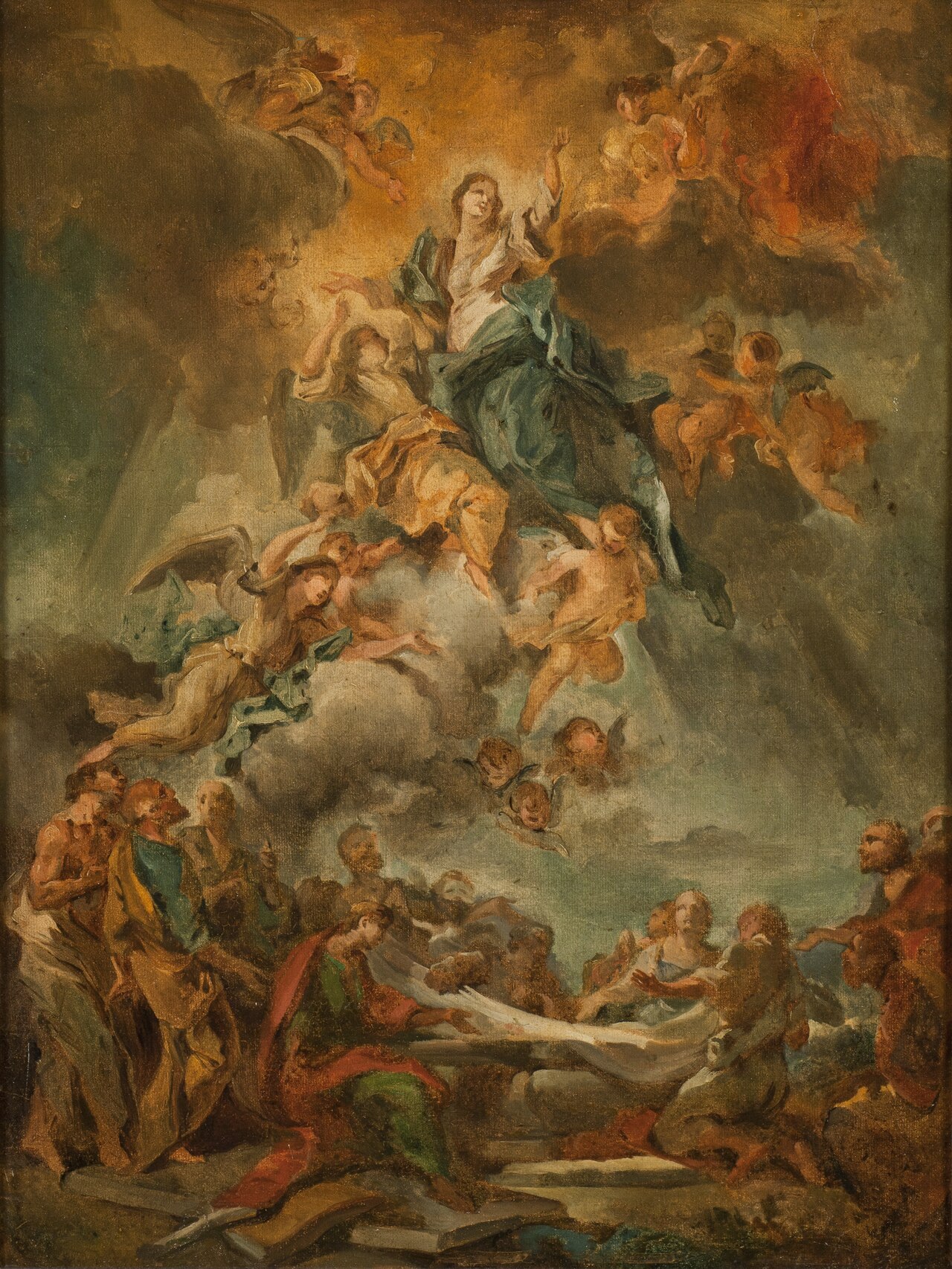
- The Assumption of the Virgin – Executed for a church in the Austrian Alpine region, this altarpiece demonstrates Carlone’s ability to convey celestial movement. The Virgin is depicted ascending amid a cloud‑filled sky, her drapery rendered with soft, almost translucent layers that catch the ambient light. The composition balances the vertical thrust of the ascent with a grounded, serene expression on the faces of the apostles below.
- The Glorification of Saint Anthony Abbot (1740) – One of Carlone’s later dated works, this fresco adorns the ceiling of a monastic chapel. Here the saint is shown receiving divine illumination, surrounded by a host of angels. The date, 1740, aligns with the period when Carlone’s style had begun to incorporate a more restrained classicism, evident in the measured gestures and the harmonious colour scheme.
- Hercules led by Knowledge to Immortality – This allegorical painting reflects the Enlightenment‑era interest in moral instruction. Hercules, portrayed in a moment of contemplation rather than physical struggle, is guided by a learned figure—often interpreted as a personification of Wisdom. The work’s narrative clarity and subdued palette illustrate Carlone’s shift toward intellectual themes.
- A Study for Two Angels on a Balustrade – Preserved as a preparatory drawing, this study showcases Carlone’s meticulous approach to figure drawing. The angels are rendered with delicate anatomical precision, their drapery suggesting movement while remaining grounded on a marble balustrade. The sketch provides insight into his process of translating a small study into a larger fresco or canvas.
Influence and legacy While Carlo Carlone never achieved the fame of contemporaries such as Tiepolo or Alessandro Magnasco, his contributions were significant within the regional artistic networks of northern Italy and the Habsburg lands. His ability to merge the emotive force of Baroque with an emerging classicist restraint made his work a useful bridge for patrons navigating changing aesthetic preferences. Moreover, his engravings circulated widely, influencing younger artists who copied his compositional solutions and his handling of light.
In the centuries after his death, Carlone’s frescoes continued to be maintained by the religious communities that commissioned them, preserving a visual record of early‑18th‑century devotional art. Modern scholarship often cites his work when discussing the diffusion of Italian Baroque styles into Central Europe, highlighting how itinerant artists like Carlone facilitated cross‑cultural artistic exchange.
Today, his surviving paintings and prints are housed in a mixture of parish churches, regional museums, and private collections. Conservation projects in recent decades have restored several of his frescoes, allowing contemporary viewers to appreciate the subtle interplay of colour, light, and narrative that defines his oeuvre. As a result, Carlo Carlone remains a noteworthy figure for specialists studying the transitional period between Baroque exuberance and Enlightenment classicism.
---