Giovanni Andrea Ansaldo
1584 – 1638
In short
Giovanni Andrea Ansaldo (1584–1638) was a Baroque painter who worked chiefly in Genoa, producing religious canvases such as the 1615 Deposition and a series of saintly compositions in the 1620s. His work blends dramatic lighting with the decorative richness of Genoese art, securing his place among the early 17th‑century contributors to the city’s visual culture.
Notable works


Early life Giovanni Andrea Ansaldo was born in 1584 in the coastal village of Voltri, then part of the Republic of Genoa. Details of his family background and early artistic training are scarce, and his exact nationality is not recorded in surviving documents. Contemporary accounts suggest that he may have begun his apprenticeship locally before moving to the city of Genoa, where a vibrant artistic community offered opportunities for young painters. The early exposure to Genoa’s thriving commercial and religious commissions would shape his career trajectory.
Career and style By the first decade of the 17th century Ansaldo had established himself as a competent painter of religious subjects, a genre in high demand from churches and confraternities throughout the Ligurian region. His style reflects the broader Baroque movement, characterised by dynamic composition, heightened emotional expression, and a keen use of chiaroscuro to model forms. While Genoese art retained a decorative quality inherited from the late‑Renaissance, Ansaldo incorporated the dramatic intensity that was spreading from Rome and Naples, creating a hybrid visual language that appealed to both local patrons and visitors.
Ansaldo’s work displays a careful balance between narrative clarity and artistic flourish. Figures are often arranged in tightly knit groups that guide the viewer’s eye toward a central focal point, such as a crucifixion or a saint’s miraculous gesture. The colour palette tends toward deep reds, luminous golds, and earthy shadows, reinforcing the spiritual gravitas of his subjects. Though documentation of his collaborations is limited, he is known to have interacted with other Genoese artists of the period, exchanging ideas that reinforced the city’s emerging Baroque identity.
Signature techniques Ansaldo’s paintings are identifiable through several recurring technical traits. First, his handling of light creates a stark contrast between illuminated bodies and surrounding darkness, a technique that enhances three‑dimensionality and dramatizes the narrative moment. Second, he often employed a layered glazing method, applying thin translucent pigments over a darker underpainting to achieve depth and a subtle glow, especially in the rendering of drapery and flesh tones. Third, his compositional scaffolding frequently uses diagonal lines that converge toward a theological or symbolic centre, a device that intensifies the sense of movement and guides contemplation.
Another hallmark of his practice is the meticulous rendering of architectural elements. Even when the setting is imagined, columns, arches, and vaulted ceilings are depicted with a precise understanding of perspective, lending his works an architectural realism that grounds the miraculous within a recognisable space. Finally, Ansaldo’s figures often display a restrained yet expressive facial language; he avoids exaggerated caricature, favouring a sober dignity that aligns with the Counter‑Reformation’s emphasis on piety.
Major works - **Deposition (1615)** – This early masterpiece presents the removal of Christ from the cross with a solemn compositional balance. The central figure of the dead Christ is bathed in a soft, almost ethereal light, while the surrounding mourners are shrouded in shadow, illustrating Ansaldo’s mastery of chiaroscuro. The work’s emotional restraint reflects the theological climate of the period, emphasizing reverence over theatricality.
- Saint Charles Borromeo in Glory with stories from his life (1620) – Executed for a Genoese confraternity, this large altarpiece combines a celestial vision of Saint Charles with narrative vignettes that illustrate the saint’s charitable deeds. The upper register displays the saint surrounded by radiant angels, while the lower register presents episodic scenes rendered with meticulous detail, showcasing Ansaldo’s ability to integrate complex iconography within a single composition.
- Saints Peter, Erasmus, Clare of Assisi and Catherine of Alexandria (1622) – This quartet of saints was commissioned for a side chapel and demonstrates Ansaldo’s skill in portraying a diverse group of holy figures together. Each saint is distinguished by specific attributes—Peter’s keys, Erasmus’s book, Clare’s veil, and Catherine’s wheel—allowing the viewer to identify them instantly. The arrangement creates a harmonious dialogue among the figures, underscored by a unified colour scheme of deep blues and golds.
- Saint Julian the Hospitaller (1620) – In this work, Ansaldo depicts the eponymous saint offering hospitality to travellers, a theme resonant with Genoa’s mercantile ethos. The composition is anchored by the saint’s benevolent gesture, while background architecture frames the scene, reinforcing the narrative of charitable service.
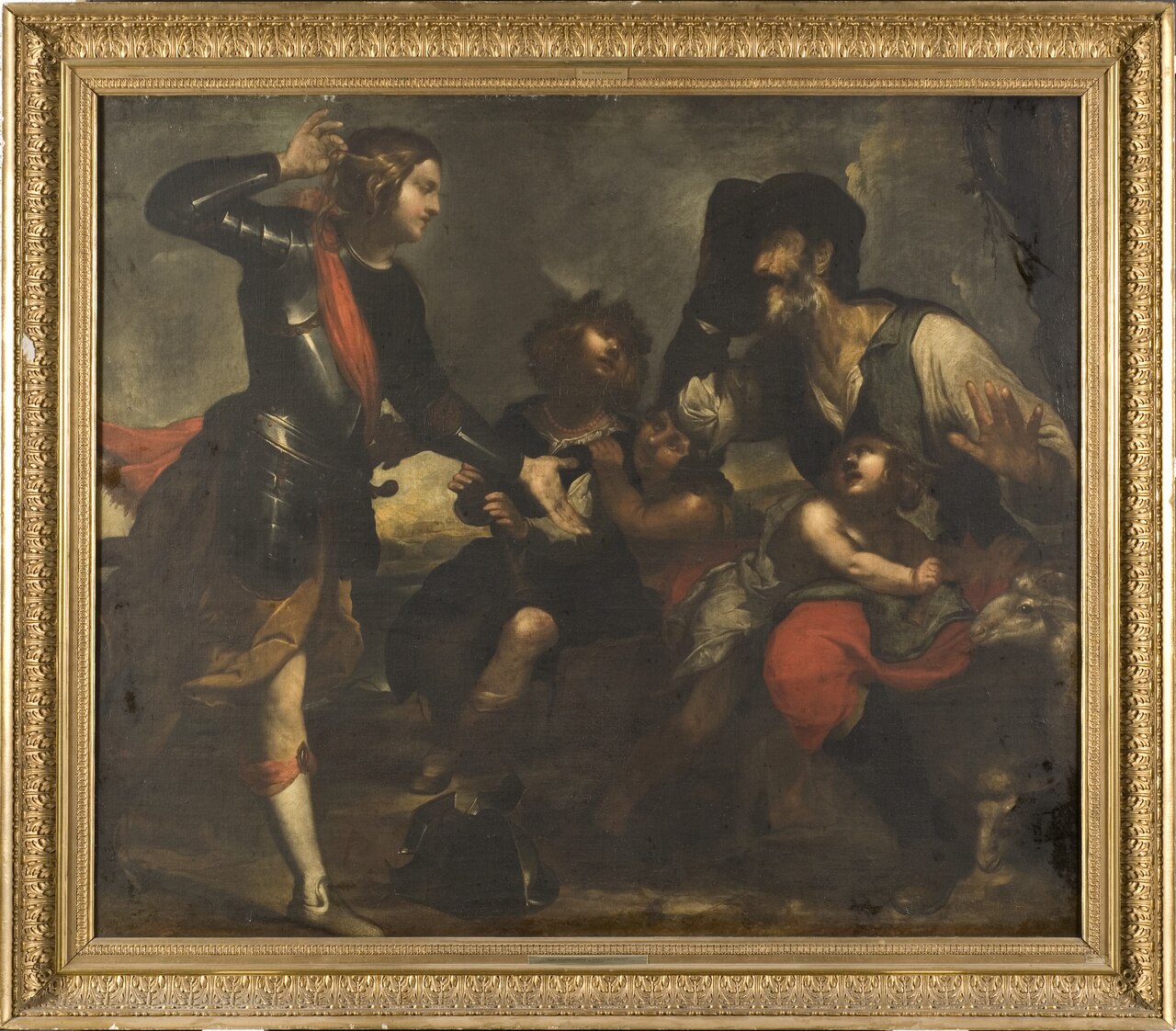
- Erminia and the Shepherds – Although undated, this composition diverges from the strictly religious repertoire by illustrating a literary subject drawn from Torquato Tasso’s epic poetry. The pastoral setting, softened lighting, and gentle interaction between Erminia and the shepherds reveal Ansaldo’s versatility and his capacity to adapt Baroque visual strategies to secular themes.
Influence and legacy Giovanni Andrea Ansaldo’s career coincided with a formative period in Genoese art, when the city was transitioning from late‑Renaissance ornamentalism to a more robust Baroque aesthetic. His works contributed to this shift by introducing a heightened sense of drama while preserving the decorative elegance prized by local patrons. Though he did not achieve the fame of later Genoese masters such as Bernardo Strozzi, his paintings provided a template for integrating narrative intensity with refined colour and architectural precision.
Later artists in Genoa and the wider Ligurian region drew upon Ansaldo’s compositional formulas and lighting techniques, especially his use of focused illumination to highlight sacred figures. The preservation of several of his canvases in prominent churches attests to his lasting relevance within the city’s religious visual culture. Scholars today regard Ansaldo as an essential, if under‑recognised, figure in the early Baroque narrative, whose oeuvre bridges the gap between the restrained piety of the late 16th century and the exuberant theatricality that would dominate the mid‑17th century.
In contemporary art‑historical scholarship, Ansaldo is often cited as an example of how regional artists assimilated broader European trends while retaining local identities. His surviving works continue to be studied for their technical finesse, compositional clarity, and the way they encapsulate the spiritual and cultural currents of early 17th‑century Genoa.
Frequently asked questions
Who was Giovanni Andrea Ansaldo?
Giovanni Andrea Ansaldo (1584–1638) was a Baroque painter who worked mainly in Genoa, creating religious canvases such as the Deposition (1615) and a series of saintly compositions in the 1620s.
What artistic movement did Ansaldo belong to?
He is associated with the Baroque movement, characterised by dramatic lighting, dynamic composition, and emotional intensity, adapted to the decorative traditions of Genoese art.
What are his most famous works?
His best‑known works include the Deposition (1615), Saint Charles Borromeo in Glory with stories from his life (1620), the quartet of Saints Peter, Erasmus, Clare of Assisi and Catherine of Alexandria (1622), Saint Julian the Hospitaller (1620), and the secular scene Erminia and the Shepherds.
Why is Ansaldo important in art history?
Ansaldo helped usher Genoa from late‑Renaissance ornamentation into a more dramatic Baroque style, influencing later regional artists and providing a bridge between restrained piety and the exuberant theatricality of mid‑17th‑century painting.
How can I recognise an Ansaldo painting?
Look for strong chiaroscuro, a disciplined yet expressive use of colour, precise architectural perspective, and a calm, dignified portrayal of holy figures that together create a balanced, narrative‑driven composition.