Gerard de Lairesse
1641 – 1711
In short
Gerard de Lairesse (1641–1711) was a Dutch Republic painter of the Baroque era, renowned for his classicising history paintings and influential art treatises. He worked in Amsterdam, where he helped shape 18th‑century Dutch art through both his canvases and his writings on drawing and composition.
Notable works


Early life Gerard de Lairesse was born in 1641 in Liège, a city that at the time lay within the Prince‑bishopric of Liège, part of the Holy Roman Empire. Little is recorded about his family background, but it is clear that he received a broad education that extended beyond the visual arts to include music, poetry and theatre. As a young man he moved to the Dutch Republic, a centre of artistic activity, where he would eventually settle in Amsterdam. The relocation placed him in a vibrant artistic environment that was still dominated by the legacy of Rembrandt, yet beginning to open to the classicising currents that were spreading from France and Italy.
Career and style De Lairesse’s career unfolded during the latter half of the Dutch Golden Age, a period when the market for large‑scale history paintings was expanding. He quickly distinguished himself by adopting a classicising style that drew heavily on the French Academy and Italian Renaissance models. Influences from the Perugian theorist Cesare Ripa, whose *Iconologia* provided a symbolic lexicon for allegorical subjects, are evident in de Lairesse’s careful use of emblematic figures. French classicist painters such as Charles le Brun and Simon Vouet also shaped his approach, as did the dramatic narrative techniques of playwrights Pierre Corneille and Jean Racine.
Unlike the chiaroscuro and introspective realism associated with Rembrandt, de Lairesse favoured a brighter palette, clear outlines, and a compositional balance that reflected the ideals of French classicism. His figures are idealised, muscular and poised, often placed within architecturally ordered settings that reinforce the moral or heroic themes of the narrative. This shift toward a more intellectual, didactic art resonated with a growing Dutch elite that sought to align itself with the broader European taste for history painting and classical learning.
Signature techniques De Lairesse’s technique combined precise drawing with a smooth, almost polished finish. He employed a layered approach to paint, beginning with a detailed underdrawing that established the anatomical correctness and spatial relationships of the figures. Over this foundation he applied thin glazes of oil, allowing colour to build up subtly without the heavy impasto typical of earlier Dutch masters. This method produced a luminous surface in which the flesh tones and drapery appear both natural and idealised.
His handling of light is controlled rather than atmospheric; illumination often comes from an implied external source that highlights the main subjects while casting softer shadows in the background. This creates a sense of clarity and order, reinforcing the narrative focus. In addition, de Lairesse paid meticulous attention to the rendering of classical architecture, using linear perspective to situate his figures within grandiose settings that underscore their heroic status.
Major works De Lairesse’s oeuvre includes a number of celebrated history paintings that exemplify his classicising vision. **The Banquet of Cleopatra (1677)** captures the legendary Egyptian queen’s opulent feast, with sumptuous textiles and a composition that balances drama and decorum. The work demonstrates his skill in rendering luxurious materials and his fascination with historic themes.
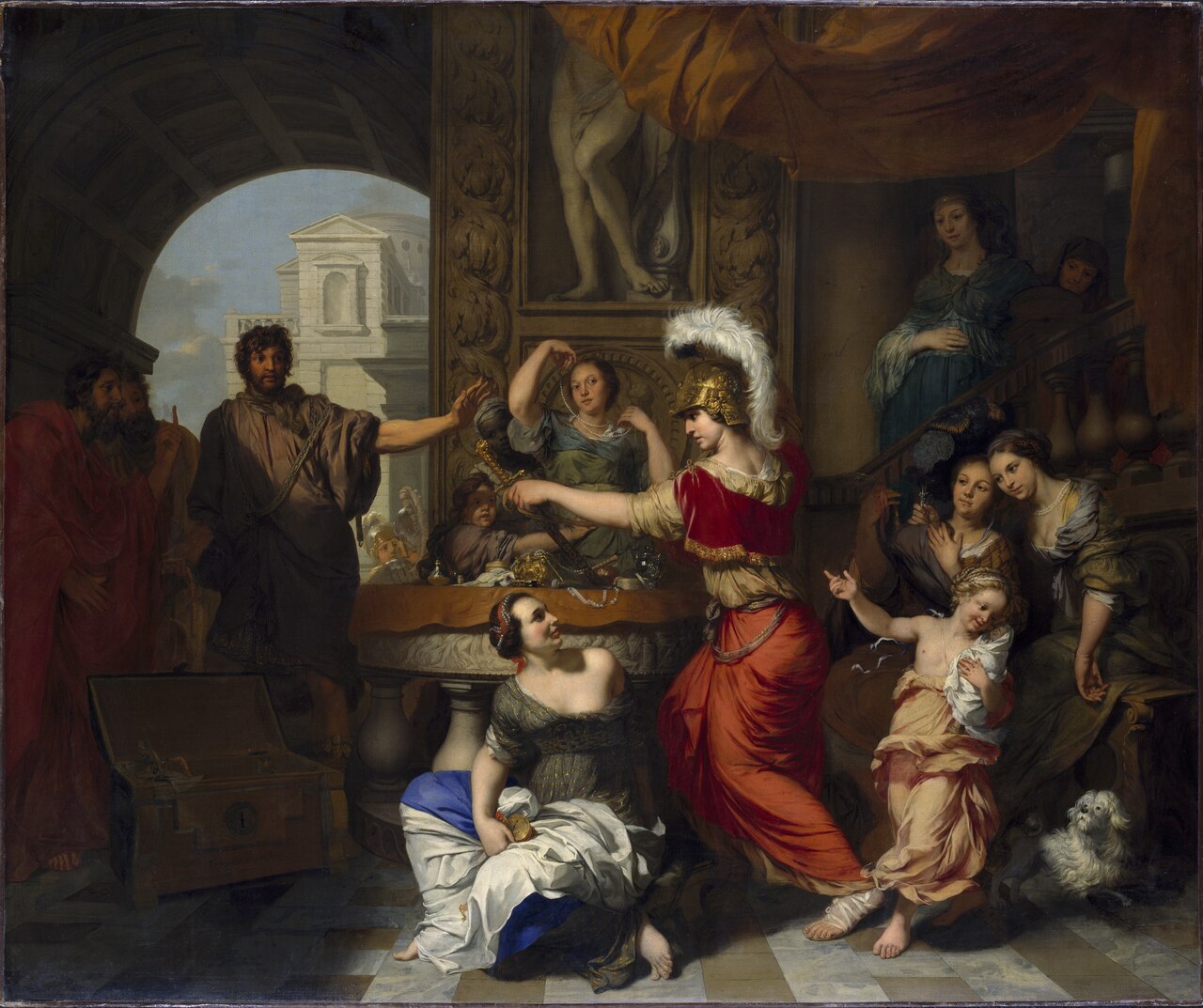
Achilles Discovered among the Daughters of Lycomedes (1685) and its earlier version Achilles Discovered Amongst the Daughters of Lycomedes (1675) both portray the mythic hero’s exposure at the court of Lycomedes. In these paintings, de Lairesse emphasizes the physical perfection of Achilles, using a restrained colour scheme that highlights the hero’s muscular form against a subdued background.
Antiochus and Stratonice (1671) presents a poignant moment from Hellenistic history, where the king Antiochus, stricken by forbidden love, is confronted by his mother Stratonice. De Lairesse captures the emotional tension through careful facial expressions and a composition that draws the viewer’s eye to the central figures.
Selene and Endymion (1680) offers a mythological scene of the moon goddess Selene visiting the sleeping shepherd Endymoon. The painting showcases de Lairesse’s ability to convey sensuality within a classical framework, using soft lighting to accentuate the dreamlike atmosphere.
These works collectively illustrate de Lairesse’s commitment to narrative clarity, idealised anatomy, and the moralising potential of history painting. They also reflect his engagement with contemporary literary sources, translating dramatic texts into visual form.
Influence and legacy Beyond his canvases, Gerard de Lairesse left a lasting imprint through his theoretical writings. His *Grondlegginge Ter Teekenkonst* (1701) and *Groot Schilderboek* (1707) codified a geometry‑based approach to drawing, advocating a disciplined study of proportion, perspective and anatomy. These treatises became standard references for aspiring painters in the eighteenth century, shaping the curriculum of Dutch academies and influencing artists who sought to align their work with the rationalist ideals of the Enlightenment.
De Lairesse’s classicising style helped bridge the late Dutch Golden Age with the emerging Rococo and Neoclassical movements. While his popularity waned with the rise of Romanticism, his emphasis on academic rigor and his synthesis of French and Italian influences continued to inform Dutch artistic practice well into the 1700s. Today, his paintings are valued for their technical mastery, their elegant reinterpretation of classical subjects, and their role in the transition from the Baroque to the more restrained aesthetic of the eighteenth century.
In summary, Gerard de Lairesse stands as a pivotal figure who combined the intellectual currents of his time with a refined visual language, leaving both a corpus of distinguished works and a theoretical legacy that shaped subsequent generations of Dutch artists.
Frequently asked questions
Who was Gerard de Lairesse?
Gerard de Lairesse (1641–1711) was a Dutch Republic painter of the Baroque period, known for his classicising history paintings and influential art treatises.
What style or movement is he associated with?
He worked in a classicising Baroque style, drawing on French classicism and Italian Renaissance models while moving away from the Dutch realism of Rembrandt.
What are his most famous works?
His best‑known paintings include *The Banquet of Cleopatra* (1677), *Achilles Discovered among the Daughters of Lycomedes* (1685 and 1675), *Antiochus and Stratonice* (1671) and *Selene and Endymion* (1680).
Why does he matter in art history?
De Lairesse shaped 18th‑century Dutch art through his paintings and his treatises on drawing, which promoted a disciplined, geometry‑based approach that influenced academies and painters across Europe.
How can I recognise a de Lairesse painting?
Look for idealised, muscular figures, clear outlines, a smooth finish, balanced composition, and a restrained colour palette that highlights classical architecture and narrative clarity.