George Bernard O'Neill
1828 – 1917
In short
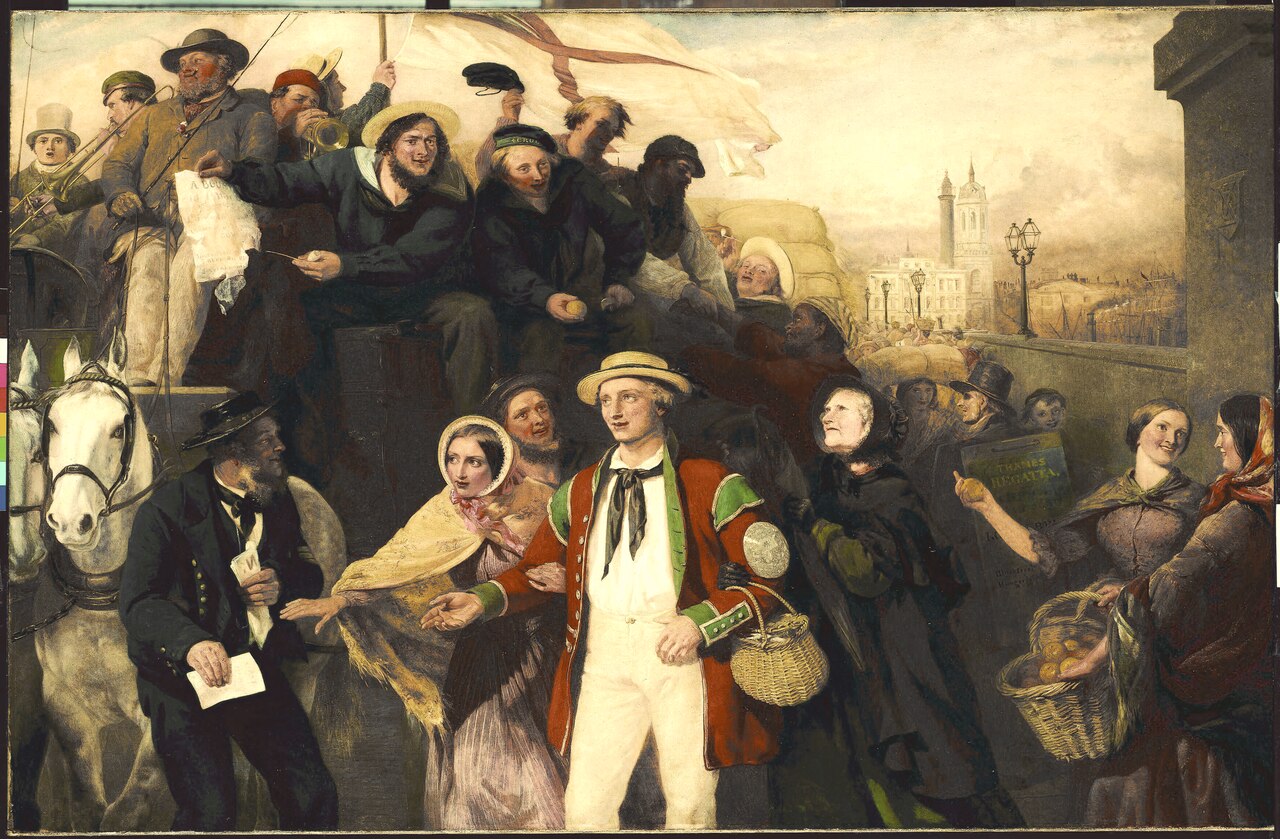
George Bernard O'Neill (1828–1917) was an Irish genre painter who spent most of his career in England, becoming a prominent member of the Cranbrook Colony from 1859 until his death in London. He is best known for narrative domestic scenes such as The Foundling (1852) and Manning the Navy (1860).
Notable works

_-_The_Foundling_-_N00618_-_National_Gallery.jpg)


Early life George Bernard O'Neill was born in Dublin in 1828 to a family that, while not aristocratic, valued education and the arts. Little is recorded about his childhood, but Dublin’s vibrant artistic milieu in the early‑19th century would have offered him exposure to the works of Irish portraitists and the emerging genre tradition. O'Neill’s early training is believed to have taken place in local academies, where he honed drawing skills that later became a hallmark of his work. By his early twenties he had moved to England, a common path for Irish artists seeking broader patronage and professional networks.
Career and style Settling in England, O'Neill quickly aligned himself with the emerging Victorian genre movement, which emphasized narrative scenes of everyday life, moral tales, and sentimental domesticity. In 1859 he was invited to join the Cranbrook Colony, a loosely organised group of artists based in Kent who shared a commitment to painting rural and domestic subjects with a realistic yet idealised touch. The colony’s collaborative environment encouraged O'Neill to develop a style that combined meticulous observation with a gentle, often humorous, storytelling tone.
O'Neill’s paintings are characterised by clear, well‑composed narratives that often involve children, family gatherings, or moments of quiet moral reflection. He favoured a palette of muted earth tones punctuated by brighter accents to draw the viewer’s eye to focal actions. Although he never formally aligned with a single artistic manifesto, his work reflects the broader Victorian sensibility that prized moral instruction, technical proficiency, and an accessible visual language.
Signature techniques O'Neill’s technique rested on a solid foundation in drawing, a skill he continually refined through life‑study and the observation of everyday objects. His brushwork is generally restrained; he employed fine, controlled strokes for details such as lace, textiles, and facial expressions, while broader, softer washes rendered background atmospheres. Light plays a crucial role in his compositions, often entering from a single source—typically a window or a lamplit interior—to illuminate the central action and create subtle chiaroscuro effects.
Another hallmark of O'Neill’s practice is his use of narrative framing. He commonly placed the main figures slightly off‑centre, allowing secondary characters or objects to contribute to the story without overwhelming the primary focus. This compositional balance, coupled with a careful rendering of period costume and interior décor, lends his works an authenticity that resonated with Victorian audiences.
Major works - **The Foundling (1852)** – One of O'Neill’s earliest recognized pieces, this painting depicts a compassionate caregiver cradling an abandoned infant. The tender interaction, softened lighting, and meticulous rendering of the caregiver’s hands underscore O'Neill’s ability to convey emotion through subtle gesture. - **Manning the Navy (1860)** – A lively domestic scene in which a young boy assists his father with naval preparations. The composition juxtaposes the disciplined routine of military life with the innocence of childhood, a recurrent theme in O'Neill’s oeuvre. - **James Hall Nasmyth (1874)** – A portrait of the noted engineer, illustrating O'Neill’s competence beyond genre scenes. The work captures Nasmyth in a thoughtful pose, set against a backdrop of engineering drawings, highlighting O'Neill’s capacity to integrate professional context into portraiture. - **A Deathbed Scene** – A somber tableau that portrays a family gathered around a dying figure. The painting’s restrained colour scheme and careful attention to the expressions of grief communicate the Victorian preoccupation with mortality and familial duty. - **Group Inspecting Boy’s Drawing** – This work shows a group of adults reviewing a young boy’s sketch. The scene reflects O'Neill’s interest in education and artistic development, emphasizing the nurturing role of community in creative pursuits.
Each of these works exemplifies O'Neill’s narrative focus, technical skill, and his ability to blend moral undertones with everyday realism.
Influence and legacy George Bernard O'Neill’s long career, spanning more than six decades, positioned him as a bridge between early Irish genre painting and the mature Victorian art market. While he never achieved the fame of contemporaries such as William Holman Hunt, his contributions to the Cranbrook Colony helped define a regional style that celebrated ordinary life with dignity and charm. His paintings were regularly exhibited at the Royal Academy and other London venues, securing a respectable commercial reputation during his lifetime.
In the decades following his death in London in 1917, O’Neill’s work experienced periodic reassessment, particularly as scholars of Irish diaspora art sought to trace the influence of Irish artists in Britain. His careful draftsmanship and narrative clarity have informed later genre painters and illustrators, especially those working in book illustration where storytelling through image is paramount.
Today, O’Neill’s paintings are held in several public collections, including regional museums in Kent and Dublin, and they continue to appear in auction houses that specialise in Victorian art. His legacy endures as an exemplar of the genre painter who combined technical competence with a compassionate eye for the human condition, offering modern viewers a window onto 19th‑century social values and domestic life.
Frequently asked questions
Who was George Bernard O'Neill?
George Bernard O'Neill (1828–1917) was an Irish genre painter who worked mainly in England and became a key member of the Cranbrook Colony of artists.
What artistic style or movement is he associated with?
He is linked to Victorian genre painting, a style that emphasizes narrative domestic scenes, moral storytelling, and realistic detail.
What are his most famous works?
His most noted paintings include The Foundling (1852), Manning the Navy (1860), James Hall Nasmyth (1874), A Deathbed Scene, and Group Inspecting Boy’s Drawing.
Why is George Bernard O'Neill important in art history?
He helped define the Cranbrook Colony’s approach to genre painting, offering a compassionate view of everyday life that influenced later illustrators and contributed to the broader Victorian visual culture.
How can I recognise a painting by George Bernard O'Neill?
Look for carefully drawn figures, soft but detailed lighting, domestic or moral narratives, and a balanced composition where secondary elements support a central, emotionally resonant scene.