George Arnald
1763 – 1841
In short
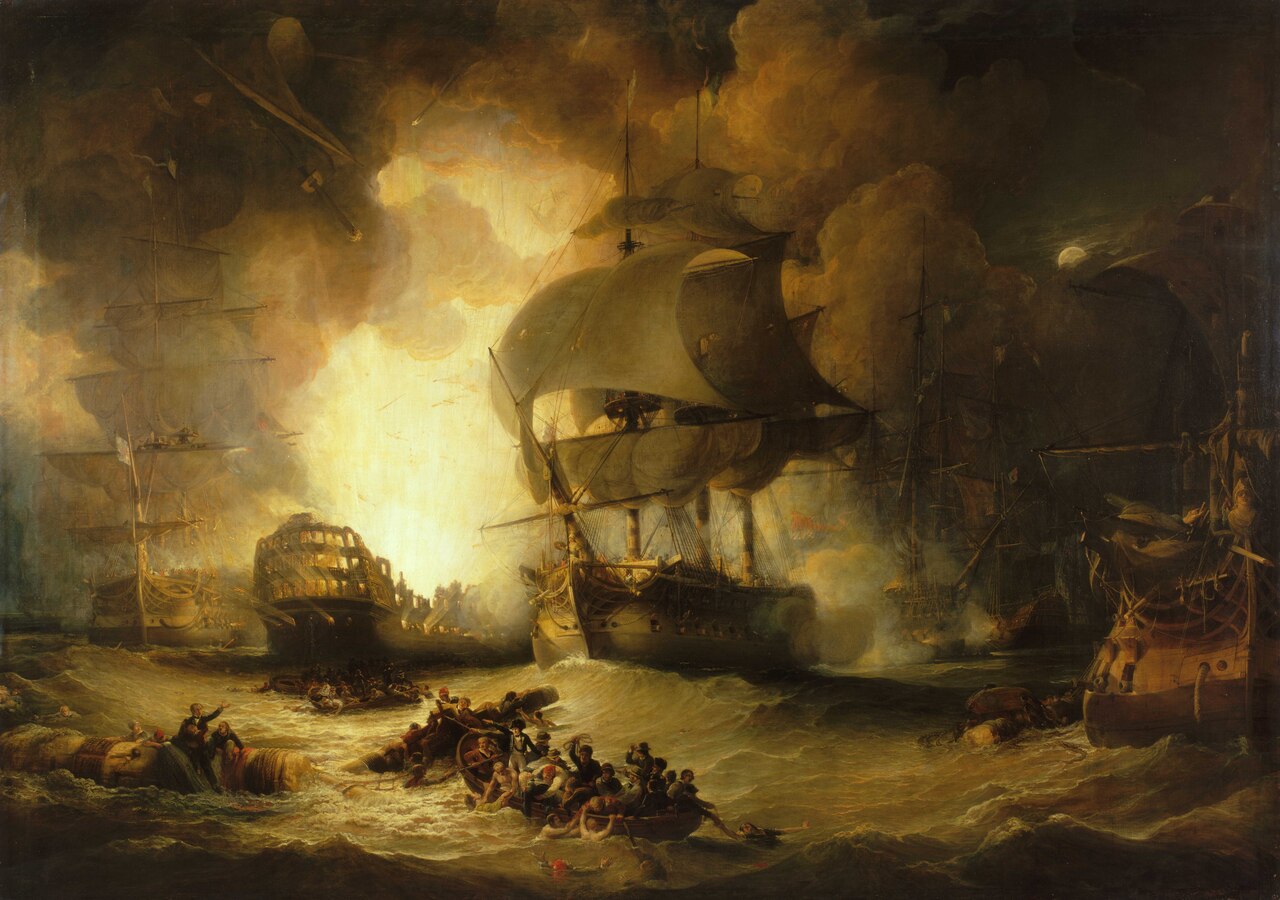
George Arnald (1763–1841) was a British realist painter renowned for his topographical landscapes and his celebrated depiction of the Battle of the Nile. He worked mainly in the early 19th century, producing works that combined accurate detail with dramatic narrative.
Notable works


_-_View_on_the_Ouse_at_York_-_NG1156_-_National_Gallery.jpg)
_-_Travellers_in_a_Mountain_Landscape_-_290239_-_National_Trust.jpg)
Early life George Arnald was born in 1763 in Berkshire, England, during the reign of George III. Little is recorded about his family background or formal education, but contemporary accounts suggest that he received a basic schooling before turning to the visual arts. Growing up in a rural county, Arnald was exposed to the English countryside, an environment that would later inform his preference for landscape subjects. By his early twenties he had moved to London, the centre of British artistic activity, where he sought apprenticeship opportunities and began to develop his craft.
Career and style Arnald’s professional career unfolded at a time when topographical painting was in demand for illustrated county histories and travel literature. He secured commissions from publishers and private patrons who required accurate depictions of towns, rivers, and countryside scenes. Although the prevailing artistic climate still favoured the grand historical genre, Arnald aligned himself with the realist tendency that emphasized faithful observation of nature. His work demonstrates a careful balance between documentary precision and compositional elegance, reflecting the influence of earlier British landscape artists such as Thomas Gainsborough and John Constable, while also anticipating the later Victorian appetite for detailed panoramas.
Signature techniques Arnald’s technique combined meticulous drawing with a restrained palette. He typically prepared his compositions with detailed sketches on site, capturing the exact placement of architectural features, foliage, and water. In the studio, he rendered these sketches in oil, building up layers of thin glazes to achieve atmospheric depth. Light is often rendered with a soft, diffused quality that highlights the horizon line, a hallmark of his realist approach. He also employed a subtle use of colour modulation, favouring earthy greens, muted blues, and warm ochres, which allowed the viewer to focus on the structural integrity of the scene rather than on flamboyant chromatic effects.
Major works - **A Western View of part of Westminster and Bird Cage Walk taken from the Mill House... (1808)** – This painting captures a bustling section of Westminster viewed from a riverside perspective. Arnald’s attention to architectural detail, such as the silhouettes of domed churches and the intricate ironwork of the Bird Cage Walk, exemplifies his skill in integrating urban elements into a broader landscape context. - **George Arnald (1831)** – Though the title suggests a self‑portrait, the work is generally understood to be a later portrait of the artist himself, produced near the end of his career. The painting reflects a mature, introspective style, with a subdued background that foregrounds the sitter’s expression and attire. - **View on the Ouse at York (1803)** – This topographical piece illustrates the River Ouse as it winds past the historic city of York. Arnald’s rendering of the water’s surface, with delicate reflections of the surrounding stone buildings, demonstrates his command of light and atmosphere. The composition is notable for its balanced perspective, guiding the viewer’s eye from the foreground riverbank to the distant skyline. - **The Destruction of 'L'Orient' at the Battle of the Nile, 1 August 1798 (1826)** – Arguably Arnald’s most celebrated work, this large‑scale historical painting dramatizes the British victory over the French flagship L’Orient. Arnald blends his realist sensibility with theatrical narrative, depicting the exploding ship amidst a turbulent sea while maintaining a high degree of factual accuracy in the ships’ rigging and the surrounding coastline. The painting was widely reproduced in prints and helped cement his reputation as a painter capable of handling both topographical detail and epic subject matter. - **Travellers in a Mountain Landscape (1804)** – In this composition, a small group of figures traverses a rugged alpine setting, providing a human scale to the imposing natural environment. The work showcases Arnald’s ability to render atmospheric perspective, with distant peaks softened by mist, and illustrates his interest in the interaction between people and landscape.
Influence and legacy George Arnald’s oeuvre occupies a distinctive niche within early‑19th‑century British art. While he never achieved the fame of contemporaries such as J. M. W. Turner, his meticulous topographical paintings contributed to the visual documentation of England’s changing geography during the Industrial Revolution. His realistic approach influenced later illustrators who worked on county histories and travel guides, establishing a visual standard for accuracy that persisted throughout the Victorian era. The Battle of the Nile composition, in particular, demonstrated that a realist painter could successfully handle large historical narratives, a precedent that informed subsequent historical painters. Today, Arnald’s works are held in several public collections, and his paintings continue to be referenced by scholars studying the development of British landscape and historical painting.
Overall, Arnald’s legacy is that of a diligent observer who combined scientific exactness with aesthetic composition, providing future generations with both artistic pleasure and valuable visual records of early 19th‑century Britain.
Frequently asked questions
Who was George Arnald?
George Arnald (1763–1841) was a British painter known for realistic landscapes and topographical views, best remembered for his depiction of the Battle of the Nile.
What style or movement did he belong to?
Arnald worked within the realist tradition, focusing on accurate observation of nature and architecture while occasionally addressing historical subjects.
What are his most famous works?
His most celebrated paintings include 'The Destruction of L'Orient at the Battle of the Nile' (1826), 'View on the Ouse at York' (1803), and the topographical piece 'A Western View of part of Westminster and Bird Cage Walk' (1808).
Why does George Arnald matter in art history?
He provided a bridge between documentary topography and narrative history painting, influencing later illustrators of county histories and demonstrating that realistic technique could serve grand historical themes.
How can I recognise a painting by George Arnald?
Look for precise architectural detail, a muted earthy palette, soft atmospheric lighting, and a balanced composition that often places human figures or ships within a meticulously rendered landscape.