François Lemoyne
1688 – 1737
In short
François Lemoyne (1688–1737) was a French Rococo painter, winner of the Prix de Rome, professor at the Académie royale, and Premier peintre du Roi to Louis XV, known for grand mythological canvases such as Perseus and Andromeda.
Notable works


.jpg)

Early life
François Lemoyne was born in Paris in 1688. Little is recorded about his parents, but the artistic environment of the capital provided ample opportunity for early exposure to drawing and painting. He entered the ateliers of the Académie royale de peinture et de sculpture as a teenager, where he received the rigorous academic training that characterised French art education in the late 17th century.
His talent was recognised early on, and he secured the prestigious Prix de Rome, granting him a scholarship to study in Italy. The Italian journey, typical for French academicians, allowed Lemoyne to study the works of Raphael, Poussin and the emerging Baroque masters, experiences that would later inform his synthesis of classical composition and Rococo lightness.
Career and style
Upon his return to Paris in the early 1710s, Lemoyne quickly established himself as a painter of large‑scale mythological and historical subjects. He was admitted as a full member of the Académie and, in 1721, was appointed professor, a role that placed him at the centre of academic training. His appointment as Premier peintre du Roi to Louis XV in 1733 marked the apex of his official career, making him responsible for royal decorative programmes and reinforcing the court’s taste for elegant, decorative painting.
Lemoyne’s style is firmly rooted in the Rococo movement, yet it retains a strong classical underpinning. He combined the fluid, pastel colour palette and decorative motifs typical of Rococo with the balanced compositions and anatomical precision of the French Baroque tradition. This hybrid approach produced works that are both graceful and monumental, a quality that appealed to the aristocratic patrons of the time.
Signature techniques
Lemoyne’s technique rested on a refined drawing foundation. He employed a loose, yet accurate, preparatory sketch that was later refined with a delicate underpainting in warm earth tones. Over this, he applied thin glazes of luminous colour, allowing the underlying drawing to show through and creating a sense of depth without heavy impasto.
His handling of light is a hallmark of his oeuvre. By modelling figures with subtle gradations of light and shadow, he achieved a soft, almost silvery sheen that enhances the ethereal quality of mythological narratives. In addition, Lemoyne often used a limited palette of rose, ivory, and pale blue, punctuated by richer reds or golds to draw the viewer’s eye to focal points.
The compositional rhythm in his canvases reveals a careful orchestration of diagonal lines and curving forms, a strategy that guides the eye across the picture plane while preserving a sense of harmonious balance. This approach, coupled with his skillful rendering of drapery, contributes to the graceful movement that characterises his figures.
Major works
Perseus and Andromeda (1726) – This canvas illustrates the heroic rescue of Andromeda, showcasing Lemoyne’s ability to merge dynamic action with a serene, almost lyrical atmosphere. The figures are rendered with precise anatomy, while the soft, pastel background reinforces the Rococo sensibility.
Continence of Scipio (1726) – Depicting the Roman general Scipio’s magnanimous gesture toward a captive woman, the work demonstrates Lemoyne’s skill in conveying moral virtue through elegant composition. The balanced arrangement of the central figures and the subtle use of colour underscore the narrative’s dignified tone.
Narcissus (1728) – In this mythological scene, Lemoyne captures the moment of self‑contemplation with a delicate interplay of light on water and flesh. The painting’s muted palette and refined brushwork exemplify his mature Rococo style.
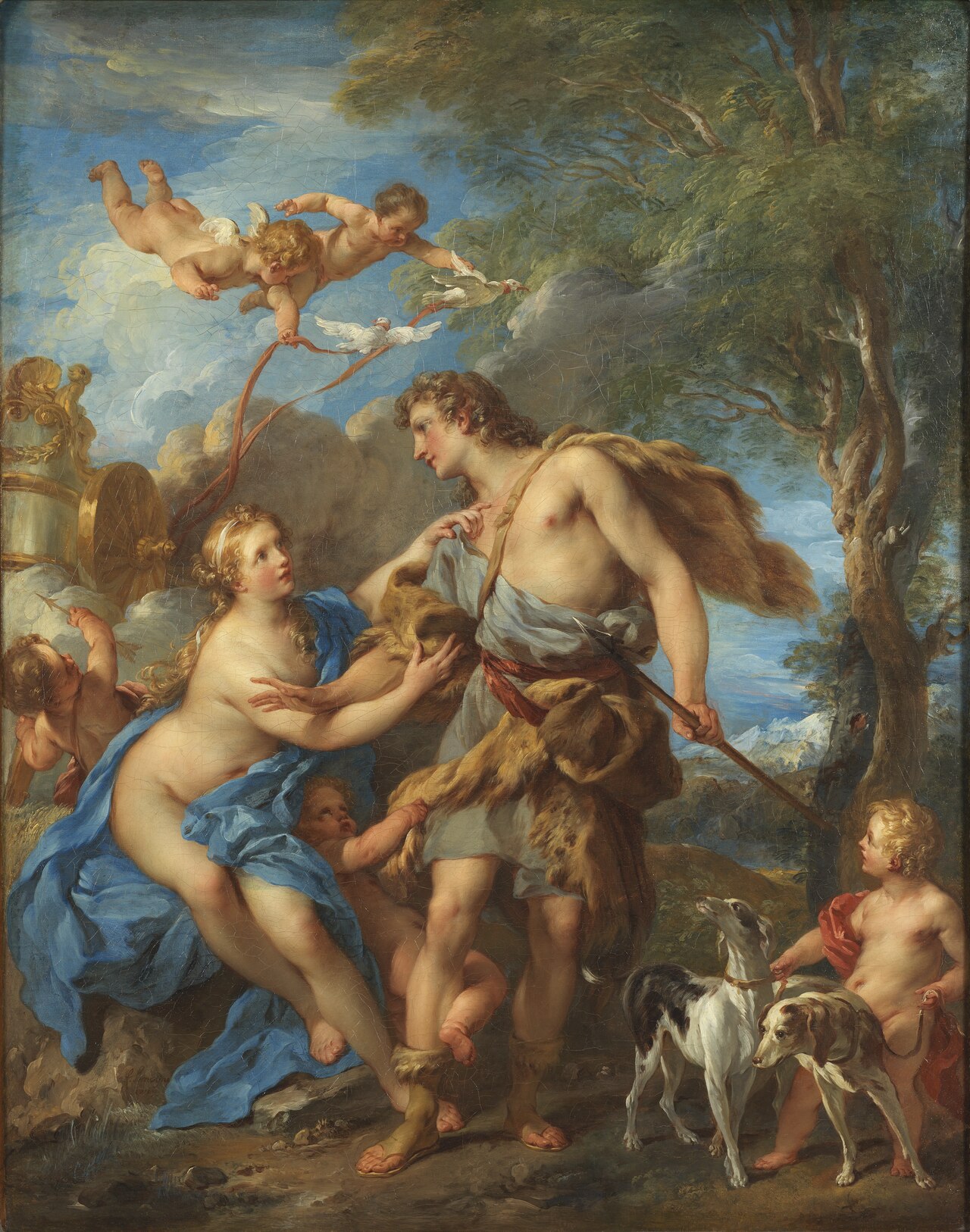
Venus and Adonis (1729) – Here Lemoyne presents the tragic love story with a focus on sensuality and movement. The fluid drapery and the luminous skin tones reveal his mastery of texture, while the composition’s diagonal thrust creates an emotional tension.
The Apotheosis of Hercules (1731) – This monumental work, executed for a royal commission, celebrates the deification of Hercules. Lemoyne employs a grandiose scale, a complex arrangement of mythological figures, and a luminous colour scheme that elevates the heroic narrative to an almost celestial realm.
These works collectively illustrate Lemoyne’s capacity to handle both intimate mythological moments and expansive allegorical programmes, cementing his reputation as a leading painter of the French Rococo.
Influence and legacy
Lemoyne’s impact on French art extended beyond his own canvases. As a professor at the Académie, he mentored a generation of artists, most notably Charles‑Joseph Natoire and François Boucher, both of whom would become leading Rococo painters in their own right. His synthesis of classical structure with Rococo delicacy provided a model for the decorative painting that dominated the French court in the mid‑18th century.
Although his career was cut short by his tragic death in 1737, Lemoyne’s contributions to the visual language of the period endured. His works continued to be exhibited in royal palaces and later entered public collections, influencing the taste of collectors and the curricula of academic institutions. Modern scholarship regards him as a pivotal figure who bridged the Baroque grandeur of the 17th century with the lighter, ornamental aesthetic that defined the Rococo era.
In contemporary art‑history discourse, Lemoyne is celebrated for his technical brilliance, his elegant handling of mythological subject matter, and his role in shaping the visual culture of Louis XV’s reign. His paintings remain essential reference points for scholars examining the transition from academic classicism to the more playful, decorative sensibilities that characterised the later 18th century.
Frequently asked questions
Who was François Lemoyne?
François Lemoyne (1688–1737) was a French Rococo painter, winner of the Prix de Rome, professor at the Académie royale, and Premier peintre du Roi to Louis XV.
What artistic movement did Lemoyne belong to?
He worked within the Rococo movement, combining its pastel colour palette and decorative elegance with a classical compositional rigor.
What are Lemoyne’s most famous works?
His best‑known paintings include Perseus and Andromeda (1726), Continence of Scipio (1726), Narcissus (1728), Venus and Adonis (1729) and The Apotheosis of Hercules (1731).
Why is Lemoyne important in art history?
He helped define the visual language of the French Rococo, taught influential artists such as François Boucher, and bridged the Baroque tradition with the lighter, decorative style of the mid‑18th century.
How can I recognise a Lemoyne painting?
Look for graceful mythological scenes rendered with soft pastel tones, delicate glazes, finely drawn anatomy, and an elegant composition that balances movement with a serene, decorative atmosphere.