François de Nomé
1593 – 1640
In short
François de Nomé (1593–1640) was a French Baroque painter who spent most of his career in Naples, noted for his fantastical, ruin‑filled landscapes that blend architectural imagination with dramatic chiaroscuro.
Notable works
.jpg)


Early life François de Nomé was born in 1593 in Metz, a city in the Lorraine region of France. Little is recorded about his family background or early artistic training, but the artistic climate of early‑17th‑century Metz, which lay on the route between the Flemish and Italian art centres, would have exposed him to a range of Northern and Southern influences. By his early twenties he had moved to Italy, a common step for aspiring French painters seeking exposure to the flourishing Baroque scene. He settled in Naples, a bustling port city that attracted a diverse community of foreign artists.
Career and style In Naples de Nomé established himself as a painter of imaginative, often nightmarish scenes. His work belongs to the broader Baroque movement, characterised by dramatic lighting, vigorous composition and an emphasis on emotional intensity. However, de Nomé carved a niche by focusing on capriccio – a genre that blends real and invented architectural elements into fantastical landscapes. His paintings typically depict decaying classical ruins, crumbling towers and desolate vistas populated by tiny, often anonymous figures. The overall effect is one of melancholy grandeur, a visual meditation on the transience of human achievement.
Signature techniques De Nomé’s technique rests on several recurring devices. He employed a stark chiaroscuro that heightens the sense of depth and creates a theatrical contrast between illuminated ruins and shadowed foregrounds. His brushwork is precise in the rendering of stone and architectural detail, yet looser in the treatment of atmospheric elements such as clouds and distant terrain. Figures are rendered on a reduced scale, serving more as narrative cues than focal points. Colour palettes are dominated by earth tones – ochres, burnt siennas and deep umbers – punctuated by occasional flashes of crimson or gold that draw the eye to key narrative moments.
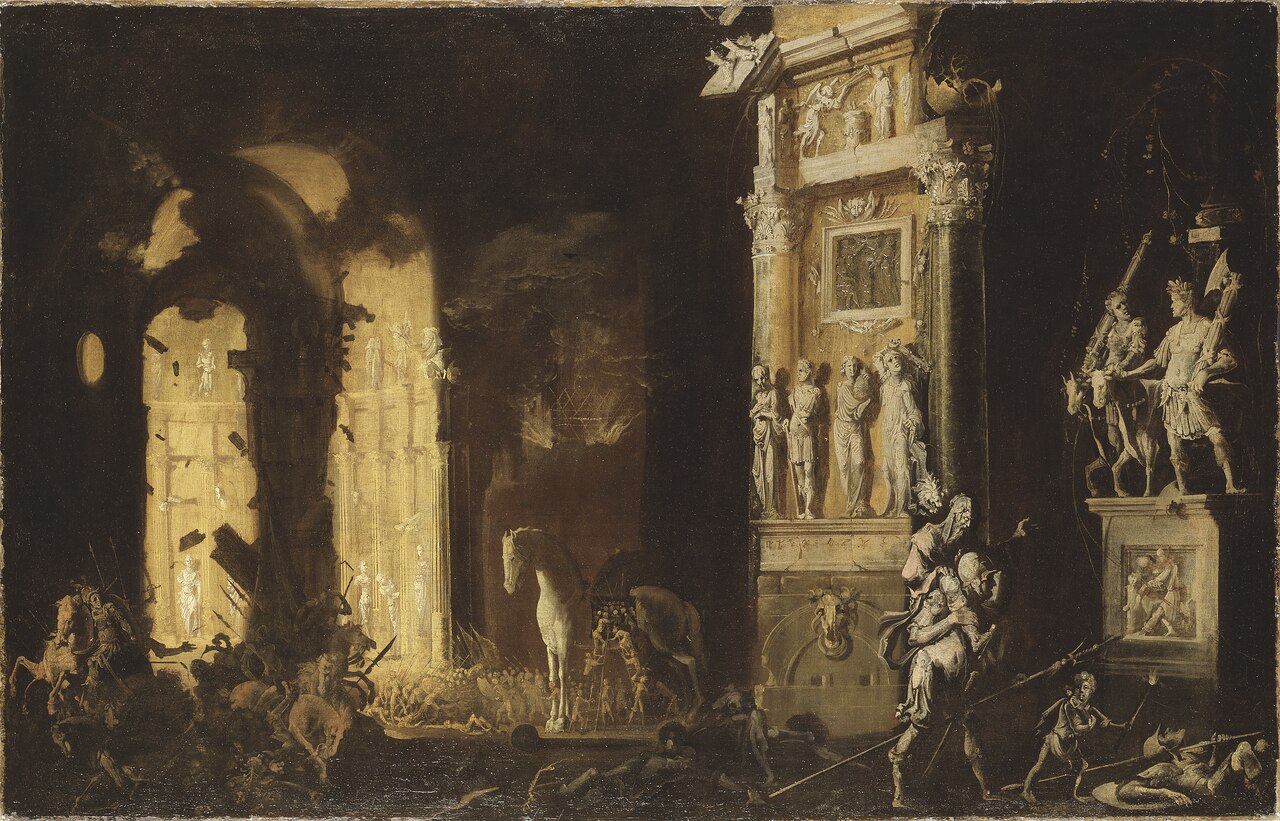
Major works - **Hell (1622)** – This early work presents a chaotic infernal landscape populated by tormented souls amid twisted, ruinous architecture. The composition is anchored by a towering, broken column that dominates the centre, while flickering light from unseen flames creates a searing contrast. - **The Burning of Troy with the Flight of Aeneas and Anchises** – In this canvas de Nomé merges historical drama with his signature ruinous setting. The city of Troy is rendered as a crumbling citadel, its walls collapsing under the weight of fire. Aeneas and Anchises are barely discernible among the fleeing masses, emphasizing the overwhelming scale of destruction. - **Landscape with Fantastic Ruins (1625)** – Perhaps the most representative of his capriccio style, this painting depicts a desolate valley strewn with shattered columns, arches and broken statues. A lone, diminutive figure walks along a winding path, underscoring the painting’s contemplative mood. - **Martyrdom of a Saint (1725)** – The date attached to this work post‑dates de Nomé’s death, and scholars treat the attribution with caution. The composition nevertheless follows his established formula: a dramatic narrative set against a backdrop of ruined architecture, illuminated by a stark light source that accentuates the saint’s suffering. - **Landscape with Roman Ruins (1725)** – Similarly, the 1725 dating suggests a later copy or workshop piece derived from de Nomé’s original designs. The painting displays the familiar blend of imagined Roman fragments and a bleak horizon, reinforcing the artist’s preoccupation with the decay of past grandeur.
Influence and legacy François de Nomé’s imaginative ruins exerted a lasting influence on the development of the capriccio genre in Italy and beyond. His approach anticipated the later work of Alessandro Salvini and, more directly, the 18th‑century vedutista Giovanni Battista Piranesi, whose engravings of Roman ruins echo de Nomé’s fascination with architectural decay. Though never achieving the fame of Caravaggio or the Carracci, de Nomé’s paintings contributed to a visual vocabulary that linked the Baroque’s dramatic intensity with a proto‑Romantic contemplation of ruin. Modern scholarship recognises his oeuvre as a vital bridge between the theatricality of early Baroque painting and the more reflective, antiquarian interests that blossomed in the Enlightenment.
Overall, de Nomé’s work remains a compelling study of how imagination can transform architectural fragments into powerful metaphors for human fragility. His paintings continue to be exhibited in European museums and are frequently cited in discussions of early modern landscape and architectural fantasy.
Frequently asked questions
Who was François de Nomé?
François de Nomé was a French Baroque painter (1593–1640) who worked mainly in Naples and is best known for his fantastical, ruin‑filled landscapes.
What artistic style or movement is he associated with?
He is linked to the Baroque period and specialised in the capriccio genre, creating imaginative scenes that combine dramatic lighting with decaying classical architecture.
What are his most famous works?
His most cited paintings include *Hell* (1622), *The Burning of Troy with the Flight of Aeneas and Anchises*, and *Landscape with Fantastic Ruins* (1625).
Why is François de Nomé important in art history?
He pioneered a distinctive vision of ruined architecture that influenced later artists such as Piranesi and helped shape the visual language of early modern landscape and architectural fantasy.
How can I recognise a painting by François de Nomé?
Look for stark chiaroscuro, tiny narrative figures, and a composition dominated by crumbling classical ruins set against a bleak horizon – often with a dramatic light source highlighting the decay.