François Bossuet
1798 – 1889
In short
François Bossuet (1798–1889) was a Belgian painter and draughtsman known for his detailed landscapes and cityscapes, especially of Spanish subjects. His works, such as A view of Córdoba (1845) and The Old Fish Market in Antwerp (1833), demonstrate a meticulous eye for architecture and atmosphere.
Notable works


_-_1850-A_-_Museum_of_Fine_Arts_Ghent_(MSK).jpg)
_-_A_Moorish_Gateway,_Ecija,_Spain_-_RCIN_400816_-_Royal_Collection.jpg)
Early life François‑Antoine Bossuet was born in 1798 in the historic town of Ypres, situated in the western part of what is now Belgium. Growing up in a region marked by the scars of the French Revolutionary wars and the subsequent reshaping of the Low Countries, he was exposed early to a blend of Flemish artistic traditions and the emerging Romantic sensibility that swept through Europe in the early nineteenth century. Details of his family background and formal training are scarce, but it is clear that he pursued a career in the visual arts, developing skills both as a painter and as a draughtsman. The Belgian art scene of his youth was characterised by a revival of interest in realistic depictions of daily life and a renewed fascination with the natural world, which would later inform Bossuce’s own artistic concerns.
Career and style Bossuet’s professional life unfolded during a period of rapid change in European art. While the dominant currents in Belgium during the 1820s and 1830s included Romanticism, Realism and the nascent Belgian School of landscape painting, Bossuet never attached himself to a single movement. Instead, his work reflects a synthesis of these influences: a Romantic appreciation for dramatic scenery combined with a Realist commitment to accurate rendering. His early output includes genre scenes and market interiors, exemplified by *The Old Fish Market in Antwerp* (1833), which captures the bustling activity of a commercial space with a clear, almost documentary eye.
A defining feature of Bossuet’s career was his fascination with Spain. Like many of his contemporaries, he was drawn to the Iberian Peninsula’s exotic architecture, vibrant light, and diverse cultural heritage. Visits to various Spanish cities allowed him to produce works that blend meticulous architectural study with atmospheric effects. The resulting paintings convey both the solidity of stone and the fleeting qualities of Mediterranean light. Throughout his oeuvre, he favoured a restrained palette, often employing earth tones punctuated by the occasional burst of colour to highlight architectural detail or the play of sunlight.
Signature techniques Bossuet’s technique is characterised by precise line work and careful compositional balance. As a draughtsman, he employed fine, controlled strokes to delineate the structural elements of his subjects, whether the arches of a Moorish gateway or the timber framing of a Flemish market hall. In his paintings, he layered thin glazes of oil to achieve depth, allowing underlying sketches to inform the final image. This method produced a subtle luminosity, especially evident in his depictions of sunlight filtering through arches or reflecting off water. He also made extensive use of atmospheric perspective, reducing colour saturation and contrast for distant elements to convey depth and space.
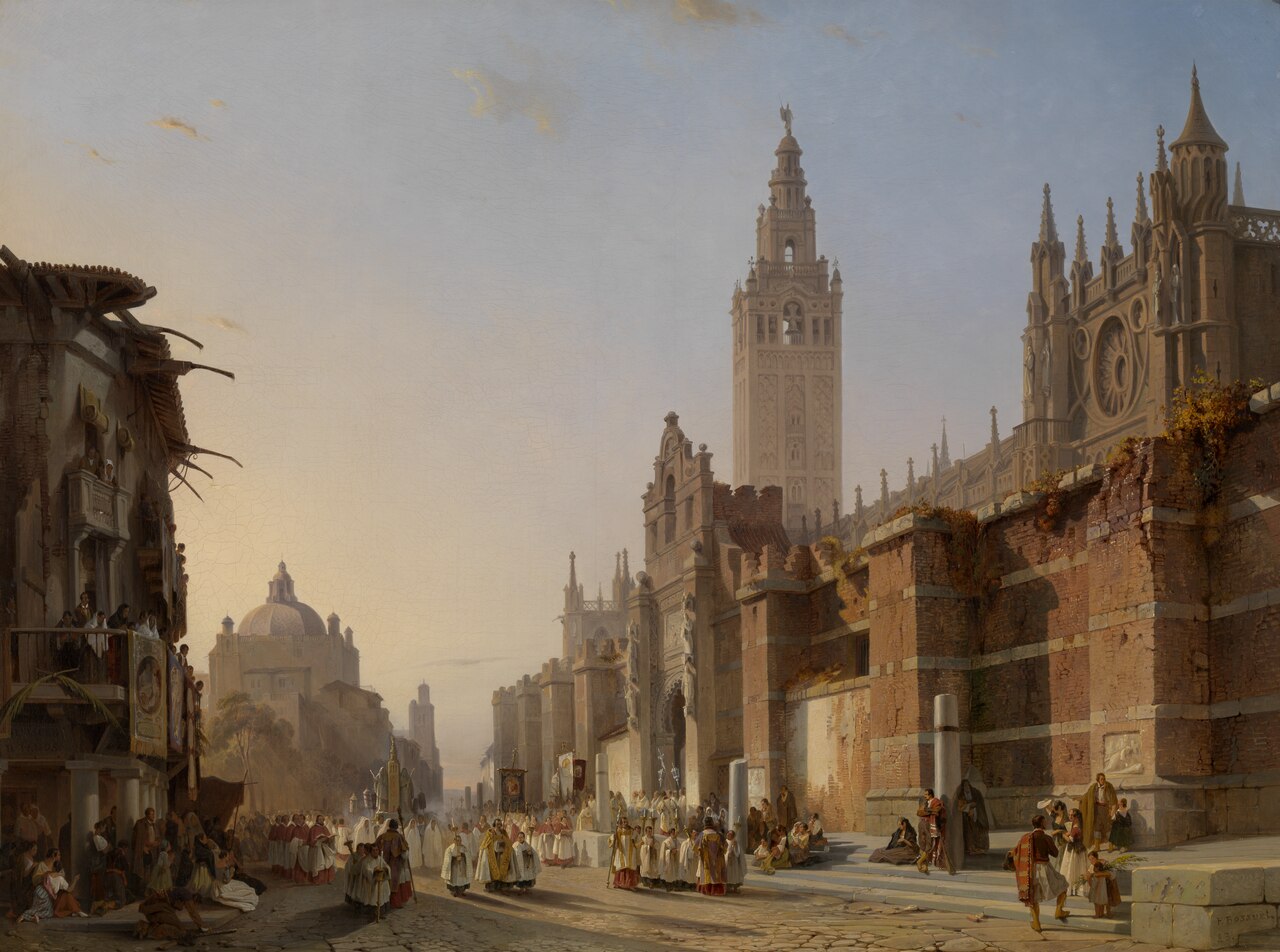
Major works - **A view of Córdoba (1845)** – This canvas presents a panoramic vista of Córdoba’s historic centre, foregrounding the iconic Mezquita‑Cathedral with its striking horseshoe arches. Bossuet renders the complex interplay of stone, shadow and light with a measured hand, highlighting the city’s layered history. - **The Old Fish Market in Antwerp (1833)** – One of his earliest dated works, this painting captures the lively interior of a Flemish market. The composition is anchored by the market stalls, while the surrounding figures and the play of natural light convey a sense of immediacy. - **The Cathedral of Seville (1843)** – Here Bossuet focuses on the grandeur of Seville’s Gothic cathedral. The piece emphasizes verticality and the intricate tracery of the façade, while the surrounding sky is rendered in soft blues that contrast with the stone’s warm tones. - **Landscape in Ugijar (Southern Spain) (1850)** – This landscape moves away from urban architecture to depict the rolling hills and cultivated fields of the Ugijar region. The work showcases Bossuet’s ability to render pastoral scenery with the same meticulous attention to detail as his cityscapes. - **A Moorish Gateway, Ecija, Spain (1853)** – In this painting, the viewer is drawn to an ornate Moorish portal, its geometric patterns and arches rendered with precise draughtsmanship. The surrounding environment is bathed in golden light, underscoring the gateway’s cultural significance.
Influence and legacy Although François Bossuet never achieved the fame of some of his Belgian contemporaries, his body of work offers valuable insight into the cross‑cultural artistic exchanges of the nineteenth century. By documenting Spanish architecture and landscapes at a time when travel was still relatively rare, he contributed to a growing European fascination with the “exotic” south. His meticulous approach to architectural detail influenced younger Belgian painters who sought to combine topographical accuracy with expressive atmosphere. After his death in 1889 in Saint‑Josse‑ten‑Noode, his paintings entered private collections and, later, public museums, where they continue to be appreciated for their documentary value and quiet elegance. Today, scholars regard Bossuet as a competent practitioner of the Belgian school whose works bridge the gap between Romantic idealisation and Realist observation, providing a nuanced visual record of both Belgian and Spanish urban environments.
Frequently asked questions
Who was François Bossuet?
François Bossuet (1798–1889) was a Belgian painter and draughtsman noted for his detailed cityscapes and landscapes, especially of Spanish subjects.
What artistic style or movement is he associated with?
He is not tied to a single movement; his work blends Romantic interest in dramatic scenery with Realist attention to accurate detail, reflecting the broader Belgian school of the nineteenth century.
What are his most famous works?
Among his best‑known paintings are *A view of Córdoba* (1845), *The Old Fish Market in Antwerp* (1833), *The Cathedral of Seville* (1843), *Landscape in Ugijar* (1850) and *A Moorish Gateway, Ecija* (1853).
Why is François Bossuet important in art history?
He provides a valuable visual record of 19th‑century architecture and everyday life in both Belgium and Spain, illustrating the cultural exchange between northern and southern Europe during that era.
How can I recognise a painting by François Bossuet?
Look for precise line work, careful architectural rendering, a restrained colour palette, and a subtle handling of light that together create a balanced, almost documentary quality.