François-Auguste Ravier
1814 – 1895
In short
François‑Auguste Ravier (1814–1895) was a French landscape painter born in Lyon and later based in Morestel. He is noted for atmospheric depictions of rural and pastoral scenes, especially sunsets and river vistas, and his work bridges the Barbizon tradition and the emerging Impressionist sensibility.
Notable works
_-_Landscape_at_Sunset_-_PD.146-1985_-_Fitzwilliam_Museum.jpg)
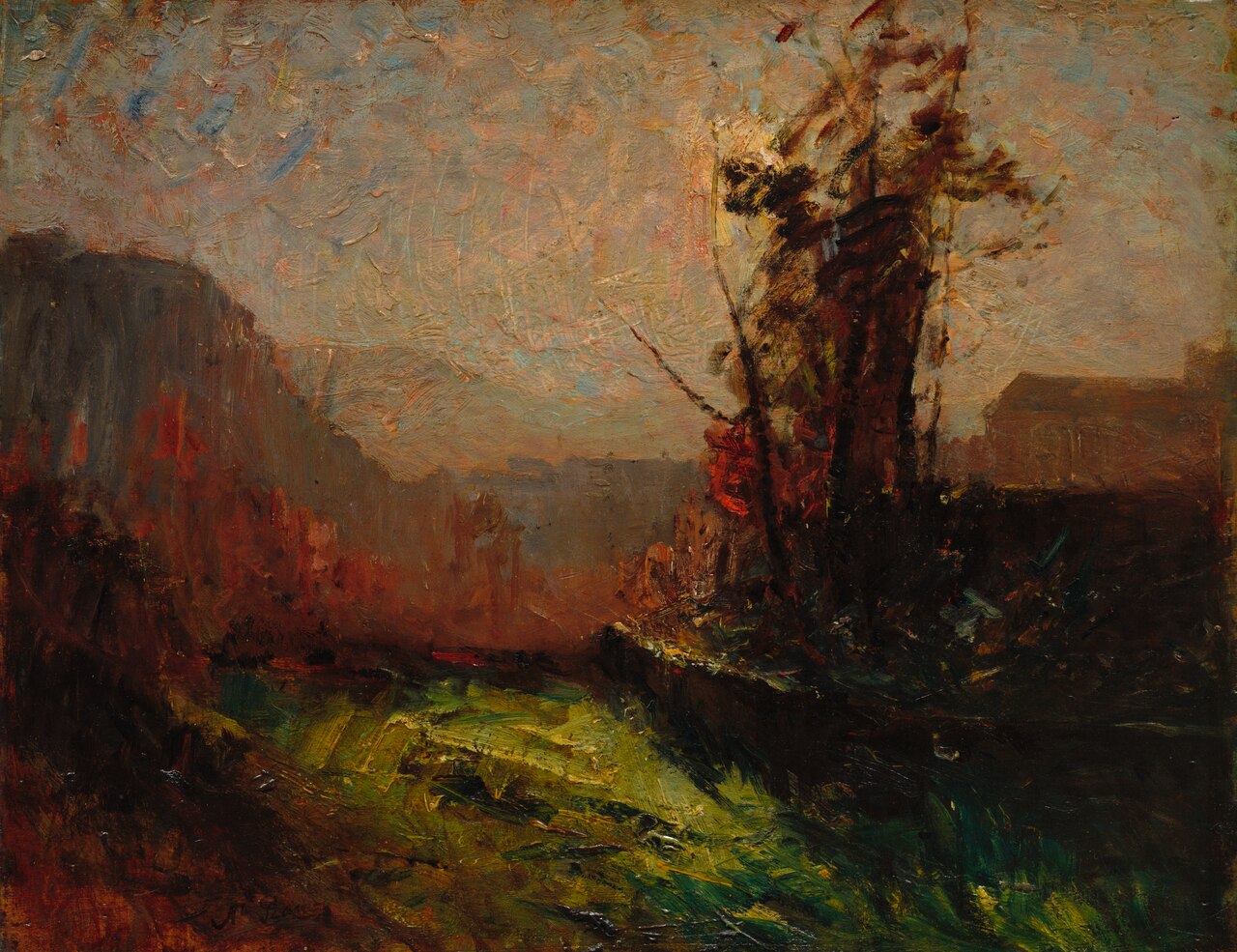


Early life François‑Auguste Ravier was born on 25 April 1814 in Lyon, a city with a vibrant artistic community and a long tradition of silk‑pattern design. His family was modest, and little is recorded about his parents, but local archives indicate that he received his first drawing lessons at a municipal school. The industrial and commercial environment of Lyon, combined with its proximity to the Rhône valley’s varied countryside, provided Ravier with early exposure to both urban and rural visual motifs. By his teenage years he was already producing sketches of the surrounding hills and riverbanks, demonstrating a keen interest in the natural world that would define his career.
In the 1830s, Ravier moved to Paris to further his artistic training. Though documentation of his formal education is scarce, it is likely that he attended the École des Beaux‑Arts or studied under a private atelier, as was customary for provincial artists seeking recognition. The Parisian art scene of the period was dominated by academic historicism, yet a growing cohort of painters—such as Camille Corot and Jean‑Baptiste-Camille Corot—were turning away from studio conventions toward plein‑air observation. Ravier’s early exposure to these currents helped shape his lifelong commitment to painting directly from nature.
Career and style Ravier returned to the Lyon region in the early 1840s, establishing a modest studio where he began to exhibit at local salons. His early works display a restrained palette and careful modelling of light, reminiscent of the Barbizon School’s emphasis on tonal harmony. By the mid‑1850s he had adopted a looser brushwork, allowing atmospheric effects to dominate the composition. This evolution coincided with his frequent trips to the countryside around Morestel, a small town near the Isère River, where he settled permanently in 1852.
Although Ravier never formally aligned himself with a specific movement, his style reflects a synthesis of several influences. The compositional balance and subdued colour schemes echo the work of Corot, while his later handling of light—particularly in sunrise and sunset scenes—anticipates the luminous concerns of early Impressionists such as Claude Monet. Ravier remained largely outside the avant‑garde circles of Paris; instead, he cultivated a regional reputation, participating in exhibitions at the Salon de Lyon and the Société des Artistes Français.
Signature techniques Ravier’s paintings are distinguished by a few recurring technical approaches:
1. Atmospheric layering – He frequently applied thin glazes of translucent pigment to convey mist, fog, or the hazy quality of early evening light. This technique softens edges and creates depth without relying on linear perspective.
2. Muted earth tones – A palette dominated by ochres, umbers, and subtle greens underpins his landscapes, allowing the occasional burst of warm orange or golden yellow (often representing the sun) to stand out dramatically.
3. Plein‑air sketches – Ravier habitually produced rapid oil sketches outdoors, which he later refined in the studio. These sketches capture the fleeting qualities of light and weather, serving as the basis for larger, more detailed canvases.
4. Textural brushwork – In water and foliage, he employed short, directional strokes that suggest movement and the play of wind, while broader, smoother strokes render sky and distant horizons.
Major works Ravier’s oeuvre, though not extensive, includes several notable pieces that exemplify his evolving approach to landscape.
- Paysage au coucher du soleil – This composition showcases a tranquil riverbank bathed in the warm glow of a setting sun. The sky is rendered in a gradient of pinks and golds, with reflected light rippling across the water. The work exemplifies Ravier’s mastery of atmospheric glazing.
- Crémieu, Seen from Chaillonnette (1869) – Painted during a visit to the historic town of Crémieu, the piece captures the village’s medieval rooftops from an elevated viewpoint. The foreground is populated with a meadow of tall grasses, while distant hills recede under a soft, cloud‑dotted sky. The date of 1869 places this work at a moment when Ravier’s brushwork had become more fluid.
- Sunset over a Pond (1880) – In this later work, Ravier focuses on a small pond surrounded by reeds. The sunset sky is rendered in deep reds and purples, reflected vividly on the water’s surface. The painting demonstrates his continued fascination with the interplay of light and water.
- Approaching Morestal (1845) – One of his earlier large‑scale canvases, this piece depicts a road winding toward the town of Morestel. The composition is anchored by a line of trees and a distant village silhouette, rendered with a restrained colour scheme that reflects the influence of early Barbizon painters.
- The Terrace of the Ravier House in Morestel (1880) – A more personal work, this painting portrays the terrace of his own residence, overlooking the surrounding countryside. The scene is suffused with a gentle afternoon light, and the careful rendering of the house’s architecture provides a sense of place and intimacy.
Collectively, these works illustrate Ravier’s lifelong preoccupation with the changing qualities of natural light and his ability to convey mood through subtle colour modulation.
Influence and legacy François‑Auguste Ravier never achieved the fame of his Parisian contemporaries, but his paintings enjoyed steady appreciation among regional collectors and art societies. His commitment to plein‑air observation and his atmospheric techniques contributed to the broader diffusion of natural‑light painting beyond the major art centres of France. Several younger painters in the Dauphiné and Rhône‑Alps regions cited Ravier as an exemplar of how to render local scenery with poetic sensitivity.
In the early twentieth century, the work of Ravier was occasionally featured in retrospectives of 19th‑century French landscape painting, where critics highlighted his role as a bridge between the Barbizon tradition and the nascent Impressionist movement. Although he did not belong to any formal school, his paintings are now held in several municipal museums, including the Musée des Beaux‑Arts de Lyon and the Musée de la Ville de Morestel, ensuring that his contribution to French landscape art remains accessible to scholars and the public.
Today, Ravier is recognised by art historians as a diligent observer of the French countryside whose nuanced handling of light anticipates later developments in modern art. His works continue to be studied for their technical merit and for the way they capture a particular moment in French artistic history—one that values the quiet beauty of everyday rural life.
Influence and legacy François‑Auguste Ravier’s legacy endures through the continued exhibition of his paintings, scholarly references in studies of 19th‑century French landscape art, and the inspiration he provides to contemporary artists seeking to portray atmospheric light. While not a household name, his work contributes to a richer understanding of the diversity within French painting during a period of significant stylistic transition.
Frequently asked questions
Who was François‑Auguste Ravier?
He was a French landscape painter (1814–1895) born in Lyon and later based in Morestel, known for atmospheric depictions of rural scenes.
What style or movement is Ravier associated with?
Ravier is not linked to a single movement; his work blends Barbizon‑inspired tonal harmony with early Impressionist interests in light and colour.
What are his most famous works?
Key paintings include Paysage au coucher du soleil, Crémieu, Seen from Chaillonnette (1869), Sunset over a Pond (1880), Approaching Morestal (1845) and The Terrace of the Ravier House in Morestel (1880).
Why does Ravier matter in art history?
He exemplifies the transition from academic landscape painting to a more natural‑light, plein‑air approach, influencing regional artists and enriching the narrative of 19th‑century French art.
How can I recognise a Ravier painting?
Look for soft, muted earth tones, delicate atmospheric glazes, and a focus on sunrise or sunset light that subtly illuminates tranquil rural settings.