Francisco Domingo Marqués
1842 – 1920
In short
Francisco Domingo Marqués (1842–1920) was a Spanish painter born in Valencia and active mainly in Madrid. Working in an eclectic style, he is noted for portraits and genre scenes such as Portrait of an Old Man and The old‑fashioned Cobbler.
Notable works

.jpg)


Early life Francisco José Domingo y Marqués was born in 1842 in the coastal city of Valencia, a region with a long tradition of artistic production. Little is recorded about his family background, but the cultural environment of Valencia in the mid‑nineteenth century, with its thriving guilds and academies, provided a fertile ground for his early artistic education. He likely received his first formal instruction at a local drawing school, where the foundations of academic drawing and the study of classical models were emphasized. By his late teens, Marqués had moved to Madrid, the capital of Spain, to pursue further training and to immerse himself in the national artistic scene.
Career and style In Madrid, Marqués entered the circles of the Spanish Academy of Fine Arts, where he was exposed to a broad spectrum of artistic influences ranging from the Romanticism of the earlier generation to the emerging Realist and Naturalist tendencies. Rather than aligning himself rigidly with any single movement, he developed an eclectic approach, drawing on diverse stylistic resources to suit the subject matter of each work. This adaptability allowed him to produce both highly detailed portraits and more narrative genre paintings. His oeuvre reflects a balance between academic rigor—evident in the precise rendering of anatomy and drapery—and a softer, sometimes sentimental, treatment of light and colour that aligns with the tastes of the Spanish bourgeoisie of the late nineteenth century.
Throughout his career, Marqués exhibited regularly at the annual Salones de Otoño in Madrid, gaining a reputation for his ability to capture psychological depth in portraiture. He also participated in regional exhibitions in Valencia and Barcelona, where his genre scenes attracted attention for their vivid storytelling and technical competence. By the 1880s, he had established himself as a respected figure within the Spanish art establishment, receiving commissions from private patrons and public institutions alike.
Signature techniques Marqués’s technique is characterised by a meticulous underdrawing, often executed in charcoal or graphite, which served as the scaffolding for his oil paintings. He employed a layered glazing method, applying thin, translucent layers of pigment over a toned ground to achieve luminous skin tones and subtle atmospheric effects. In portraiture, he favoured a restrained palette of earth tones, muted blues, and warm ochres, allowing the sitter’s features to emerge with clarity without overwhelming the composition with colour. His brushwork varies according to the narrative: tight, controlled strokes render the faces and hands of his subjects, while looser, more expressive passages suggest background elements such as fabrics or interior décor. Light is treated with particular care; he often positioned a single, diffused light source to model the figure, creating a gentle chiaroscuro that enhances three‑dimensionality without dramatic contrast.
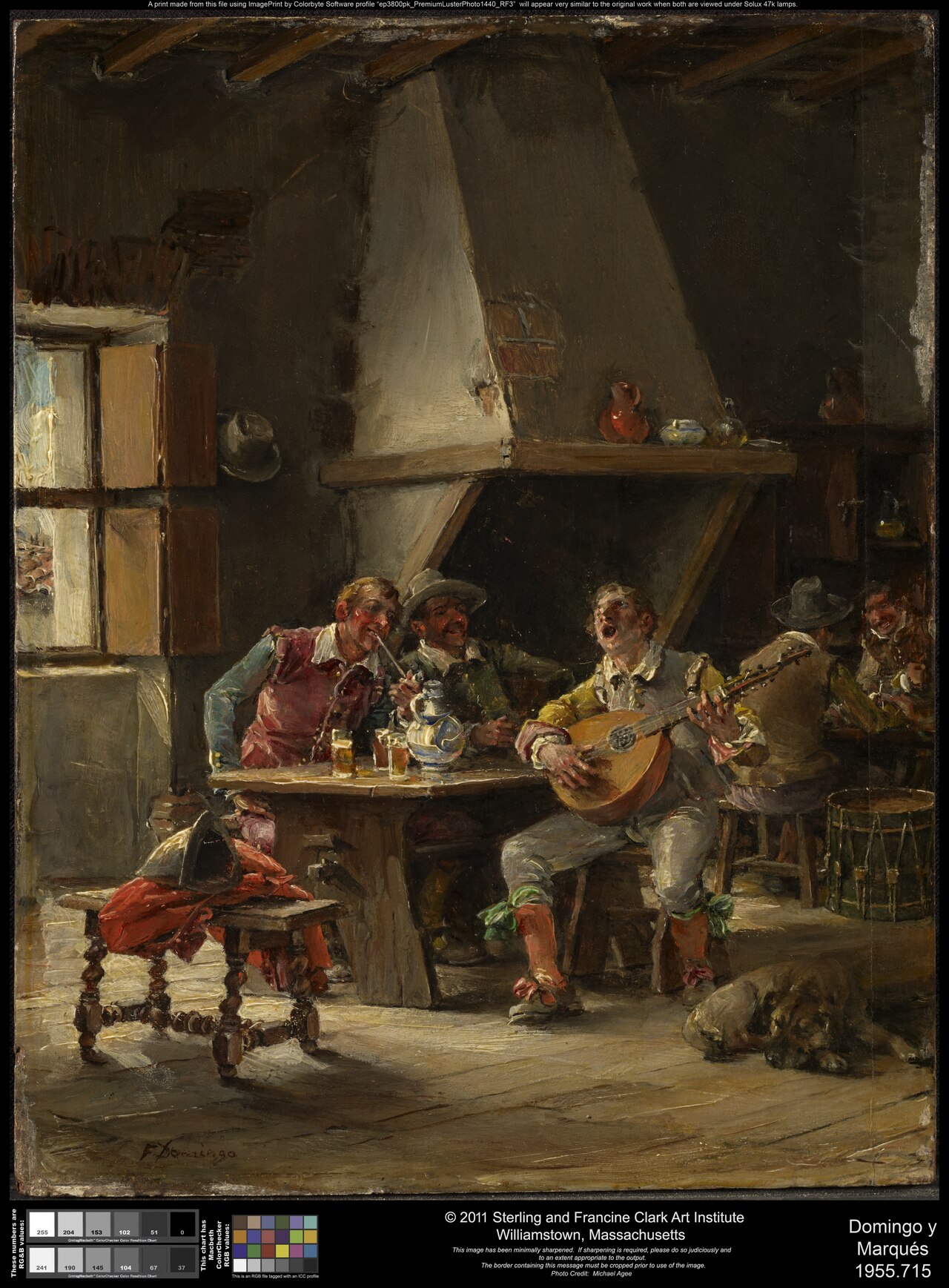
Major works Marqués’s most frequently cited pieces illustrate both his portraiture skill and his interest in everyday life. **Portrait of an Old Man (1882)** presents a dignified elderly sitter, rendered with a soft focus on the weathered skin and contemplative gaze. The composition places the figure against a muted backdrop, allowing the viewer to concentrate on the subtle interplay of light across the face. **The old‑fashioned Cobbler (1870)** is a genre painting that captures a traditional shoemaker at work, his tools and workshop rendered with precise detail, reflecting Marqués’s fascination with the disappearing artisanal trades of his time. **Self‑Portrait (1884)** offers insight into the artist’s self‑perception; he depicts himself with a calm, introspective expression, employing the same measured brushwork that defines his portraits of others. **Head of a Gentleman (1883)** demonstrates his ability to convey personality through limited compositional elements; the sitter’s slightly tilted head and nuanced facial expression suggest a narrative beyond the canvas. Finally, **Drinking Song (1890)** returns to genre subject matter, portraying a group of revelers in a convivial setting. The work’s lively atmosphere is achieved through a brighter palette and more fluid brushwork, showing Marqués’s versatility in handling both intimate portraiture and broader social scenes.
Influence and legacy Although Marqués never founded a distinct artistic movement, his eclectic practice contributed to the broader acceptance of stylistic pluralism in Spanish art at the turn of the century. By navigating between academic conventions and the emerging desire for more personal, narrative-driven works, he helped bridge the gap between the formalism of the Academy and the later modernist tendencies that would dominate Spanish art in the early twentieth century. His portraits, in particular, served as reference points for younger artists seeking to combine technical precision with psychological insight. Collections of his work are held in several Spanish museums, including the Museo del Prado’s regional annexes, where they continue to be studied for their exemplary technique and as documentation of Spanish social life in the late nineteenth century. Modern scholarship regards Marqués as a competent, though not revolutionary, figure whose body of work offers valuable insight into the artistic climate of his era and the evolving tastes of a nation in transition.
Frequently asked questions
Who was Francisco Domingo Marqués?
Francisco Domingo Marqués (1842–1920) was a Spanish painter from Valencia who worked mainly in Madrid, known for his eclectic style and a range of portraits and genre scenes.
What style or movement is he associated with?
He is best described as an eclectic painter, drawing on academic, realist and sentimental influences rather than belonging to a single defined movement.
What are his most famous works?
His most recognised pieces include Portrait of an Old Man (1882), The old‑fashioned Cobbler (1870), Self‑Portrait (1884), Head of a Gentleman (1883) and Drinking Song (1890).
Why does he matter in art history?
Marqués exemplifies the transitional period in Spanish art between strict academicism and the more narrative, personal approaches of the late nineteenth century, influencing younger artists through his technical skill and versatile subject matter.
How can I recognise a painting by Marqués?
Look for careful underdrawing, layered glazing, a restrained colour palette, and a subtle chiaroscuro that highlights psychological depth, especially in portraits where the sitter’s expression is rendered with fine detail.