Florent Willems
1823 – 1905
In short
Florent Willems (1823‑1905) was a Belgian painter and art restorer renowned for his meticulous genre scenes that emulate the 17th‑century Flemish and Dutch Baroque, especially in his realistic treatment of textiles. Based in Paris for much of his career, he gained acclaim for works such as A Seated Page with a Dog and The Important Response, earning the nickname “modern Ter Borch”.
Notable works



Early life
Florent Willems was born in 1823 in Liège, a city that was then part of the United Kingdom of the Netherlands and later became a cultural centre of Belgium. Little is recorded about his family background, but the artistic climate of Liège in the early nineteenth century offered a range of opportunities for budding painters. Willems received his initial training locally, where he would have been exposed to the strong traditions of Flemish painting that characterised the region. By the mid‑1840s he had developed a proficiency in drawing and oil painting, skills that prepared him for a professional career in the visual arts.
Career and style
In the late 1840s Willems moved to Paris, the epicentre of European art, to further his practice. The capital’s galleries and salons provided a marketplace for artists who could combine the technical rigour of academic training with the charm of genre subjects. Willems settled into a niche that blended a reverence for the 17th‑century Flemish and Dutch Baroque with a contemporary sensibility. His paintings typically depict small groups of figures inside domestic interiors, illuminated by a soft, naturalistic light that recalls the works of Gerrit Dou and Jan Vermeer. While his subject matter was modest—pages, musicians, market scenes—the compositional balance and attention to detail placed his work firmly within the tradition of genre painting.
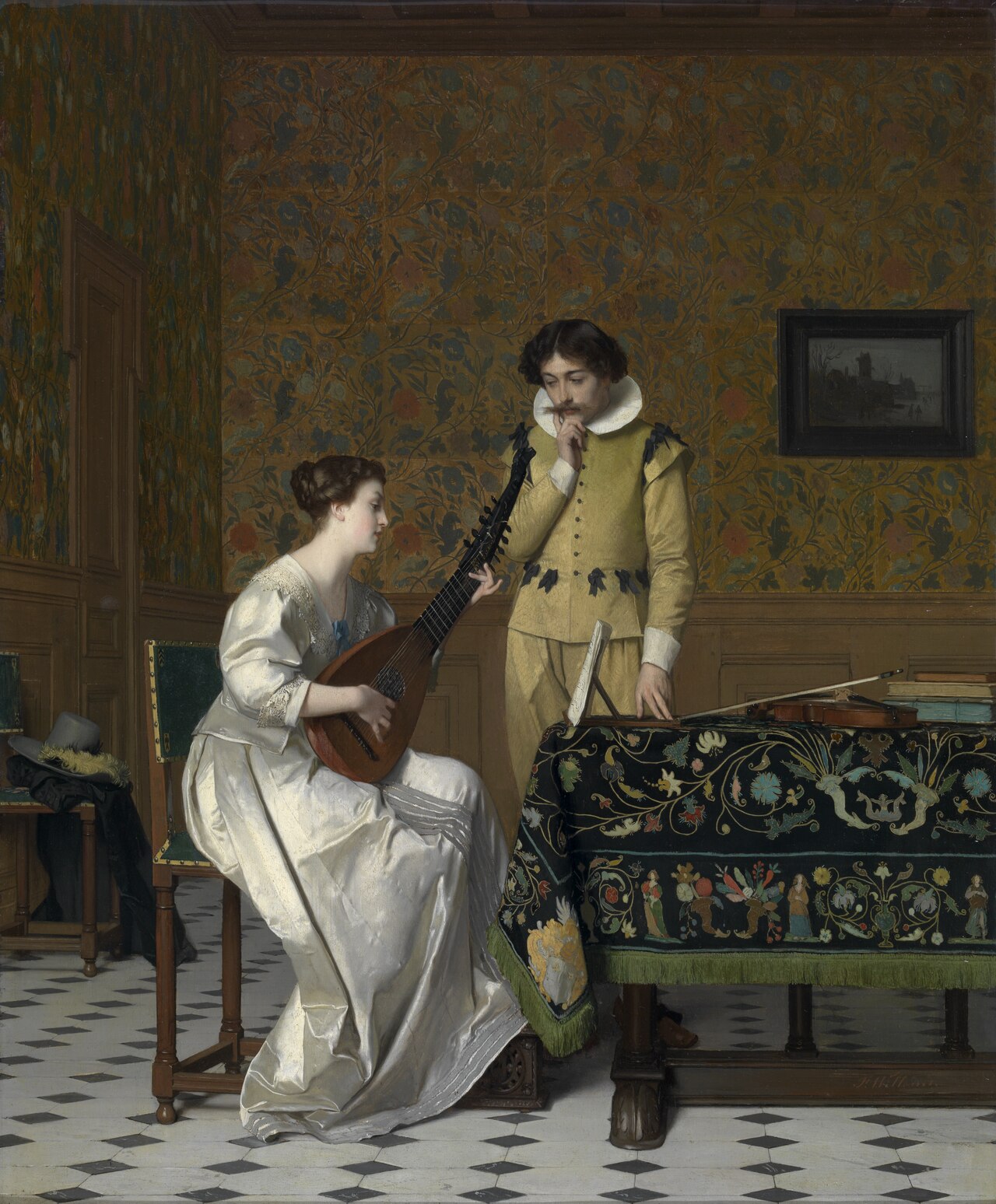
Willems’s style is characterised by an exacting finish and a particular focus on the materiality of clothing. He rendered silk, lace, and velvet with a clarity that allowed viewers to almost feel the texture of the fabrics. This preoccupation with surface detail earned him the comparison to the 17th‑century Dutch master Gerard ter Borch, whose own depictions of satin and fur are celebrated for their realism. Though he did not belong to a formally defined movement, Willems can be situated within the broader currents of historicist painting that sought to revive earlier styles for a nineteenth‑century audience.
Signature techniques
Willems employed a meticulous layering technique, beginning with a finely drawn under‑drawing that defined the contours of each figure and object. He then applied thin glazes of colour to build depth, a method that allowed him to achieve subtle gradations of light on fabric. The artist’s palette was restrained, favouring earth tones, muted blues, and occasional accents of crimson or gold to highlight focal points. In addition to painting, Willems worked as an art restorer, a discipline that reinforced his knowledge of historical pigments and varnishes. This dual expertise contributed to his ability to replicate the visual language of the seventeenth century while maintaining a clean, polished surface.
Major works
- A Seated Page with a Dog (1848) – This early work illustrates Willems’s fascination with intimate interior scenes. A young page, dressed in a richly embroidered coat, is shown seated beside a small dog. The careful rendering of the page’s satin and the delicate fur of the animal exemplify his skill at depicting texture. The composition balances the figure’s pose with the dog’s attentive gaze, creating a quiet narrative moment.
- The Important Response (1850) – In this painting, Willems captures a brief exchange between two individuals, one of whom gestures with a folded handkerchief. The work is notable for its subtle use of chiaroscuro, which draws attention to the reflective surfaces of the subjects’ clothing. The painting’s title, though somewhat enigmatic, reflects the artist’s interest in portraying fleeting social interactions.
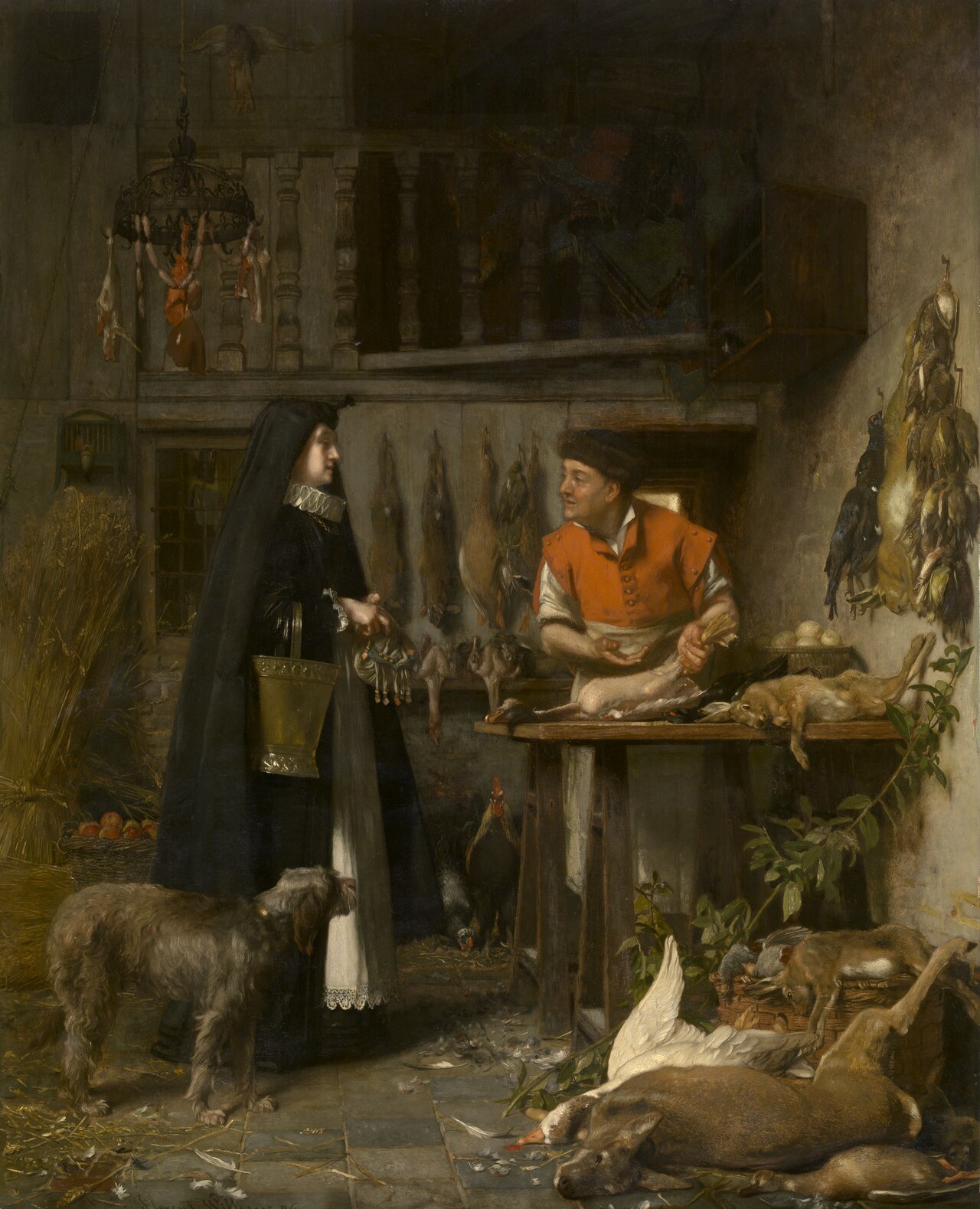
- Market Scene in the 17th Century (1886) – Produced later in his career, this piece demonstrates Willems’s continued engagement with historicist themes. He reconstructs a bustling market stall, populated by merchants and shoppers in period‑appropriate attire. The composition is crowded yet orderly, and the play of light across the canvas evokes the atmosphere of a Flemish market painting.
- Musician – Though undated, the work “Musician” follows the same formula of a solitary figure absorbed in music-making. The figure’s clothing, rendered with luminous brushwork, reflects Willems’s lifelong preoccupation with fabric. The subdued background ensures that the viewer’s focus remains on the musician’s contemplative pose.
- Revery – This painting portrays a lone figure lost in thought, perhaps gazing out of a window. The soft illumination and the gentle folds of the sitter’s robe exemplify the artist’s consistent approach to portraying psychological depth through material detail.
Across these works, Willems consistently employed a restrained colour scheme, careful modelling of light, and an emphasis on the tactile qualities of textiles, thereby creating a visual link between nineteenth‑century realism and seventeenth‑century genre painting.
Influence and legacy
Florent Willems remained active in the Parisian art world until his death in 1905. While he never achieved the fame of more avant‑garde contemporaries, his paintings were well received by collectors who appreciated the nostalgic charm of his historicist approach. His reputation as a restorer further cemented his status among museum professionals, who relied on his expertise to preserve older works.
In the decades following his death, Willems’s paintings continued to appear in exhibitions of Belgian art, and his meticulous technique influenced a small circle of genre painters who sought to emulate the textures of the Dutch Golden Age. Modern scholarship often cites him as an example of the nineteenth‑century revival of baroque aesthetics, and his works are frequently used as reference points for studies of textile representation in painting. Though not a household name, Willems’s contribution to the preservation of baroque visual vocabularies and his skillful synthesis of historic style with contemporary practice secure his place in art‑historical narratives.
Overall, Florent Willems exemplifies the 19th‑century artist who straddled the roles of creator and conservator, using his deep knowledge of historical techniques to produce works that both honoured and revitalised the genre traditions of his Flemish forebears.
Frequently asked questions
Who was Florent Willems?
Florent Willems (1823‑1905) was a Belgian painter and art restorer known for genre scenes that echo 17th‑century Flemish and Dutch Baroque styles.
What artistic style or movement is he associated with?
He is not linked to a specific movement, but his work belongs to historicist genre painting, drawing heavily on the visual language of the Dutch Golden Age.
What are his most famous works?
Key works include A Seated Page with a Dog (1848), The Important Response (1850), Market Scene in the 17th Century (1886), as well as the paintings Musician and Revery.
Why is Florent Willems important in art history?
He is valued for his exceptional rendering of textiles, earning the nickname ‘modern Ter Borch’, and for bridging nineteenth‑century realism with seventeenth‑century baroque aesthetics.
How can one recognise a painting by Willems?
Look for intimate interior settings, a limited number of figures, and especially the meticulous, luminous depiction of fabrics such as silk and lace, often accompanied by a soft, natural light.