Évariste Carpentier
1845 – 1922
In short
Évariste Carpentier (1845–1922) was a Belgian painter known for genre scenes and animated landscapes. Working initially in the academic tradition, he later embraced impressionistic luminism alongside Emile Claus, producing works such as Playing Child (1872) and Madame Roland in the prison of Sainte Pélagie (1886).
Notable works


.jpg)
Early life Évariste Carpentier was born in 1845 in Kuurne, a small town in the province of West Flanders, Belgium. Little is recorded about his family background, but the cultural milieu of mid‑nineteenth‑century Belgium offered a growing network of art academies and exhibitions. Carpentier received his formal training at the Royal Academy of Fine Arts in Brussels, where he studied drawing, composition and the techniques of the academic tradition. The academy emphasized mastery of the human figure, careful rendering of light and shadow, and adherence to classical subjects, all of which would shape his early artistic output.
Career and style After completing his studies, Carpentier established himself as a painter of genre scenes—everyday moments captured with narrative detail—and of animated landscapes that conveyed both the people and the surrounding environment. In the 1870s his work reflected the rigorous standards of academic art, with a polished finish, balanced composition and a muted colour palette. By the early 1880s, however, Carpentier began to experiment with looser brushwork and a brighter handling of light, influenced by the burgeoning Impressionist movement in France and the naturalist tendencies of Belgian contemporaries.
Around the mid‑1880s Carpentier’s style shifted decisively toward luminism, a strand of Impressionism that foregrounded the effects of sunlight and atmospheric conditions on colour. Together with Emile Claus, he became one of the earliest Belgian practitioners of this approach. The luminist phase is characterised by a more vibrant palette, broken colour passages, and an emphasis on the fleeting qualities of light on foliage, water and human figures. While he never abandoned the narrative content of his earlier genre works, Carpentier’s later paintings display a softer, more atmospheric ambience that aligns him with the broader European transition from academic realism to modernist experimentation.
Signature techniques Carpentier’s signature techniques evolved alongside his stylistic development. In his academic period he employed precise, layered glazing to achieve depth and a smooth surface. He favoured a controlled chiaroscuro, modelling forms through subtle gradations of tone. During his luminist phase, he adopted a more direct application of paint, often laying thin, semi‑transparent strokes that allowed underlying colours to shine through. This technique created a luminous effect that suggested the play of natural light. He also used a limited but carefully chosen colour palette to capture the tonal variations of a particular time of day, a hallmark of luminist practice.
Another notable aspect of his method is the integration of human activity within landscape settings. Whether depicting a child at play, a shepherd in the Ardennes, or a prisoner in a historic cell, Carpentier placed his figures in environments that reinforce the narrative, using the surrounding light and atmosphere to enhance emotional resonance. This synthesis of figure and setting became a distinguishing feature of his oeuvre.
Major works - **Playing Child (1872)** – One of Carpentier’s earliest documented paintings, this work portrays a young boy engaged in a simple game. The composition reflects academic precision, with a clear focus on the figure’s anatomy and a restrained colour scheme. The controlled lighting underscores the painter’s mastery of chiaroscuro and his ability to convey a quiet, intimate moment.
- Madame Roland in the prison of Sainte Pélagie (1886) – This historically themed canvas illustrates the revolutionary heroine Madame Roland confined in the Sainte Pélagie prison. While the subject matter is dramatic, Carpentier’s treatment of light softens the scene, hinting at his emerging luminist sensibility. The work balances narrative detail with an atmospheric rendering of interior light, demonstrating his transitional style.
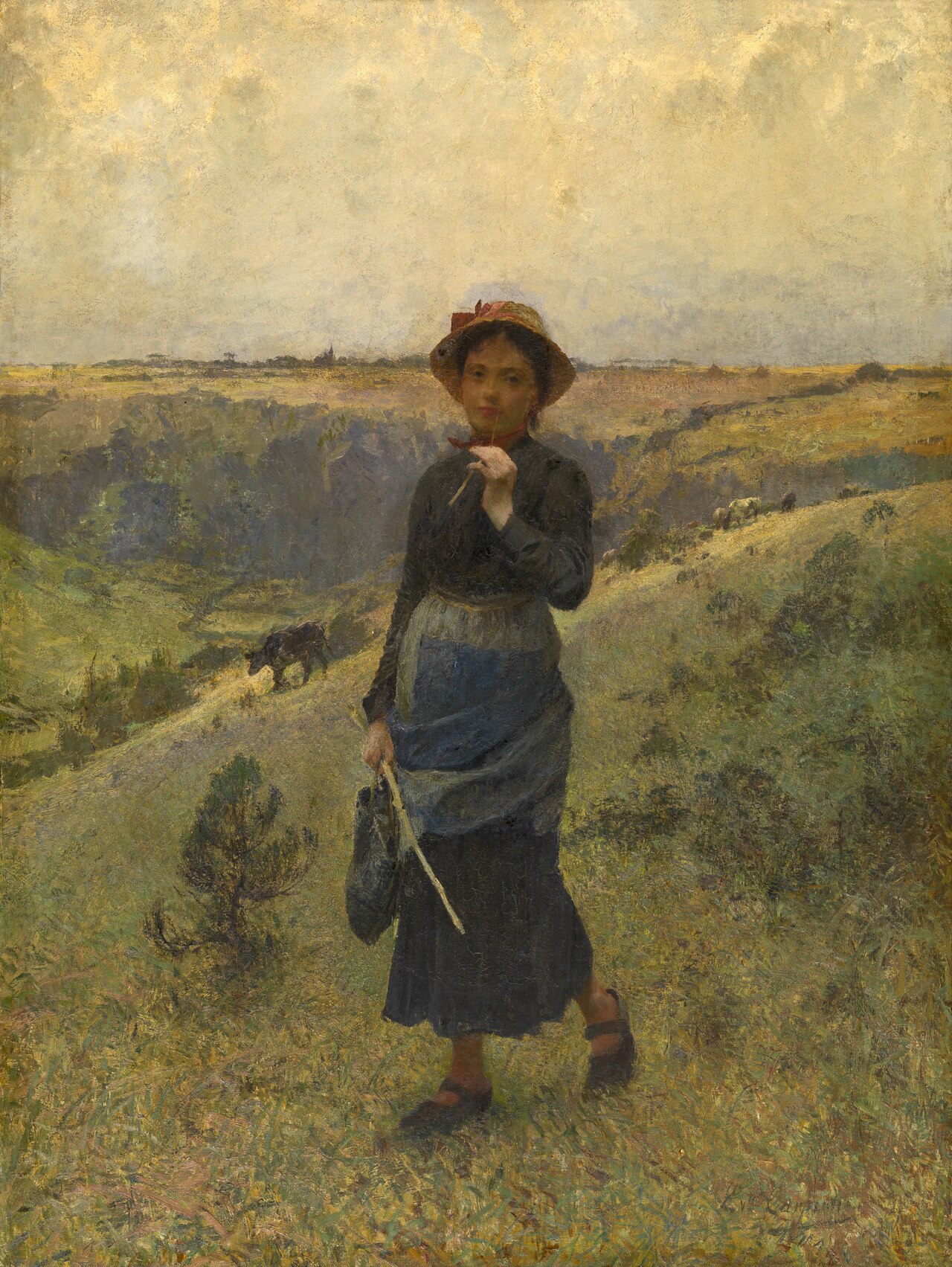
- Cowherd in the Ardennes – In this landscape, a solitary shepherd watches over his flock amid the rolling hills of the Ardennes. The painting exemplifies Carpentier’s later luminist approach; the foliage and sky are rendered with broken colour and a bright, naturalistic palette, capturing the fleeting quality of daylight.
- After Work – This genre scene depicts labourers resting after a day’s toil. The composition is populated with figures whose gestures convey fatigue and camaraderie. The handling of light, falling across the figures and the surrounding environment, reflects Carpentier’s mature technique, where the interplay of sun and shadow contributes to the overall mood.
These works collectively illustrate Carpentier’s artistic trajectory from academic realism to a more impressionistic, light‑focused practice, while maintaining a consistent interest in everyday narratives.
Influence and legacy Évariste Carpentier occupies a modest but significant place in Belgian art history. His early embrace of luminism positioned him alongside Emile Claus as a pioneer of the movement within Belgium, helping to bridge the gap between strict academic conventions and the freer, light‑driven approaches that would dominate the early twentieth century. Though he never achieved the widespread fame of some contemporaries, his paintings are valued for their technical proficiency and for documenting the social and rural life of his era.
Carpentier’s legacy endures in several ways. First, his works are part of the collections of regional museums in Belgium, where they serve as reference points for the study of Belgian genre painting and the transition to modernist aesthetics. Second, his method of integrating narrative figures within luminous landscapes influenced younger Belgian artists who sought to blend story with atmosphere. Finally, scholars of European luminism frequently cite Carpentier as an example of how the movement was adapted beyond France, illustrating the cross‑national diffusion of Impressionist ideas.
Overall, Évariste Carpentier’s career reflects the broader artistic currents of his time: a grounding in academic training, a willingness to experiment with light and colour, and a commitment to portraying the lived experiences of ordinary people. His body of work offers insight into the evolution of Belgian painting at the turn of the century and remains a point of reference for researchers and enthusiasts of 19th‑century European art.
Frequently asked questions
Who was Évariste Carpentier?
Évariste Carpentier (1845–1922) was a Belgian painter known for genre scenes and animated landscapes, working initially in the academic tradition before adopting impressionistic luminism.
What artistic style or movement is he associated with?
He began as an academic artist and later became one of Belgium’s early luminist painters, a branch of Impressionism that emphasises the effects of natural light.
What are his most famous works?
Key works include Playing Child (1872), Madame Roland in the prison of Sainte Pélagie (1886), Cowherd in the Ardennes, and After Work.
Why is Carpentier important in art history?
Carpentier helped introduce luminist techniques to Belgian painting, bridging academic realism and modernist approaches, and his works document everyday life in 19th‑century Belgium.
How can I recognise a painting by Évariste Carpentier?
Look for genre scenes with narrative figures placed in luminous, naturalistic settings; his later works show broken colour, bright palettes and a focus on the interplay of sunlight and atmosphere.