Eugène Laermans
1864 – 1940
In short
Eugène Laermans (1864–1940) was a Belgian painter known for his socially engaged scenes of labourers and emigrants, working in a realist style with a muted palette. His work, such as The Blind One (1898) and Storm (1899), captures the hardship of the turn‑of‑the‑century working class.
Notable works

_Storm_-_MSK_Gent_20-8-2016_15-57-04.JPG)


Early life Eugène Jules Joseph Baron Laermans was born in 1864 in the Brussels suburb of Molenbeek‑Saint‑Jean. Growing up in an industrialising part of Belgium, he was exposed early to the daily rhythms of working‑class neighbourhoods, an experience that would later inform his artistic concerns. Laermans pursued formal artistic training in his native city, enrolling at the Royal Academy of Fine Arts in Brussels where he received instruction in drawing and composition. Seeking broader exposure, he later spent time in Paris, attending classes at the Académie Julian, a hub for many foreign artists of the period. This dual education gave him a grounding in both Belgian academic traditions and the more progressive currents circulating in the French capital.
Career and style Returning to Belgium in the late 1880s, Laermans began exhibiting his work at local salons and societies. He quickly established a reputation for paintings that combined a rigorous realist approach with a deep empathy for his subjects. While he never aligned himself formally with a particular avant‑garde movement, his oeuvre reflects the influence of social realism, a current that sought to portray the conditions of ordinary people rather than idealised mythological or historical scenes. Critics of his time noted the sombre tonalities of his canvases, which often employed earth tones and muted blues to evoke the bleakness of poverty and migration.
Laermans’ subject matter frequently centred on labourers, itinerants, and scenes of collective struggle. By focusing on these themes, he positioned himself alongside contemporaries such as Jean-François Millet and Gustave Courbet, whose work similarly foregrounded the dignity and hardship of the working class. Though his paintings retain a narrative clarity, they also hint at a psychological depth, suggesting the inner lives of his figures beyond the immediate visual description.
Signature techniques A hallmark of Laermans’ technique is his use of chiaroscuro to model forms and to create a sense of atmospheric tension. He often placed his figures against stark, low‑lit backgrounds, allowing the light to fall on faces and hands, thereby emphasising gesture and expression. His brushwork varies between tight, controlled passages for facial details and looser, more gestural strokes for surrounding landscapes or interiors, a contrast that reinforces the focus on human experience within a broader environment.
Laermans also employed a restrained colour palette, favouring ochres, umbers, and muted greys. This limited chromatic range serves both to unify the composition and to underscore the somber mood of his subjects. In addition, he demonstrated a keen observational skill, rendering clothing textures, weathered surfaces, and the subtle play of light on skin with a fidelity that lends his scenes an almost documentary quality.
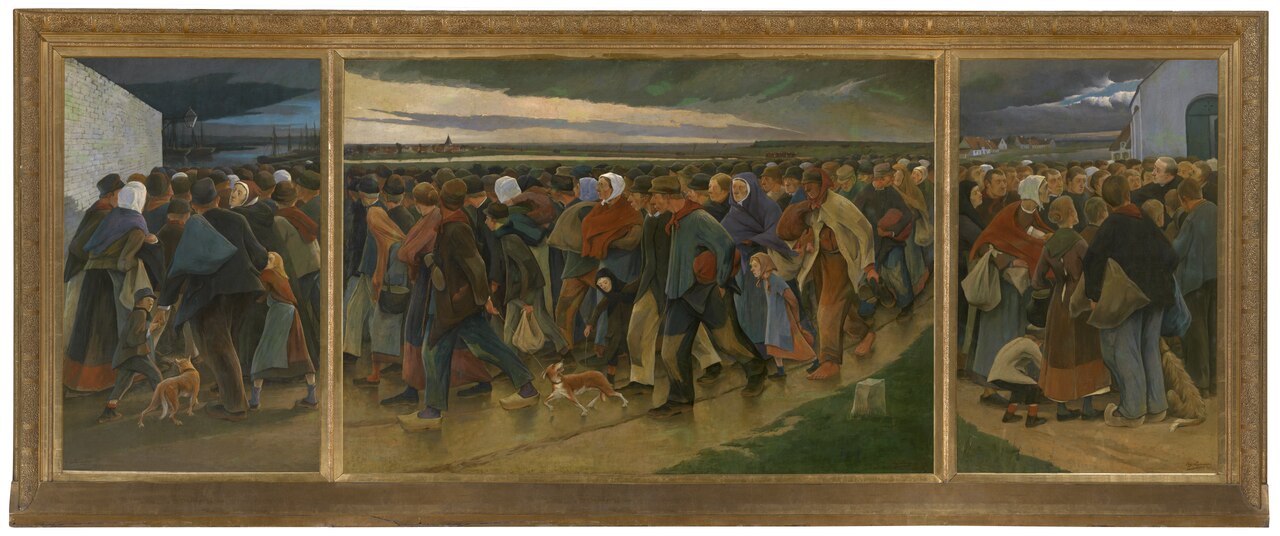
Major works Among Laermans’ most cited paintings are **The Blind One** (1898) and **Storm** (1899). In *The Blind One*, a solitary figure is rendered with a compassionate focus, the artist’s handling of light accentuating the vulnerability of the subject. *Storm* captures a turbulent sky over a rural landscape, the dark clouds echoing the emotional weight of the human figures caught beneath them.
Earlier works such as Un soir de grève (1893) depict a group of striking workers gathered at dusk, the composition balancing collective action with individual expression. The series of paintings titled The Emigrants (dated both 1894 and 1896) portray families and individuals embarking on journeys, their faces marked by a mixture of hope and anxiety. These works collectively illustrate Laermans’ ongoing preoccupation with movement, displacement, and the social forces shaping the lives of ordinary people.
Influence and legacy Eugène Laermans died in 1940 in the Brussels metropolitan area, leaving behind a body of work that continues to be studied for its social commentary and technical proficiency. Though he never achieved the fame of some contemporaries, his paintings are valued for their honest portrayal of the working class at a time of rapid industrial change in Belgium. Art historians regard Laermans as an important figure in the development of Belgian realist painting, and his works are held in several public collections, where they serve as visual testimonies of late‑19th‑century social conditions.
In recent decades, Laermans’ paintings have been re‑examined within the context of European social realism, highlighting his contribution to a tradition that bridges artistic practice and social observation. Exhibitions focusing on the representation of labour and migration often include his work, underscoring its continued relevance. Today, scholars and curators reference Laermans when discussing the visual articulation of poverty, migration, and collective struggle in the art of the fin de siècle.
Overall, Laermans’ legacy rests on his ability to fuse compassionate narrative with disciplined technique, producing images that remain resonant both as historical documents and as works of art.
Frequently asked questions
Who was Eugène Laermans?
Eugène Laermans (1864–1940) was a Belgian painter noted for his realistic depictions of labourers, emigrants and social hardship in the late 19th and early 20th centuries.
What artistic style or movement is Laermans associated with?
He is generally linked to social realism, a current that emphasised truthful, often gritty portrayals of everyday working‑class life.
What are Laermans’ most famous works?
Key paintings include *The Blind One* (1898), *Storm* (1899), *Un soir de grève* (1893) and the two versions of *The Emigrants* (1894 and 1896).
Why does Laermans matter in art history?
His work offers a compassionate yet unflinching visual record of social conditions during Belgium’s industrialisation, influencing later realist and documentary painters.
How can I recognise a Laermans painting?
Look for muted earth tones, strong chiaroscuro, carefully rendered figures set against stark backgrounds, and subject matter that focuses on workers, migrants or scenes of collective struggle.