Eugène Carrière
1849 – 1906
In short
Eugène Carrière (1849–1906) was a French Symbolist painter renowned for his muted brown tones and atmospheric, dreamlike portraits. His work linked the fin-de-siècle aesthetic to later modernist movements, influencing artists such as Pablo Picasso.
Notable works

_Portrait_de_Mme_Arthur_Fontaine_Eug%C3%A8ne_Carri%C3%A8re_MTL.inv.mod.105.jpg)


Early life Eugène Anatole Carrière was born on 23 June 1849 in the small town of Gournay-sur-Marne, just east of Paris. He grew up in a modest family; his father worked as a clerk for the postal service. Carrière displayed an early aptitude for drawing, copying sketches from local church murals and practising figure studies in his spare time. In 1868, he entered the École des Beaux‑Arts in Paris, where he received formal training in academic drawing and composition. Although he was not a standout student, his dedication to mastering the fundamentals of drawing laid the groundwork for his later, more experimental work.
Career and style After completing his studies, Carrière struggled to find commercial success. He supported himself by producing illustrations for newspapers and periodicals, a common avenue for aspiring artists of the era. The turning point came in the early 1880s when he encountered the Symbolist circle centred around the poet Stéphane Mallarmé. The Symbolists rejected the strict realism of the Academy in favour of mood, emotion and the evocation of the unseen. Carrière adopted this ethos, developing a personal visual language that emphasised atmosphere over narrative detail.
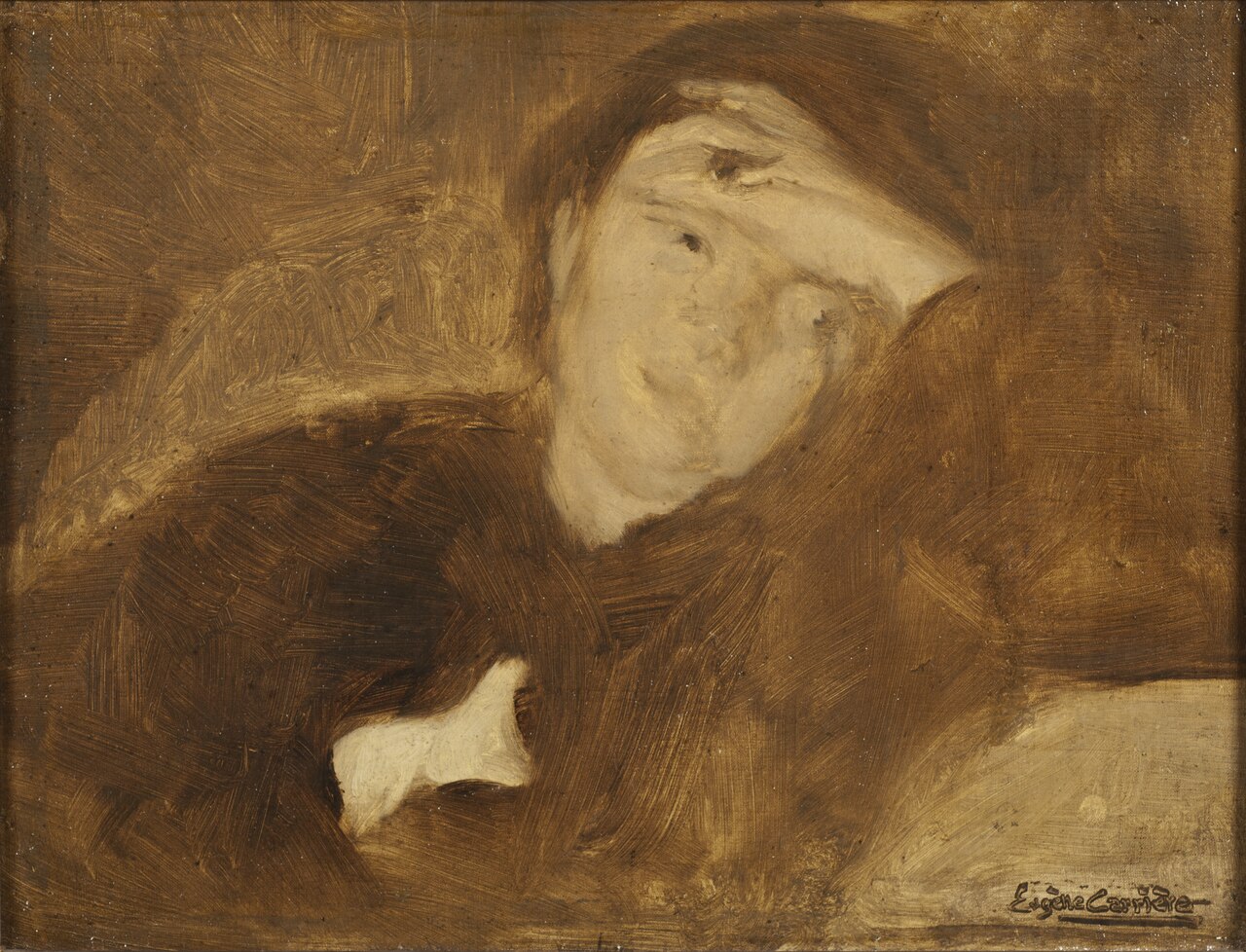
His mature style is characterised by a near‑monochrome palette dominated by warm, earthy browns. This limited colour range creates a soft, enveloping veil over his subjects, suggesting a world filtered through memory or reverie. The figures in his paintings often appear slightly blurred at the edges, enhancing the sense of intimacy and psychological depth. Carrière’s work therefore straddles the line between portraiture and allegory, inviting viewers to contemplate the inner lives of his sitters rather than merely their outward appearance.
Signature techniques Carrière achieved his characteristic tonal unity through a combination of thin, semi‑transparent layers of oil paint and meticulous glazing. He would begin with a loosely drawn under‑drawing, then apply successive washes of diluted pigment, allowing each layer to dry before adding the next. This method produced a luminous, almost mist‑like surface that captures subtle variations of light. The artist also favoured soft, blended brushstrokes that avoided hard outlines, thereby reinforcing the dreamlike quality of his compositions.
Another hallmark of his technique is the use of chiaroscuro in a restrained manner. Rather than employing stark contrasts, Carrière modulated light and shadow gently, often allowing the darkest tones to merge seamlessly with the mid‑tones. This approach contributes to the overall cohesion of his compositions, where the background and foreground appear as a single, unified field.
Major works Carrière’s most celebrated pieces illustrate his preoccupation with quiet domestic scenes and intimate portraiture.
- Self‑Portrait (1893) – This work is a study in self‑reflection, both literally and stylistically. Carrière renders his own features with the same hazy brown tonality that defines his oeuvre, allowing the viewer to sense his introspective mood.
- Portrait of Mme Arthur Fontaine – Though the exact date is uncertain, this portrait exemplifies Carrière’s ability to convey elegance without resorting to decorative detail. The sitter’s delicate features emerge from a softly illuminated background, emphasising her inner poise.
- Portrait of a Lady. Study – A preparatory sketch for a larger composition, this study reveals Carrière’s meticulous approach to capturing facial expression. Even in its unfinished state, the work demonstrates the subtle interplay of light and shadow that would later define his finished portraits.
- Women Sewing at a Table (1894) – Here Carrière turns his attention to a domestic genre scene. The figures are rendered in muted tones, their hands and faces bathed in a gentle, diffused light that underscores the quiet concentration of everyday labour.
- The First Communion (1896) – This religious subject is treated with the same atmospheric sensitivity as his secular works. The composition focuses on the solemnity of the rite, with the young participant’s face illuminated by a soft, almost heavenly glow, reinforcing the spiritual undertones of the event.
These works collectively illustrate Carrière’s commitment to evoking mood over explicit narrative, a hallmark of Symbolist painting.
Influence and legacy Carrière’s influence extended beyond his immediate circle. His close friendship with sculptor Auguste Rodin facilitated cross‑disciplinary exchanges that enriched both artists’ practices. Rodin’s emphasis on emotional expressiveness in form resonated with Carrière’s painterly concerns, while Carrière’s muted palette is thought to have informed the tonal choices of later modernists.
Art historians have noted that Carrière’s work prefigured Pablo Picasso’s Blue Period (1901–1904), particularly in the use of limited colour to evoke melancholy. Though there is no direct documentation of Picasso studying Carrière’s paintings, the similarity in mood suggests an indirect lineage through the Symbolist network.
In literature, Carrière maintained relationships with poets such as Paul Verlaine and Charles Morice, who praised his ability to visualise the ineffable. These connections helped to cement his reputation as a visual counterpart to the Symbolist literary movement.
Today, Carrière’s paintings are held in major European collections, including the Musée d’Orsay in Paris and the Musée du Luxembourg. His contribution to Symbolism is recognised for its subtle synthesis of colour, light, and psychological depth, offering a bridge between 19th‑century academic traditions and the emerging modernist sensibilities of the early 20th century.
Frequently asked questions
Who was Eugène Carrière?
Eugène Carrière was a French Symbolist painter (1849–1906) known for his muted brown palette and ethereal portraiture.
What artistic movement did he belong to?
He worked within Symbolism, embracing mood, atmosphere and the expression of inner feelings over realistic detail.
What are his most famous works?
Key works include Self‑Portrait (1893), Women Sewing at a Table (1894), The First Communion (1896), and portraits such as Mme Arthur Fontaine.
Why is Carrière important in art history?
His tonal innovations and psychological depth influenced later modernists, notably foreshadowing Picasso’s Blue Period, and linked visual art with contemporary Symbolist literature.
How can I recognise a Carrière painting?
Look for a limited brown colour scheme, soft blended brushstrokes, hazy outlines, and a tranquil, dreamlike ambience that unifies figure and background.