Emile Wauters
1846 – 1933
In short
Émile Wauters (1846–1933) was a Belgian painter known for his large‑scale historical and Orientalist canvases. Educated in Brussels and Paris, he achieved international recognition for works such as Panorama du Caire and Mary of Burgundy Granting the Great Privilege.
Notable works


.jpg)

Early life Émile Wauters was born in 1846 in the Brussels metropolitan area, then part of the United Kingdom of the Netherlands and later the Kingdom of Belgium. He grew up in a city that was rapidly becoming a centre for artistic training, and his early exposure to the vibrant Brussels art scene sparked a lifelong commitment to painting. Wauters entered the Royal Academy of Fine Arts in Brussels, where he studied under the distinguished Belgian orientalist and genre painter François-Joseph Navez‑Portaels, commonly known simply as Portaels. Portaels, himself a well‑travelled artist, encouraged his students to master the academic tradition while exploring exotic subject matter, an influence that would later be reflected in Wauters’ own oeuvre.
After completing his studies in Brussels, Wauters moved to Paris, the epicentre of 19th‑century academic art. There he entered the studio of Jean‑Léon Gérôme, a leading figure of the French Academic movement and a master of historical and Orientalist painting. Under Gérôme’s tutelage, Wauters refined his draftsmanship, honed his compositional skills, and absorbed the meticulous approach to historical accuracy that would become a hallmark of his later works.
Career and style Wauters launched his professional career in the late 1860s, quickly establishing a reputation for large‑scale compositions that combined rigorous historical research with a polished, academic finish. His early work, such as the 1868 canvas *The Battle of Hastings: the Finding of the body of Harold by Edith*, demonstrated a capacity to render dramatic narrative moments with clarity and emotional restraint. Throughout his career, Wauters gravitated toward subjects that allowed him to showcase both his technical skill and his interest in national history, religious scenes, and exotic locales.
Although he never formally aligned himself with a specific avant‑garde movement, Wauters can be situated within the broader academic tradition that dominated French and Belgian salons of the period. His paintings display the characteristic smooth brushwork, careful modelling of light and shadow, and precise anatomy associated with academic realism. At the same time, his exposure to the Orientalist fascination that swept Europe in the latter half of the 19th century led him to adopt vivid colour palettes and intricate architectural details when depicting North‑African and Middle‑Eastern subjects.
Wauters maintained a prolific exhibition schedule, showing regularly at the Paris Salon and at the Brussels Salon. His works were often purchased by royal patrons, municipal authorities, and private collectors, cementing his status as a respected figure in the art‑market of his day.
Signature techniques Wauters’ technique is marked by a disciplined underdrawing, usually executed in charcoal or graphite, which allowed him to construct complex groupings of figures before committing to paint. He favoured a layered approach: a thin, transparent glaze was applied over an initial opaque underpainting, creating depth and a luminous quality particularly evident in his sky and water renderings.
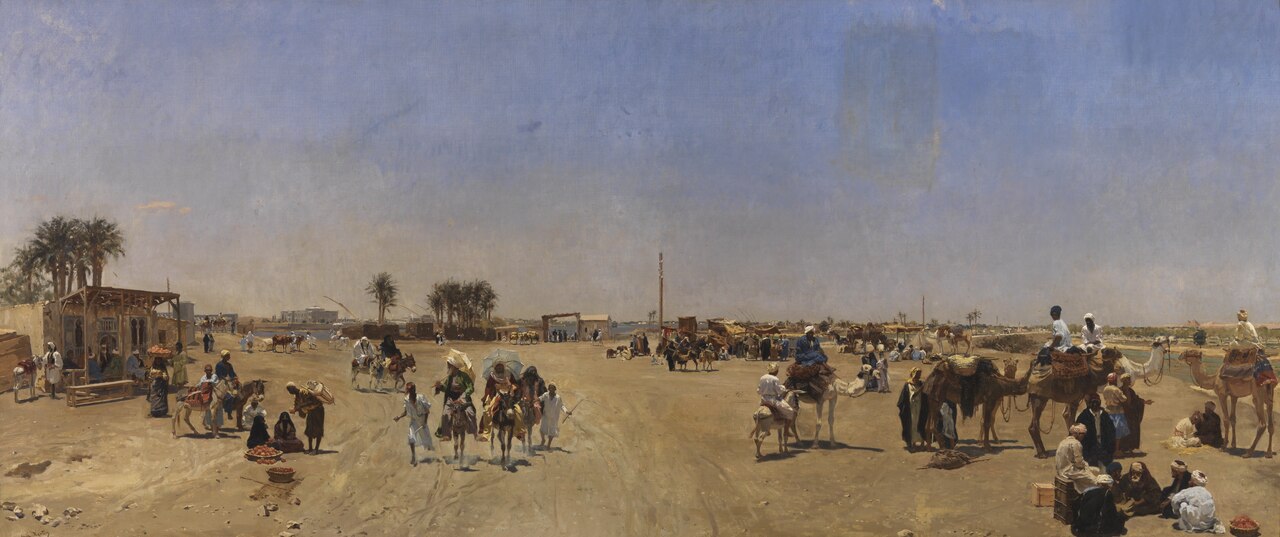
Colour was employed with restraint in his historical canvases, where earth tones and muted blues dominate, reinforcing a sense of gravitas. By contrast, his Orientalist scenes—most notably those of Cairo—feature richer, saturated hues, reflecting the vibrant atmosphere of the city’s markets and riverbanks. The artist’s meticulous attention to architectural detail, such as the precise rendering of arches, domes, and decorative tilework, demonstrates his commitment to authenticity.
Wauters also experimented with panoramic formats, a popular spectacle in the late 19th century. By using a wide‑angle perspective and a carefully calculated horizon line, he succeeded in immersing viewers within the depicted environment, a technique that would later influence the development of immersive exhibition spaces.
Major works - **Panorama du Caire (1881)** – This expansive canvas captures a sweeping view of Cairo from the Kasr‑el‑Nil Bridge. Executed in a panoramic format, the work combines meticulous architectural rendering with a bustling street scene, illustrating Wauters’ skill in blending documentary accuracy with artistic composition.
- The painter Hugo van der Goes in the Rouge‑Cloître Abbey (1872) – In this historically themed piece, Wauters imagines the 15th‑century Flemish master at work within the cloistered setting of the Rouge‑Cloître Abbey. The painting demonstrates his interest in art‑historical subjects and his ability to recreate period interiors with scholarly precision.
- Mary of Burgundy Granting the Great Privilege (1878) – This composition portrays the 1477 ceremony in which Mary of Burgundy conferred the Great Privilege upon the States of the Netherlands. Wauters renders the event with a dignified, almost theatrical quality, using a balanced arrangement of figures to convey the political significance of the moment.
- Cairo Seen from the Kasr‑el‑Nil Bridge (1881) – Complementary to the Panorama, this work offers a more focused vista of the Nile’s banks, emphasizing the interplay of light on water and the intricate silhouettes of the city’s minarets. The piece showcases Wauters’ talent for atmospheric effects.
- Scholar at the Table (1866) – An early work that reflects the artist’s academic training, this painting depicts a solitary figure engaged in study. The subdued palette and careful modelling of the scholar’s features highlight Wauters’ capacity for intimate, genre‑type scenes.
These works collectively illustrate Wauters’ versatility: from grand historical narratives to detailed Orientalist studies, each painting bears his characteristic compositional clarity and technical refinement.
Influence and legacy Émile Wauters occupies a distinct niche within 19th‑ and early‑20th‑century European painting. While he never embraced the modernist revolutions that reshaped the art world after the 1880s, his commitment to academic standards provided a counterpoint to the avant‑garde movements of his time. His panoramic works anticipated later developments in immersive exhibition design, influencing both commercial panorama producers and later museum installations.
In Belgium, Wauters’ historical canvases reinforced a burgeoning sense of national identity, contributing visual narratives that celebrated key moments in the country’s past. French and Belgian institutions continued to acquire his paintings well into the early 20th century, ensuring that his works remained visible in public collections.
Art historians today regard Wauters as a representative figure of the academic tradition that persisted alongside Impressionism, Symbolism, and early Modernism. His paintings are valuable primary sources for scholars studying the visual representation of Belgian history and the European fascination with the Orient during the late 19th century. Moreover, his meticulous approach to architectural detail offers insight into the period’s documentary aspirations.
Wauters died in Paris in 1933, leaving behind a body of work that, while perhaps less celebrated than that of his more radical contemporaries, continues to be exhibited and studied for its technical excellence and its role in shaping historical and Orientalist painting in Belgium and France.
Frequently asked questions
Who was Émile Wauters?
Émile Wauters (1846–1933) was a Belgian painter noted for his large‑scale historical and Orientalist canvases, trained in Brussels and Paris.
What artistic style or movement is he associated with?
He worked within the academic tradition, combining rigorous historical realism with Orientalist subject matter, but did not belong to a specific avant‑garde movement.
What are his most famous works?
His best‑known paintings include *Panorama du Caire* (1881), *Mary of Burgundy Granting the Great Privilege* (1878), and *The painter Hugo van der Goes in the Rouge‑Cloître Abbey* (1872).
Why is Émile Wauters important in art history?
He exemplifies the late‑19th‑century academic painter who blended historical narrative with Orientalist fascination, influencing panoramic exhibition formats and contributing to Belgium’s visual heritage.
How can I recognise a painting by Émile Wauters?
Look for smooth, highly finished brushwork, precise architectural detail, a balanced composition, and a muted palette in historical scenes versus richer colours in his Orientalist works.