Émile-René Ménard
1862 – 1930
In short
Émile‑René Ménard (1862–1930) was a French Symbolist painter known for lyrical landscapes and mythic scenes, blending the naturalism of the Barbizon school with a poetic, often dream‑like atmosphere.
Notable works


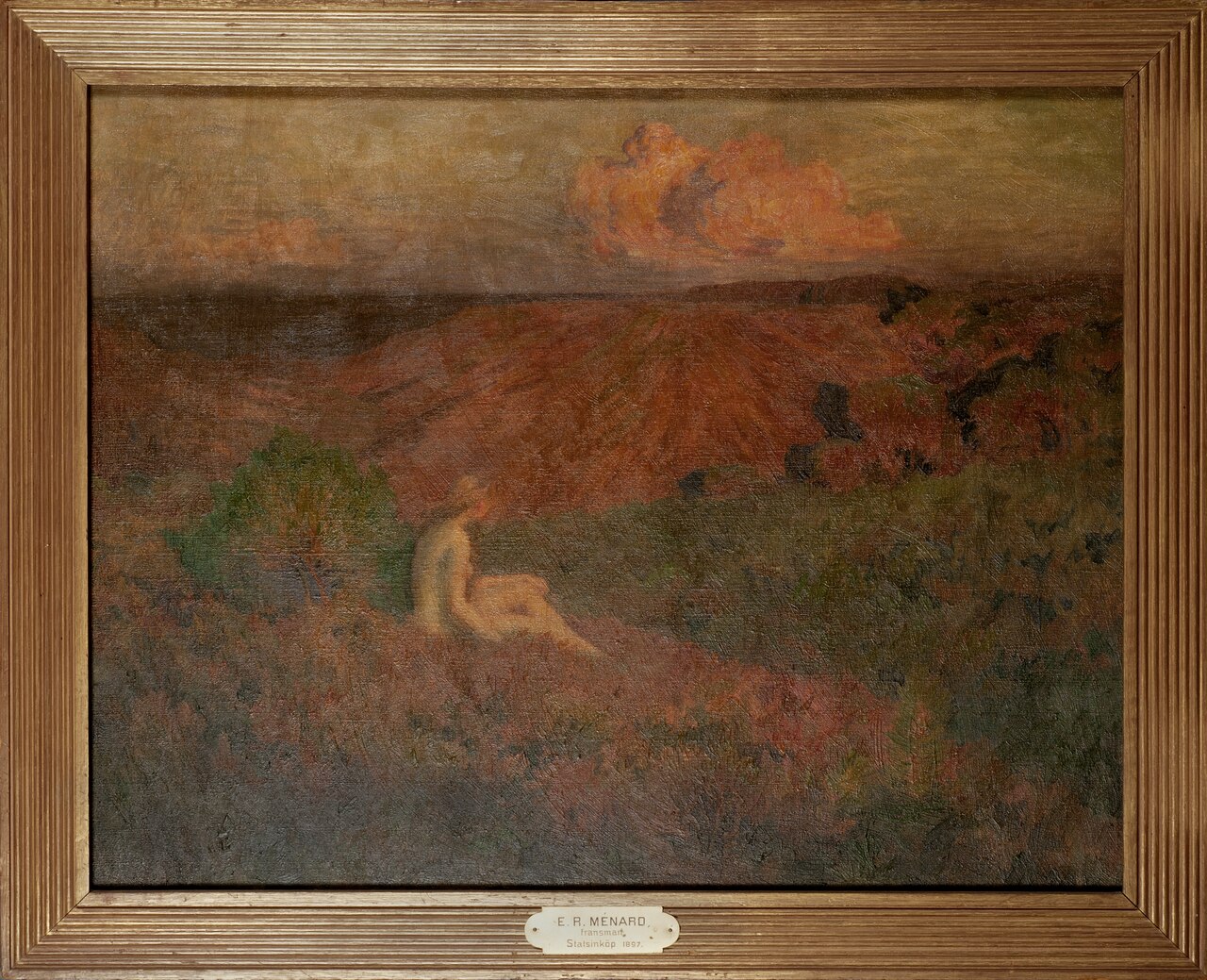


Early life Émile‑René Ménard was born in 1862 in the 5th arrondissement of Paris, a district steeped in artistic activity. His family home became a informal salon for leading artists of the mid‑19th century; painters such as Jean‑Baptiste‑Camille Corot, Jean‑François Millet and members of the Barbizon circle were regular visitors. This environment gave the young Ménard early exposure to both plein‑air landscape painting and the study of classical antiquity. Although formal records of his early education are sparse, it is clear that the proximity to these masters shaped his visual vocabulary and fostered a lifelong fascination with the intersection of nature and myth.
Career and style Ménard began exhibiting publicly in the late 1880s, aligning himself with the Symbolist movement that sought to convey ideas and emotions through evocative imagery rather than strict realism. While Symbolism was often associated with literary and mythological subjects, Ménard applied its principles to landscape, creating scenes that felt both grounded in observation and suffused with an inner, almost mystical light. His work frequently juxtaposes tranquil natural settings with references to antiquity—classical statues, ancient ruins, or celestial motifs—suggesting a timeless dialogue between the past and the present.
Throughout his career, Ménard maintained a delicate balance between the naturalistic approach learned from the Barbizon painters and the more introspective, poetic concerns of Symbolism. This synthesis placed him in a niche that appealed to both traditionalist collectors and avant‑garde audiences. He exhibited regularly at the Paris Salon and the Société Nationale des Beaux‑Arts, receiving commendations for his ability to render atmospheric effects and his sophisticated handling of colour.
Signature techniques Ménard’s paintings are characterised by a soft, luminous palette dominated by muted greens, warm ochres and pale blues. He often employed a glazing technique, applying thin, translucent layers of oil paint to build depth and a subtle glow. This method allowed him to suggest the diffusion of light through foliage or the hazy ambience of early morning. His brushwork is generally restrained; fine, almost invisible strokes give his surfaces a smooth, almost polished finish, reinforcing the dream‑like quality of his compositions.
Another hallmark of Ménard’s practice is his compositional framing. He frequently uses a low horizon line, allowing the sky to dominate the canvas and creating a sense of vastness. Architectural or sculptural elements—columns, arches, or fragmented statues—are often placed in the foreground, anchoring the viewer’s eye and providing a narrative entry point. The interplay of these elements with the surrounding landscape conveys a sense of quiet contemplation.
Major works - **Spring (date uncertain)** – Though the precise year of this painting is not documented, "Spring" exemplifies Ménard’s fascination with renewal. The work depicts a verdant meadow bathed in gentle sunrise light, with delicate blossoms emerging among grasses. The composition is anchored by a solitary marble statue partially obscured by foliage, hinting at the coexistence of nature and antiquity.
- Charles Cottet (1896) – This portrait of fellow painter Charles Cottet reflects Ménard’s respect for his contemporaries. Rendered in muted tones, the figure is set against a subdued interior, the background hinted at with soft, atmospheric brushwork. The portrait captures Cottet’s contemplative demeanor while subtly referencing the shared artistic milieu of late‑19th‑century France.
- Solitude – In "Solitude," Ménard presents a lone figure seated on a rocky outcrop overlooking a mist‑filled valley. The palette is dominated by cool greys and blues, reinforcing a feeling of isolation. A ruined column lies nearby, suggesting that the subject’s introspection is linked to the remnants of a bygone civilization.
- Ancient Astronomers (1883) – One of his earlier dated works, this painting portrays a group of classical figures gazing at a night sky strewn with stars. The composition combines a realistic rendering of the landscape with an idealised, almost ethereal depiction of the heavens, illustrating Ménard’s capacity to merge scientific curiosity with poetic imagination.
- Landscape – A generic title for several canvases, Ménard’s landscapes typically feature expansive fields, distant horizons and a calm, diffused light. The recurring motif of a distant, barely visible temple or ruin underscores his belief that the natural world is a repository for cultural memory.
These works collectively demonstrate Ménard’s consistent thematic preoccupations: the dialogue between the natural and the mythic, the subtle interplay of light, and an overarching sense of quiet reverence.
Influence and legacy Émile‑René Ménard occupies a modest yet significant place in French art history. While he never achieved the fame of contemporaries such as Gustave Moreau or Odilon Redon, his paintings contributed to the broader Symbolist discourse by extending its concerns into the realm of landscape. Later generations of painters, particularly those working in the inter‑war period, drew upon his atmospheric treatment of light and his integration of classical motifs.
Art historians note that Ménard’s work anticipates certain aspects of early 20th‑century modernism, especially the emphasis on mood over narrative. His subtle glazing techniques and restrained brushwork influenced younger artists who sought to convey emotional resonance through colour and tone rather than explicit storytelling.
Ménard died in 1930 in the 14th arrondissement of Paris, leaving behind a modest oeuvre that continues to be exhibited in French regional museums and occasionally appears in international Symbolist retrospectives. Scholars appreciate his paintings for their technical finesse and their ability to evoke a timeless, contemplative atmosphere, ensuring that his contribution to Symbolist landscape painting remains recognised within the canon of French art.
--- Overall, Émile‑René Ménard’s legacy endures as a testament to the power of subtlety, where the quiet meeting of nature and antiquity invites viewers into a reflective, almost mystical experience.
Frequently asked questions
Who was Émile‑René Ménard?
Émile‑René Ménard (1862–1930) was a French painter associated with Symbolism, best known for lyrical landscapes that blend natural scenery with classical references.
What artistic movement did he belong to?
He worked within the Symbolist movement, incorporating its emphasis on mood and metaphor into his depictions of nature and antiquity.
What are his most famous works?
Key works include "Ancient Astronomers" (1883), the portrait "Charles Cottet" (1896), the evocative "Solitude", the atmospheric "Landscape", and the ambiguous "Spring".
Why is Ménard important in art history?
Ménard broadened Symbolist concerns to landscape painting, influencing later artists with his subtle glazing, muted palette and the poetic fusion of natural and mythic elements.
How can I recognise a Ménard painting?
Look for soft, luminous colours, smooth glazing, low horizons, and the presence of classical fragments—often a statue or ruin—integrated into tranquil, mist‑filled scenes.