Edward Theodore Compton
1849 – 1921
In short
Edward Theodore Compton (1849–1921) was an English‑born German painter, illustrator and mountaineer renowned for his detailed alpine landscapes and for making over 300 major climbs, including 27 first ascents.
Notable works
_-_Ansicht_des_Gro%C3%9Fglockners_mit_der_Pasterze_-_3523_-_F%C3%BChrermuseum.jpg)
_-_Snow_Scene_on_the_Col_d%27Orny,_Valais,_Switzerland_-_VIS.2000_-_Sheffield_Galleries_and_Museums_Trust.jpg)


Early life Edward Theodore Compton was born in 1849 in the London borough of Hackney. Though his birthplace was English, his family moved to the German states when he was a child, and he spent the majority of his formative years in Germany. Growing up amid the burgeoning industrial and cultural changes of the mid‑19th century, Compton developed an early fascination with both art and the natural world. He received a basic education that included drawing, and his exposure to the Alpine environment during family trips sparked a lifelong passion for mountains.
Career and style By the 1870s Compton had begun to work as a professional artist and illustrator. He quickly distinguished himself by focusing on the high‑altitude landscapes of the Alps, a subject that was still relatively under‑represented in the visual arts of his time. His work combined the precision of a trained draftsman with the emotive power of a romantic landscape painter. While he is not formally attached to a single art movement, his paintings reflect elements of both the Realist attention to detail and the later Symbolist interest in the sublime aspects of nature.
Compton’s career was intertwined with his mountaineering pursuits. He climbed extensively throughout the Alps, logging more than three hundred major ascents and achieving at least twenty‑seven first ascents. These experiences gave him an intimate knowledge of the terrain, weather patterns, and light conditions that he could translate onto canvas. His dual identity as artist and alpinist allowed him to produce works that were both aesthetically compelling and topographically accurate, making his paintings valuable to both art collectors and mountaineering historians.
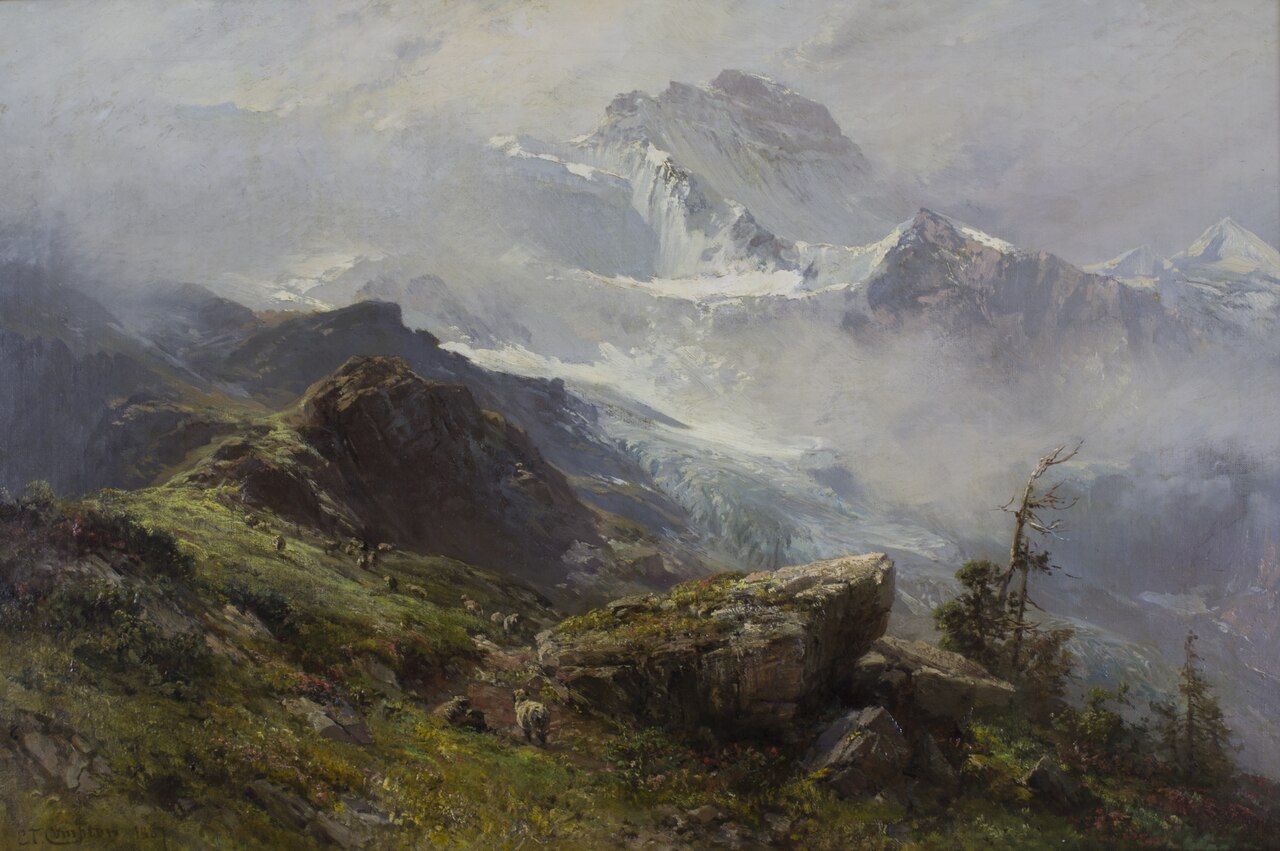
Signature techniques Compton’s alpine scenes are characterised by several recurring technical approaches: - **Atmospheric perspective:** He rendered distant peaks with muted colours and softened outlines, creating a convincing sense of depth that mirrors the way light diffuses in high‑altitude air. - **Precise line work:** Even in fully painted works, the underlying structure often shows the influence of his drawing background, with crisp outlines that delineate rock formations and glacier edges. - **Dynamic lighting:** He captured the fleeting qualities of alpine light—sunrise glows, midday starkness, and twilight shadows—by using a restrained palette that emphasises the contrast between illuminated snow and darker rock. - **Scale and human figures:** Small, often solitary figures are placed within vast landscapes, underscoring the grandeur of the mountains and the humility of the climber. - **Textural fidelity:** Whether depicting the granular surface of a glacier or the delicate brush of alpine flora, Compton paid close attention to texture, lending his works an almost photographic realism while preserving artistic expression.
These techniques together create paintings that feel both documentary and poetic, a balance that contributed to his reputation as a leading alpine artist.
Major works Compton’s oeuvre includes several paintings that have become reference points for Alpine art: - **The Jungfrau (1887):** This early masterpiece presents the iconic Jungfrau peak bathed in soft morning light. The composition centres the mountain’s massive bulk against a sky that transitions from pale blue to warm gold, illustrating Compton’s skill in rendering atmospheric effects. - **Mountainous landscape (1900):** Produced at the turn of the century, this work showcases a broader vista of rugged peaks and valleys. The painting’s balanced horizon line and measured placement of human activity highlight the painter’s mature control over composition. - **Saleinaz Glacier (1906):** In this piece Compton focuses on the icy surface of the Saleinaz Glacier, emphasizing texture and the subtle colour shifts within the ice. The work is noted for its meticulous depiction of crevasses and the interplay of light on snow. - **High mountain landscape (1908):** This later work reflects a more dramatic use of contrast, with stark white snow against dark rock silhouettes. The painting conveys both the grandeur and the peril of high‑altitude environments. - **Snow Scene on the Col d’Orny, Valais, Switzerland (1914):** One of his final known Alpine paintings, it captures a remote mountain pass under heavy snowfall. The subdued palette and careful rendering of the snow‑laden terrain convey a sense of solitude and the harsh conditions faced by climbers.
Each of these paintings demonstrates Compton’s consistent dedication to accuracy, his evolving handling of light, and his ability to evoke the emotional resonance of the mountains.
Influence and legacy Edward Theodore Compton occupies a unique niche at the intersection of art and mountaineering. His paintings were widely reproduced in travel books, scientific journals, and Alpine guides, providing visual documentation for an audience that extended beyond traditional art collectors. By combining artistic skill with firsthand climbing experience, he set a standard for later Alpine illustrators such as Hans Gasser and Josef Moroder, who similarly sought to portray the mountains with both aesthetic beauty and topographic fidelity.
Compton’s work also contributed to the growing public fascination with mountain tourism in the late 19th and early 20th centuries. His images helped popularise destinations like the Jungfrau and the Valais region, influencing travel writers and early photographers. Museums in Germany and Switzerland continue to hold his paintings, and his sketches are frequently cited in mountaineering histories as visual records of routes that have since changed due to glacial retreat.
In the broader context of art history, Compton is recognised as a precursor to the 20th‑century landscape movements that emphasized the sublime power of nature. While he never aligned himself with a specific avant‑garde group, his commitment to depicting the raw, unmediated experience of high‑altitude environments paved the way for later artists who explored environmental themes.
Today, collectors, historians, and climbers alike value his work for its dual authenticity: as fine art that captures the majesty of the Alps, and as a historical record of early Alpine exploration. His legacy endures in the continued appreciation of mountain art and in the recognition of the artist‑explorer archetype that he so elegantly embodied.
Frequently asked questions
Who was Edward Theodore Compton?
Edward Theodore Compton (1849–1921) was an English‑born German painter, illustrator and mountaineer best known for his detailed Alpine landscapes and for completing over 300 major climbs.
What artistic style or movement is he associated with?
Compton is not tied to a single movement; his work blends Realist precision with Romantic and Symbolist influences, focusing on the sublime qualities of high‑altitude scenery.
What are his most famous works?
Key paintings include The Jungfrau (1887), Mountainous landscape (1900), Saleinaz Glacier (1906), High mountain landscape (1908) and Snow Scene on the Col d’Orny (1914).
Why is Edward Theodore Compton important in art history?
He pioneered the realistic yet poetic portrayal of Alpine environments, linking artistic practice with mountaineering experience and influencing later landscape and mountain artists.
How can I recognise a painting by Edward Theodore Compton?
Look for meticulous line work, atmospheric perspective, subtle lighting on snow and rock, small human figures set against vast peaks, and an overall balance of documentary accuracy with romantic mood.