Eduard Bendemann
1811 – 1889
In short
Eduard Bendemann (1811–1889) was a German‑Jewish painter born in Berlin and later based in Düsseldorf, noted for his history, genre and portrait works such as 'Jews Mourning in Exile' and 'Two Girls at the Well'. His career spanned the early to late 19th century, bridging Romantic sensibilities and academic painting.
Notable works

.jpg)
,_(1830-31).jpg)

Early life Eduard Julius Friedrich Bendemann was born in 1811 in Berlin, then part of the Kingdom of Prussia. He grew up in a culturally engaged Jewish family that valued education and the arts. Early exposure to drawing and classical literature shaped his ambition to become a painter. After completing basic schooling, Bendemann entered the Berlin Academy of Arts, where he received formal training in drawing, anatomy and the study of Old Master techniques. His teachers encouraged a disciplined approach to composition, which would later become a hallmark of his work.
Career and style Around 1830 Bendemann moved to Düsseldorf, a city that had become a centre for German painting under the influence of the Düsseldorf School. The city’s artistic community offered him opportunities to exhibit and to collaborate with established artists. While his precise affiliation with a single movement remains ambiguous, his style reflects the Romantic interest in narrative drama combined with the academic emphasis on precise draftsmanship. Bendemann favoured historical and literary subjects, often imbuing them with a moral or emotional undercurrent that resonated with contemporary audiences.
Throughout the 1830s and 1840s he participated in the annual exhibitions of the Kunstverein Düsseldorf and the Royal Academy in Berlin. Critics noted his ability to render figures with a subtle psychological depth, a quality that distinguished his genre scenes from more decorative contemporaries. By the 1850s he had secured a reputation as a reliable portraitist, receiving commissions from both private patrons and civic institutions. His later work, produced in the 1870s, shows a gradual softening of palette and a more relaxed handling of brushwork, suggesting an adaptation to evolving tastes while retaining his compositional rigor.
Signature techniques Bendemann’s paintings are characterised by several recurring technical choices:
* Controlled chiaroscuro – He employed light and shadow to model forms with a three‑dimensional quality, often using a narrow light source to focus attention on the central figures. * Meticulous underdrawing – Surviving sketches reveal that he prepared his canvases with detailed charcoal or ink studies, ensuring accurate anatomy and perspective before applying paint. * Layered glazing – In oil, Bendemann built colour through thin, translucent layers, which gave his surfaces a luminous depth and allowed subtle tonal shifts. * Narrative framing – He frequently positioned figures within architectural or natural settings that reinforce the story, using architectural elements such as arches, columns or interior doorways as compositional anchors. * Fine brushwork in facial features – Portraits display a delicate handling of eyes, lips and skin tones, creating a sense of individuality while maintaining an overall harmony with the surrounding environment.
These techniques combined to produce works that are both technically proficient and emotionally resonant.
Major works
The Schadow Circle (1830) – One of Bendemann’s earliest known canvases, this painting depicts a group of artists gathered around the sculptor Johann Gottfried Schadow. The composition showcases Bendemann’s interest in artistic community and his skill in rendering multiple figures within a coherent space. The work’s muted palette and careful attention to facial expression hint at his later narrative style.
Jews Mourning in Exile (1832) – A powerful history painting, it portrays a biblical scene of exile, emphasizing collective grief. Bendemann’s use of chiaroscuro heightens the emotional impact, while the detailed rendering of clothing and setting reflects his academic training. The piece was exhibited at the Berlin Academy and attracted notice for its sympathetic portrayal of a Jewish subject during a period of limited representation.
Two Girls at the Well (1833) – This genre work captures a quiet moment of everyday life, with two young women drawing water from a stone well. The painting demonstrates Bendemann’s ability to infuse simple scenes with narrative potential; the girls’ gestures suggest conversation and anticipation. The meticulous rendering of the well’s stonework and the soft, diffused light exemplify his early mastery of texture and atmosphere.
Portrait of Lida Bendemann (1847) – A personal commission, this portrait presents Lida, likely a family member, in a three‑quarter view against a neutral background. The work is notable for its psychological depth; Bendemann captures a contemplative expression, using subtle tonal variations to model the face. The portrait illustrates his competence as a portraitist and his capacity to convey individuality within a restrained compositional framework.
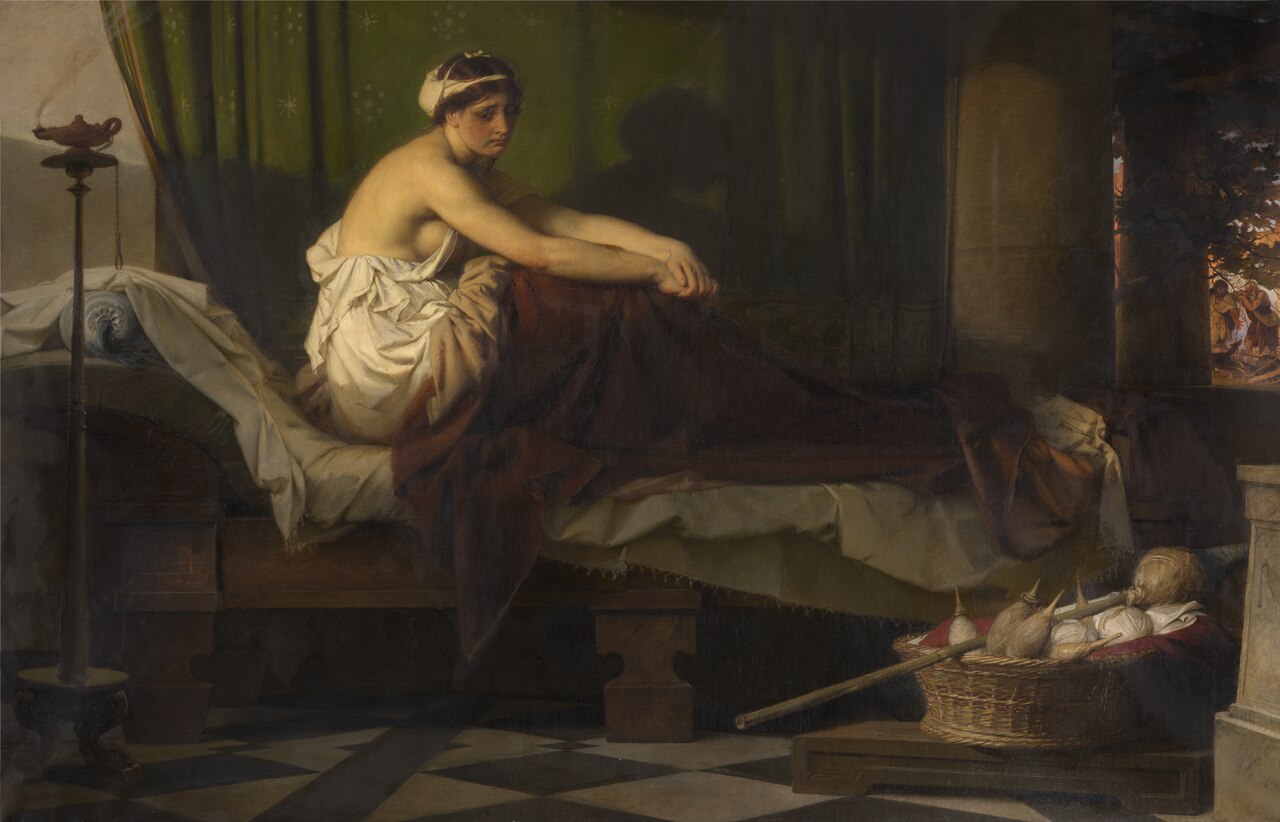
The Awakened Penelope Waits for the Return of Ulysses (1877) – Created late in his career, this mythological composition revisits the classical theme of Penelope’s fidelity. Bendemann places the heroine in a domestic interior, illuminated by a single lamp, suggesting both anticipation and solitude. The painting’s softer colour scheme and looser brushstrokes indicate an adaptation to late‑19th‑century aesthetic trends, while the narrative focus remains consistent with his earlier oeuvre.
These works collectively reveal Bendemann’s consistent engagement with narrative subjects, his technical refinement, and his capacity to evolve stylistically over a long career.
Influence and legacy Eduard Bendemann never achieved the fame of some of his Düsseldorf contemporaries, yet his paintings contributed to the visual vocabulary of 19th‑century German art. By portraying Jewish historical themes, he provided early visual representation of a community that was often marginalised in mainstream academic painting. His genre scenes and portraits offered a model of disciplined composition that later artists in the Düsseldorf School could reference.
In the decades after his death in 1889, Bendemann’s works were collected by regional museums in Düsseldorf and Berlin, where they served as exemplars of the transition from Romantic historicism to a more restrained academic realism. Art historians regard his oeuvre as a useful barometer for the shifting tastes of German audiences between the 1830s and 1870s. Contemporary scholars also cite his paintings when discussing the broader inclusion of Jewish subjects in European art, noting that his sympathetic treatment pre‑figured later, more overtly political works.
While his name may not appear in every general survey of German painting, Bendemann’s paintings continue to be exhibited in thematic shows on 19th‑century genre and history painting, and they remain a point of reference for researchers exploring the intersection of cultural identity and artistic practice in the Kingdom of Prussia.
Overall, Eduard Bendemann stands as a diligent practitioner whose disciplined technique, narrative focus, and occasional engagement with Jewish themes enrich the tapestry of 19th‑century European art.
Frequently asked questions
Who was Eduard Bendemann?
Eduard Bendemann (1811–1889) was a German‑Jewish painter born in Berlin who worked mainly in Düsseldorf, known for history, genre and portrait paintings.
What artistic style or movement is he associated with?
Bendemann is not tied to a single movement; his work blends Romantic narrative interests with the academic realism of the Düsseldorf School.
What are his most famous works?
His best‑known paintings include 'Jews Mourning in Exile' (1832), 'Two Girls at the Well' (1833), 'The Schadow Circle' (1830), 'Portrait of Lida Bendemann' (1847) and 'The Awakened Penelope Waits for the Return of Ulysses' (1877).
Why is Eduard Bendemann important in art history?
He contributed to 19th‑century German painting by combining disciplined technique with narrative content, and he offered early visual representation of Jewish historical subjects within academic art.
How can I recognise a Bendemann painting?
Look for carefully drawn figures, controlled chiaroscuro, layered glazing, and a narrative setting that often includes architectural or domestic details, all rendered with a restrained, academic palette.