Edouard Agneessens
1842 – 1885
In short
Edouard Agneessens (1842–1885) was a Belgian academic painter from Brussels who studied under Jean‑François Portaels, won the Prix de Rome in 1869, and co‑founded the Société Libre des Beaux‑Arts. He is known for his refined portraits such as Mathilde Costermans (1874) and the Portrait of Diana Vernon (1876).
Notable works


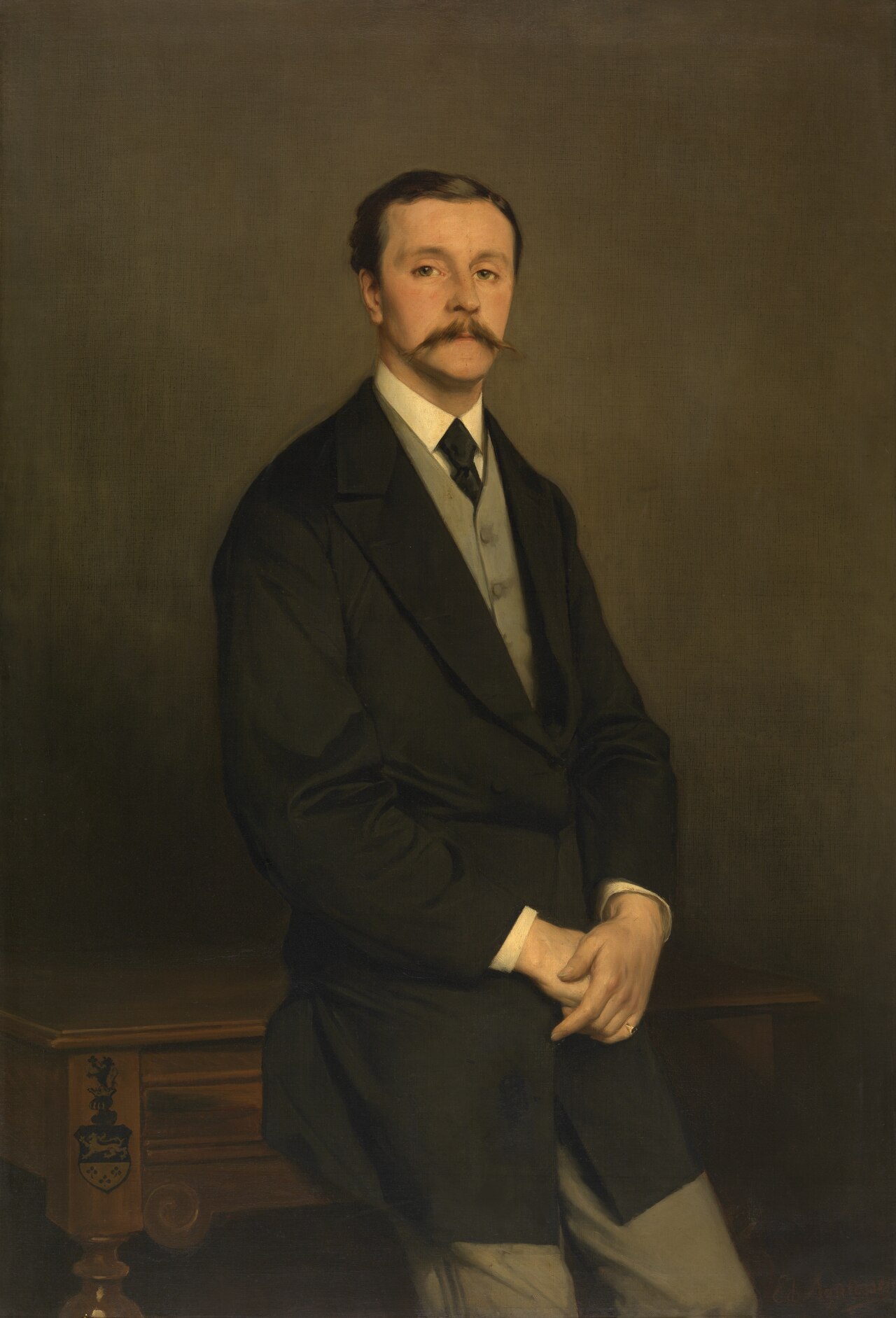
.jpg)
.jpg)
Early life Edouard Agneessens was born in Brussels in 1842. Growing up in a city that was a vibrant centre for artistic training, he entered the Académie Royale des Beaux‑Arts at a young age. From 1859 he studied under the eminent painter Jean‑François Portaels, whose teaching emphasized rigorous drawing, careful observation of nature, and a strong grounding in the classical tradition. This formative period gave Agneessens a solid technical foundation and an appreciation for the academic standards that would dominate his later work.
Career and style After completing his studies, Agneessens quickly emerged as a promising talent within the Belgian art world. In 1868 he was among the founding members of the Société Libre des Beaux‑Arts, a progressive association that sought to promote artistic freedom while still respecting the academic heritage. The following year he secured the prestigious Prix de Rome, which allowed him to travel to Italy and study the masterpieces of the Renaissance and Baroque periods. These experiences deepened his commitment to the academic style, characterised by meticulous draftsmanship, balanced composition, and a restrained palette.
Agneessens’ oeuvre is principally portraiture, but his approach reflects a synthesis of academic precision and a subtle sensitivity to the psychological presence of his sitters. He adhered to the conventions of academic art—clear modelling of forms, careful handling of light, and smooth brushwork—while also incorporating a modest degree of naturalism that hinted at the evolving tastes of the late‑19th century. His paintings are marked by an elegant restraint, avoiding overt dramatics in favour of compositional harmony and a dignified portrayal of his subjects.
Signature techniques Agneessens employed several technical hallmarks that make his work recognisable:
* Layered glazing – He built colour through successive thin layers, achieving depth and luminosity without heavy impasto. This method contributed to the soft modelling of flesh tones and the subtle gradations of shadow. * Controlled line work – Even in fully painted passages, the underlying drawing remains evident, a testament to his rigorous academic training. Precise contours define the faces and hands of his sitters, lending clarity to their features. * restrained palette – His colour choices are often muted, favouring earth tones, subdued blues, and warm ochres. This palette reinforces the dignified atmosphere of his portraits. * Subtle texture – While the overall surface appears smooth, careful observation reveals delicate textural variations in fabrics and hair, achieved through fine brushstrokes rather than broad, gestural marks.
These techniques combine to produce portraits that are both technically accomplished and emotionally resonant.
Major works Agneessens’ most frequently cited pieces illustrate his mastery of academic portraiture.
* Mathilde Costermans (1874) – This portrait captures the young woman with a calm, introspective gaze. The composition places her against a muted background, allowing the nuanced modelling of her face and the soft sheen of her dress to dominate the visual field. * César Costermans (1874) – Executed in the same year, this work presents a male sitter with a dignified posture. Agneessens uses a restrained colour scheme and careful lighting to emphasise the sitter’s features, while the subtle rendering of the clothing hints at the subject’s social standing. * Portrait of a Man – Though the sitter’s identity remains uncertain, the painting exemplifies Agneessens’ skill in conveying personality through restrained expression and the interplay of light across the facial plane. * Portrait of Diana Vernon (1876) – This later work demonstrates a more mature handling of light, with a luminous quality that enhances the sitter’s complexion. The background recedes, focusing attention on the elegant pose and the delicate details of the attire. * Portrait of General Nijpels and his Family – A multi‑figure composition, this painting showcases Agneessens’ ability to organise a group while maintaining individual characterisation. The general is rendered with a sense of authority, while the surrounding family members are depicted with gentle affection, all within a harmonious compositional framework.
These works collectively illustrate Agneessens’ consistent adherence to academic conventions, his careful observation of texture, and his capacity to infuse portraiture with a quiet psychological depth.
Influence and legacy Although Agneessens died relatively young, at the age of 43 in Uccle, his contributions to Belgian academic painting were significant. As a member of the Société Libre des Beaux‑Arts, he helped shape a community that balanced respect for tradition with an openness to new ideas. His portraits, prized for their technical excellence and subtle characterisation, served as exemplars for younger Belgian artists seeking to master the academic style.
In the broader context of 19th‑century European art, Agneessens represents a bridge between the strict classicism of early academic painting and the emerging naturalism that would later influence the Impressionists and Symbolists. While he never abandoned the academic framework, his nuanced handling of light and his restrained colour palette anticipate the softer, more atmospheric approaches that followed.
Today, Agneessens’ paintings are held in several Belgian museum collections and continue to be studied for their exemplary technique. Art historians regard his work as a valuable record of Belgian portraiture during a period of cultural transition, and his legacy endures in the ongoing appreciation of academic artistry within the nation’s artistic heritage.
Frequently asked questions
Who was Edouard Agneessens?
Edouard Agneessens (1842–1885) was a Belgian painter known for his academic portraiture, a Prix de Rome winner, and a co‑founder of the Société Libre des Beaux‑Arts.
What style or movement is he associated with?
He worked within the academic art tradition, combining rigorous draftsmanship with a restrained, naturalistic palette.
What are his most famous works?
His best‑known paintings include the portraits Mathilde Costermans (1874), César Costermans (1874), Diana Vernon (1876), and the family portrait of General Nijpels.
Why does Agneessens matter in art history?
He exemplifies the high level of technical skill in Belgian academic painting and helped shape the artistic community that balanced tradition with emerging modern ideas.
How can I recognise an Agneessens painting?
Look for smooth, layered glazing, precise line work, a muted colour palette, and a calm, dignified portrayal of the sitter with subtle textural detail.