Derick Baegert
1440 – 1515
In short
Derick Baegert (1440–1515) was a German late‑Gothic painter from Wesel, known for religious panels such as Pilate Washing His Hands and Holy Kinship. His work reflects the devotional art of northern Germany in the late 15th and early 16th centuries.
Notable works



Early life Derick Baegert was born in 1440 in the town of Wesel, a trading centre on the lower Rhine that was part of the Holy Roman Empire. Little is recorded about his family background, but the city’s thriving commercial life provided a fertile environment for artistic training. It is likely that Baegert began his apprenticeship in a local workshop, where the dominant visual language was the late Gothic style that characterised northern German painting at the time. By the mid‑15th century Wesel had a modest but active market for altarpieces and devotional panels, creating a demand for skilled painters who could meet the expectations of both ecclesiastical patrons and private confraternities.
Career and style Baegert’s career unfolded during a period of transition in German art. The late Gothic idiom, with its intricate detail, rich colour palette and emphasis on narrative clarity, remained the prevailing aesthetic, even as early Renaissance influences began to filter in from the Low Countries. Baegert worked primarily for churches and monasteries in the Rhineland, producing altarpieces that combined traditional iconography with a personal sensitivity to human expression. His figures are often rendered with a solid, sculptural presence, and his compositions display a careful balance between foreground action and background depth. While he never travelled extensively, the occasional exchange of prints and sketches with neighbouring artistic centres allowed him to absorb contemporary trends without abandoning his regional visual vocabulary.
Signature techniques Baegert’s paintings are distinguished by several technical hallmarks. First, his use of tempera and oil in layered glazes creates a luminous surface that enhances the tactile quality of fabrics and metalwork. He frequently employed a fine, linear brushstroke to delineate the edges of garments, a technique that imparts a crispness to the figures. Second, his handling of light is subtle yet purposeful; illumination often falls on the faces of central saints, drawing the viewer’s eye to their expressions while casting peripheral figures into softer shadow. Third, Baegert demonstrated a particular skill in rendering architectural elements—arches, columns and vaulted ceilings—using a restrained perspective that suggests depth without the full linear rigour later associated with the Renaissance. Finally, his attention to narrative detail—such as the inclusion of small, symbolic objects—adds layers of meaning that reward close viewing.
Major works Among Baegert’s surviving oeuvre, five panels illustrate his artistic range. **Pilate Washing His Hands (1480)** portrays the biblical moment of Pontius Pilate’s ritual cleansing, a subject that allowed Baegert to explore both psychological tension and ceremonial detail. The composition places Pilate centrally, his gestures rendered with a measured calm that contrasts with the anxious faces of surrounding onlookers. The painter’s handling of the wet hand‑washing basin demonstrates his skill in depicting reflective surfaces.
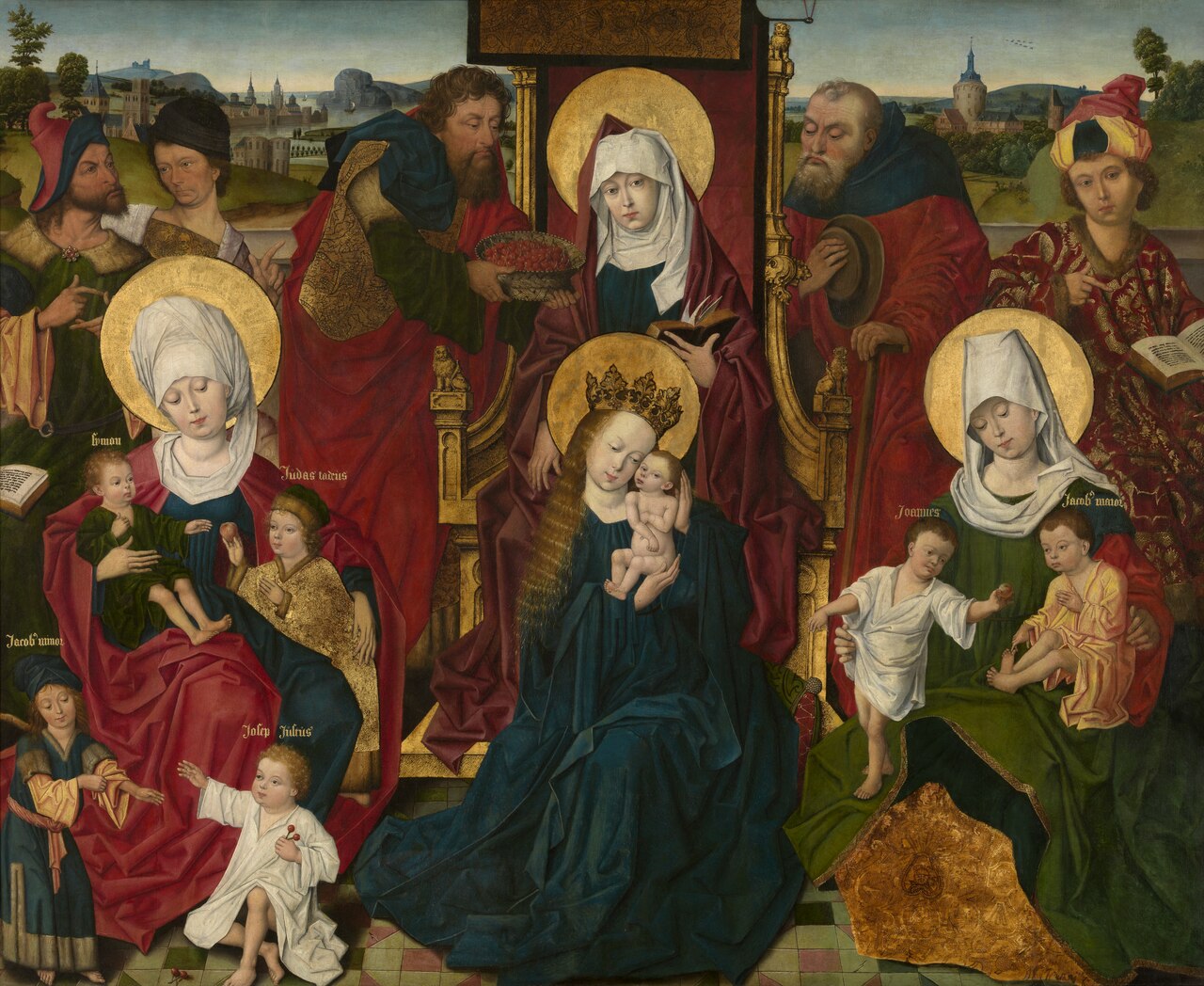
Holy Kinship (1500) is a large altarpiece that brings together multiple generations of the Virgin Mary’s family. Baegert arranges the figures in a harmonious grouping, using a muted colour scheme of reds, blues and golds to unify the scene. The work reflects the devotional focus on lineage and sanctity that was popular in late medieval Germany, and it showcases Baegert’s ability to manage complex groupings without visual clutter.
The panel Saint Veronica and a Group of Knights combines a saintly encounter with a martial audience. Baegert renders Saint Veronica’s compassionate gesture—offering her veil to Christ’s image—with a gentle softness, while the knights are depicted in armour that reveals his meticulous attention to texture and reflective detail. The juxtaposition underscores the theme of piety intersecting with worldly power.
In Knights and Soldiers Playing Dice for Christ’s Robe (1477), Baegert captures a moment of moral ambiguity: soldiers gamble for the garments of a crucified Christ. The scene is animated, with dynamic poses and a palpable sense of movement. Baegert’s use of chiaroscuro highlights the tension between the divine and the profane, while the dice themselves become a visual focal point.
Lastly, Christ Bearing the Cross (1477) presents the Passion narrative with a solemn, introspective tone. The figure of Christ is rendered with a weighty realism; the cross’s wooden texture is rendered in fine detail, and the surrounding landscape recedes into a muted horizon, emphasising the central figure’s suffering. This work exemplifies Baegert’s capacity to convey spiritual gravitas through compositional restraint.
Influence and legacy Derick Baegert’s output contributed to the visual culture of the Rhineland at a time when local churches sought artworks that combined devotional clarity with artistic quality. Though he never achieved the fame of contemporaries such as Albrecht Dürer, his panels were widely circulated within the region and served as models for lesser‑known workshop painters. Baegert’s careful treatment of light, his nuanced rendering of textiles, and his narrative sensitivity anticipated the more naturalistic approaches that would later dominate northern European painting. Modern scholarship regards him as a representative figure of the late Gothic tradition, whose work bridges the medieval devotional emphasis and the emerging interest in human emotion that characterised the early modern period. His surviving panels continue to be studied for their technical proficiency and as evidence of the artistic vitality of smaller German towns during the late 15th century.
Frequently asked questions
Who was Derick Baegert?
Derick Baegert (1440–1515) was a German late‑Gothic painter from Wesel, known for religious panels such as Pilate Washing His Hands and Holy Kinship.
What style or movement is Baegert associated with?
He worked within the late Gothic tradition of northern Germany, employing detailed narrative composition and emerging oil‑tempera techniques.
What are his most famous works?
His most cited works include Pilate Washing His Hands (1480), Holy Kinship (1500), Saint Veronica and a Group of Knights, Knights and Soldiers Playing Dice for Christ’s Robe (1477), and Christ Bearing the Cross (1477).
Why is Baegert important in art history?
Baegert exemplifies the high quality of regional late Gothic painting, bridging medieval devotional art and the early modern interest in human emotion, and influencing later northern European painters.
How can I recognise a Baegert painting?
Look for finely rendered fabrics, subtle lighting that highlights saintly faces, meticulous depiction of metal and wood, and narrative scenes that balance detailed background architecture with clear, expressive figures.