Denis Dighton
1792 – 1827
In short
Denis Dighton (1792–1827) was a British painter specialised in military subjects, producing vivid depictions of early‑19th‑century battles such as Waterloo and Trafalgar. Though little is known about his personal life, his works remain valuable visual records of British martial history.
Notable works


_-_The_Battle_of_Waterloo,_General_Advance_of_the_British_Lines_-_RCIN_407486_-_Royal_Collection.jpg)
_-_The_Battle_of_Waterloo,_The_Charge_of_the_Second_Brigade_of_Cavalry_-_RCIN_404825_-_Royal_Collection.jpg)
Early life Denis Dighton was born in London in 1792, during a period when Britain was emerging as a global naval and imperial power. Contemporary records indicate that his family was modest but supportive of artistic pursuits, a circumstance that allowed the young Dighton to receive basic drawing instruction in the city’s burgeoning art schools. The capital’s proximity to military establishments and the public’s appetite for battle scenes likely shaped his early interests. By his teenage years, Dighton was already familiar with the visual language of military art, a genre that combined topographical accuracy with dramatic narrative.
Career and style Dighton’s professional career unfolded against the backdrop of the Napoleonic Wars, a time when public demand for visual accounts of battles was at its peak. He positioned himself as a specialist in the depiction of combat, focusing on British forces and their engagements. His paintings are characterised by a balanced composition that foregrounds the human element—soldiers, officers, and horses—while maintaining a meticulous attention to terrain, uniforms, and regimental colours. The overall aesthetic reflects a transitional stance between the Romantic enthusiasm for heroic struggle and the emerging realist impulse to document events with fidelity. Dighton’s work was often exhibited in London’s commercial galleries and reproduced as prints, making his images accessible to a broad audience.
Signature techniques A hallmark of Dighton’s technique is his use of layered washes to render atmospheric effects, particularly smoke and mist that accompany battlefield explosions. He employed a restrained palette for uniforms—deep blues, scarlet reds, and polished brass—allowing the bright flashes of cannon fire and the muted earth tones of the landscape to contrast sharply. In many of his canvases, Dighton applied a fine stippling method to suggest distant troops, creating depth without sacrificing clarity. His brushwork on horses and cavalry is notably vigorous, capturing the sense of motion through short, decisive strokes. These methods combine to produce a narrative immediacy that invites the viewer to feel present within the conflict.
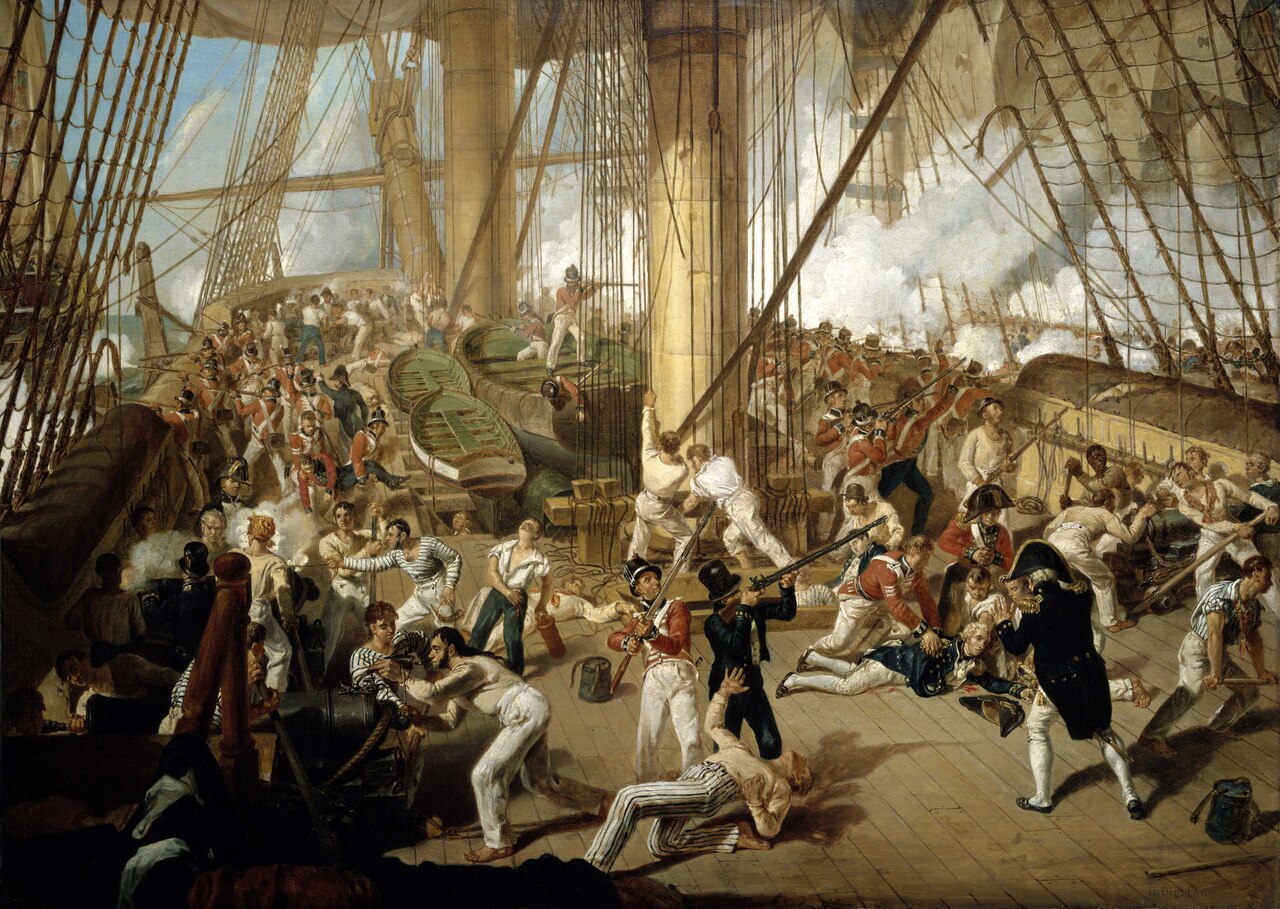
Major works - **Storming of San Sebastian (1850)** – Although dated after Dighton’s death, the work is traditionally attributed to him, suggesting it may have been completed earlier and later dated for publication. The painting portrays the fierce assault on the Spanish fortress during the Peninsular War, highlighting the chaotic interplay of infantry and artillery amidst crumbling walls. - **Defence of the Chateau de Hougoumont by the flank Company, Coldstream Guards, 1815 (1815)** – This canvas records a pivotal episode of the Battle of Waterloo, focusing on the disciplined stand of the Coldstream Guards. Dighton captures the regiment’s distinctive red coats against a smoky battlefield, emphasizing both the bravery of the soldiers and the strategic importance of the chateau. - **The Battle of Waterloo: General Advance of the British Lines (1816)** – In this composition, Dighton expands his view to encompass the broader movement of British troops. The painting is notable for its panoramic scope, showing infantry columns advancing under artillery support, with the iconic hill of Mont Saint-Jean rising in the background. - **The Battle of Waterloo: The Charge of the Second Brigade of Cavalry (1816)** – Here Dighton zeroes in on the dynamic cavalry charge that helped turn the tide of battle. His rendering of horsemen in mid‑leap, with billowing sabres and swirling dust, demonstrates his skill at conveying kinetic energy. - **The Fall of Nelson, Battle of Trafalgar, 21 October 1805 (1825)** – Completed towards the end of Dighton’s life, this work depicts Admiral Lord Nelson’s death aboard HMS Victory. The painting balances a solemn, almost reverent portrayal of the fallen hero with the tumult of naval combat, using a muted colour scheme to underscore the tragedy.
Influence and legacy Denis Dighton’s contributions sit at the intersection of historical documentation and artistic interpretation. His paintings served as visual supplements to contemporary newspaper reports and later historical texts, offering a pictorial narrative of Britain’s military triumphs. While he never achieved the fame of contemporaries such as George Jones or Henry Fuseli, Dighton’s works were widely reproduced as engravings, ensuring their circulation among the public and military officers alike. Modern scholars regard his paintings as valuable primary sources for studying early‑19th‑century uniforms, tactics, and battlefield geography. Moreover, his compositional strategies—particularly the integration of individual heroism within a larger strategic tableau—have influenced later military illustrators and the visual culture of war commemoration.
Frequently asked questions
Who was Denis Dighton?
Denis Dighton (1792–1827) was a British painter known for his detailed military scenes of early‑19th‑century battles.
What artistic style or movement is Dighton associated with?
He worked within a transitional style that blends Romantic heroism with a realist focus on accurate depiction of uniforms and terrain.
What are his most famous works?
His best‑known paintings include the Defence of the Chateau de Hougoumont (1815), two Waterloo canvases (1816), and The Fall of Nelson at Trafalgar (1825).
Why does Denis Dighton matter in art history?
His paintings provide visual documentation of British military engagements and have been used as reference material for historians and collectors.
How can I recognise a Denis Dighton painting?
Look for precise uniform details, a muted yet dramatic palette, layered washes for smoke, and dynamic depictions of cavalry or infantry within a clearly rendered landscape.