Charles Venneman
1802 – 1875
In short
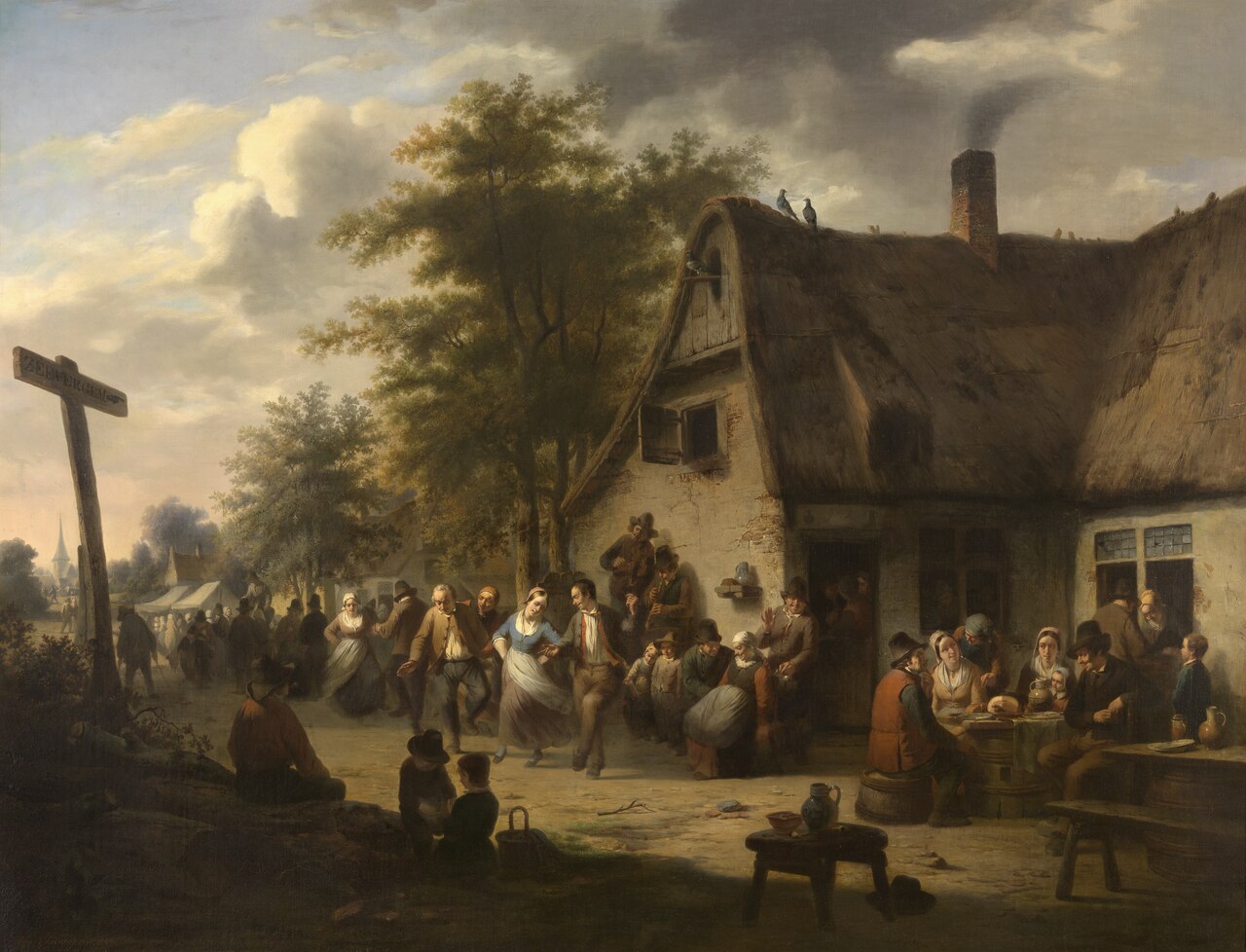
Charles Venneman (1802–1875) was a Belgian painter known for his anecdotal genre scenes, depictions of Flemish fairs, and animal‑laden landscapes. He worked chiefly in the mid‑19th century, producing works such as Flemish Kermis (1849) and Passing the Candle (1847).
Notable works


_-_The_Itinerant_Fiddler_(copy_after_Adriaen_van_Ostade)_-_TWCMS_,_B8438_-_Shipley_Art_Gallery.jpg)
Early life Charles Venneman was born in 1802 in the historic city of Ghent, Belgium. Little is recorded about his family background, but like many aspiring artists of his generation he likely received his first artistic instruction locally before entering formal study. Ghent was home to a respected Royal Academy of Fine Arts, which attracted young talents from across the region; it is probable that Venneman pursued his foundational training there, absorbing the academic emphasis on drawing, composition, and the study of the Old Masters. The early 19th‑century Belgian art scene was still heavily influenced by the legacy of the Dutch Golden Age, and young painters were encouraged to master genre subjects that depicted everyday life with moral or narrative undertones.
Career and style After completing his education, Venneman established himself as a professional painter in the 1820s and 1830s, a period when Belgium was forging its national identity following independence in 1830. He gravitated toward anecdotal genre scenes, a choice that aligned him with a tradition stretching back to Pieter Bruegel the Elder and later Dutch genre painters such as Jan Steen and Adriaen van Ostade. Venneman’s canvases frequently portray bustling market fairs, intimate interior gatherings, and pastoral landscapes populated with cattle, sheep, and other farm animals. Though no formal movement claims his name, his work can be situated within the broader Belgian genre‑painting tradition, which sought to combine realistic observation with a gentle, often sentimental narrative tone.
Signature techniques Venneman’s technique is marked by careful draftsmanship and a restrained yet vivid colour palette. He often employed a warm, earthy base—ochres, muted greens, and soft browns—to evoke the rustic ambience of Flemish village life. Light is rendered with subtle gradations, allowing domestic interiors to glow softly while outdoor scenes capture the diffused daylight of early morning or late afternoon. His brushwork varies between fine, precise strokes for detailed figures and looser, more painterly passages for foliage and background architecture. This duality gives his paintings a sense of depth and immediacy, inviting viewers to linger on the narrative details without losing the overall compositional harmony.
Major works Among Venneman’s most celebrated pieces is **Flemish Kermis (1849)**, a lively tableau of a village fair. The composition brims with activity: merchants hawk their wares, children chase one another, and a central band of musicians provides a festive soundtrack. Venneman captures the exuberance of the celebration while subtly highlighting the social hierarchies at play, a hallmark of his narrative sensibility. **Passing the Candle (1847)** offers a quieter, more intimate glimpse into domestic life. In this work a candle is handed from one figure to another, the act illuminated by a warm, amber light that draws attention to the faces and gestures of the participants, underscoring themes of generosity and communal responsibility.
Another notable canvas, Interior Scene, depicts a modest household interior where figures engage in everyday tasks—reading, sewing, or sharing a modest meal. The careful arrangement of objects, from a wooden table to a hanging tapestry, showcases Venneman’s skill in rendering texture and spatial relationships. Finally, The Itinerant Fiddler, a copy after Adriaen van Ostade, demonstrates Venneman’s reverence for his Dutch predecessors. By reproducing a work by Ostade, he not only paid homage to a master of genre painting but also refined his own approach to depicting itinerant musicians, a recurring motif in his original oeuvre.
Influence and legacy During his lifetime Venneman exhibited regularly in Brussels and Ghent, gaining a modest reputation among collectors who appreciated his ability to render the charm of Flemish daily life. Though he never achieved the fame of contemporaries such as Antoine Wiertz or the later Symbolist painters, his paintings contributed to the preservation of 19th‑century Belgian rural culture at a time of rapid industrialisation. After his death in 1875 in Saint‑Josse‑ten‑Noode, his works entered the collections of regional museums and private holdings, where they continue to serve as visual documents of a bygone era. Modern scholars view Venneman as a bridge between the Dutch Golden Age genre tradition and the more romantic, nationalist currents that would dominate Belgian art in the late 19th century. His meticulous attention to narrative detail and his skillful handling of light and colour remain instructive for students of genre painting, and his works are occasionally featured in exhibitions exploring the social history of Belgium.
Overall, Charles Venneman occupies a niche but respected place in Belgian art history: a painter whose gentle, narrative‑driven canvases preserve the textures of everyday life and whose technical competence reflects the academic training of his generation.
Frequently asked questions
Who was Charles Venneman?
Charles Venneman (1802–1875) was a Belgian painter known for genre scenes, Flemish fairs, and animal‑filled landscapes.
What artistic style or movement is he associated with?
He is linked to the Belgian genre‑painting tradition, drawing on the Dutch Golden Age’s anecdotal style rather than a specific modern movement.
What are his most famous works?
His best‑known paintings include Flemish Kermis (1849), Passing the Candle (1847), Interior Scene, and his copy of The Itinerant Fiddler after Adriaen van Ostade.
Why does Charles Venneman matter in art history?
He preserved mid‑19th‑century Flemish daily life through detailed genre scenes, bridging earlier Dutch traditions with emerging Belgian artistic identity.
How can I recognise a painting by Venneman?
Look for warm, earthy colours, careful light effects, narrative detail of village fairs or domestic interiors, and a subtle mix of precise figure work with looser background brushstrokes.