Charles Joshua Chaplin
1825 – 1891
In short
Charles Joshua Chaplin (1825‑1891) was a French painter and printmaker celebrated for his refined portraits of young women, working in oil, watercolor, pastel and various print media.
Notable works
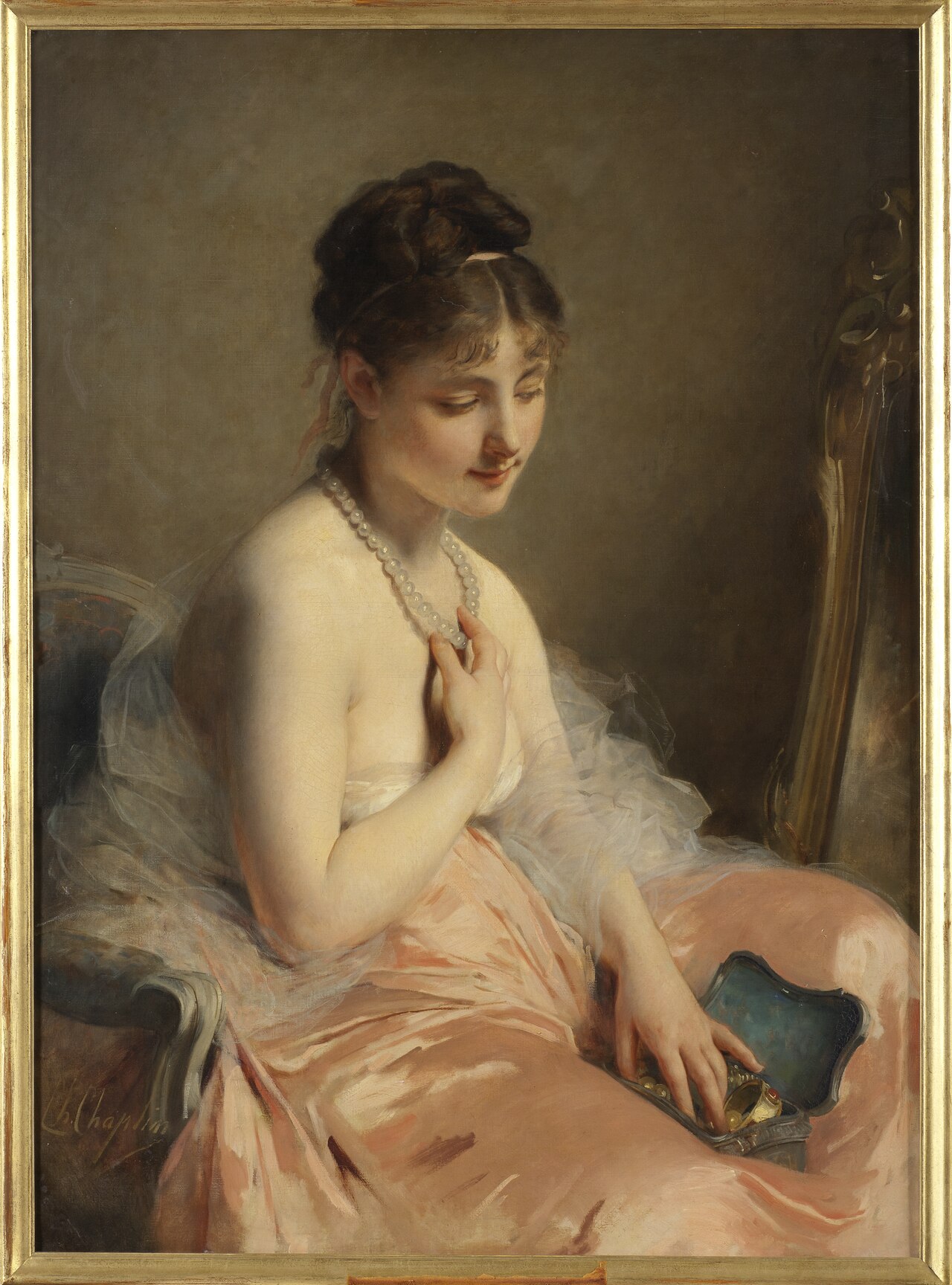


Early life Charles Joshua Chaplin was born in 1825 in the Normandy town of Les Andelys. Little is recorded about his family background, but like many provincial artists of his generation he moved to Paris to pursue formal artistic training. The capital offered access to the École des Beaux‑Arts and the vibrant salon culture that shaped the careers of many nineteenth‑century French painters. Chaplin’s early exposure to the academic tradition equipped him with a solid grounding in drawing, composition and the technical skills that would later define his diverse body of work.
Career and style By the mid‑1850s Chaplin had established himself as a portraitist whose work appealed to the tastes of the Parisian bourgeoisie. He specialised in depictions of young women, rendering them with an elegant poise and a subtle sense of intimacy. His portraits are characterised by a gentle modelling of flesh, a restrained yet expressive use of colour, and an attention to the details of dress and accessories that convey both fashion and personality.
Although portraiture formed the core of his reputation, Chaplin also painted landscapes and genre scenes. These works display a softer, more atmospheric approach, often employing delicate brushwork and a muted palette. Throughout his career he remained outside the avant‑garde movements that were reshaping French art in the latter half of the nineteenth century; instead he pursued a personal, refined aesthetic that resonated with collectors seeking decorative elegance rather than radical innovation.
Signature techniques Chaplin was proficient in a wide range of media. In oil he achieved a smooth, almost velvety surface that enhanced the luminous quality of skin tones. His watercolours and pastel drawings reveal a mastery of layered washes and dry pigment, allowing him to suggest texture and light with a lightness that is particularly evident in his portrait miniatures. Lithography and etching provided him with a means of producing reproducible images, and his prints often retain the same delicate line work and tonal subtlety as his paintings.
A hallmark of Chaplin’s technique is the careful rendering of fabrics and jewellery. He frequently employed a restrained palette of pastel blues, pinks and creams, punctuated by highlights that catch the eye without overwhelming the composition. The overall effect is one of graceful restraint, a visual language that conveys both the sitter’s inner character and the social conventions of the period.
Major works - **Portrait of a Young Woman (1850)** – One of Chaplin’s earliest recognised portraits, this oil painting displays his skill in capturing youthful freshness. The sitter’s down‑turned gaze and the soft modelling of her cheekbones exemplify his delicate handling of flesh. - **Devotion (1857)** – A genre piece that moves beyond pure portraiture, *Devotion* presents a contemplative figure in an interior setting. The subdued colour scheme and the quiet intensity of the figure’s expression reflect Chaplin’s capacity for narrative depth. - **Girl with a Nest (1869)** – Executed in pastel, this work illustrates Chaplin’s affection for children and domestic scenes. The pastel medium allows for a luminous, almost ethereal quality, highlighting the innocence suggested by the subject’s interaction with a small nest. - **The Pearl‑necklace (1874)** – Perhaps his most celebrated portrait, this oil composition showcases a young woman adorned with a pearl necklace, the jewellery rendered with meticulous attention to light and texture. The painting’s compositional balance and the subtle interplay of colour have made it a favourite of nineteenth‑century collectors. - **Big Sister (1900)** – Listed among Chaplin’s works, the date post‑dates his death in 1891, suggesting that the piece may have been catalogued posthumously or that the title refers to a later reproduction. The work continues the theme of feminine intimacy that defines his oeuvre, employing his characteristic soft palette and refined brushwork.
Influence and legacy During his lifetime Chaplin enjoyed considerable commercial success, especially among the Parisian middle class who prized his graceful portraits as symbols of taste and refinement. His works were exhibited at the Salon and reproduced in popular print series, extending his reach beyond elite circles. While he did not align with the Impressionist or Symbolist movements that dominated the later nineteenth century, his emphasis on elegance and technical finesse influenced a generation of decorative painters and commercial illustrators.
In the twentieth century, Chaplin’s paintings fell out of critical favour as avant‑garde styles came to dominate art historical narratives. Nevertheless, the resurgence of interest in Victorian‑era aesthetics and the market for finely executed portraiture have revived appreciation for his contributions. Today his works are sought after by collectors of 19th‑century French art, and they continue to appear in exhibitions that explore the intersection of academic tradition and the decorative arts.
Chaplin’s legacy endures in the way he captured the quiet dignity of his subjects, offering a window into the social customs and aesthetic preferences of his era. His technical versatility—spanning oil, pastel, watercolor, lithography and etching—demonstrates a breadth of skill that remains noteworthy for scholars and practitioners alike.
Frequently asked questions
Who was Charles Joshua Chaplin?
Charles Joshua Chaplin (1825‑1891) was a French painter and printmaker best known for his elegant portraits of young women, working in oil, pastel, watercolor and print media.
What artistic style or movement is Chaplin associated with?
Chaplin did not belong to a specific avant‑garde movement; his work reflects a refined, academic style that catered to the tastes of the 19th‑century French bourgeoisie.
What are his most famous works?
His most celebrated pieces include *Portrait of a Young Woman* (1850), *Devotion* (1857), *Girl with a Nest* (1869), *The Pearl‑necklace* (1874) and the later‑catalogued *Big Sister* (1900).
Why is Chaplin important in art history?
He exemplifies the high‑quality portraiture that bridged academic tradition and decorative art, influencing later painters and remaining prized by collectors of 19th‑century French art.
How can I recognise a Chaplin painting?
Look for soft, muted colour palettes, delicate modelling of skin, meticulous rendering of fabrics and jewellery, and a calm, intimate pose—often a young woman rendered with subtle elegance.