Charles Henry Niehaus
1855 – 1935
In short
Charles Henry Niehaus (1855–1935) was an American sculptor noted for his large public monuments, working in a neoclassical style that combined classical formality with American historical themes.
Notable works




Early life Charles Henry Niehaus was born in 1855 in Cincinnati, Ohio, a city that was, at the time, a burgeoning centre for artistic activity in the United States. He was the son of a family that valued education and the visual arts, which allowed him to pursue an early interest in drawing and modelling. After completing his basic schooling, Niehaus was sent to Europe to receive formal training, a common practice for American artists seeking professional credentials in the late nineteenth century. He enrolled at the Royal Academy of Fine Arts in Munich, where he studied under established masters and absorbed the rigour of the German academic tradition. His time in Munich was followed by a brief period in Paris, where he attended the Académie Julian, exposing him to a broader range of contemporary European sculpture.
Career and style Returning to the United States in the 1880s, Niehaus quickly established a reputation as a sculptor capable of handling large-scale commissions. He settled in New York, the hub of American artistic patronage, and began to receive commissions for civic monuments, a genre that was flourishing as cities and states sought to commemorate historical figures and events. Niehaus’s style can be described as neoclassical, characterised by idealised anatomy, balanced compositions and the use of allegorical symbolism. While the term "movement" is not attached to his name in the same way as the Ashcan School or the Hudson River School, his work aligns with the broader American Renaissance, a period in which public art drew heavily on classical motifs to convey civic virtues.
Niehaus’s career was marked by a steady stream of commissions from municipal governments, private foundations and the federal government. He was a regular exhibitor at the National Academy of Design, where he became a full member, and his work was also shown at the Paris Salon, reinforcing his standing as an internationally recognised sculptor. Throughout his professional life he maintained a workshop that employed assistants, a typical practice for sculptors working on monumental projects. In addition to his public monuments, Niehaus produced portrait busts of notable individuals, further cementing his reputation for capturing likeness within a classical idiom.
Signature techniques Niehaus’s technical repertoire combined traditional modelling techniques with a pragmatic approach to large-scale production. He began most projects with a small maquette in clay or plaster, allowing him to refine the composition before committing to the final material. For marble works, he employed the pointing machine, a device that transferred measurements from the model to the stone block with high precision, ensuring faithful reproduction of anatomical detail. In bronze commissions, he used the lost‑wax casting process, overseeing the creation of the original wax model, the investment, and the final patination. His surfaces often display a subtle polish that enhances the play of light across muscular forms, while his drapery is rendered with a crispness that suggests both movement and classical restraint. A recurring motif in his oeuvre is the use of allegorical figures—often representing virtues such as liberty, justice or progress—situated beside realistic portraiture, a compositional strategy that underscores the narrative intent of his monuments.
Major works Niehaus’s most celebrated public monuments illustrate his command of both historical narrative and classical form.
- Trenton Battle Monument (1893) – Located in Trenton, New Jersey, this monument commemorates the pivotal Revolutionary‑War battle of 1776. The composition centres on a bronze figure of Liberty, standing atop a granite pedestal, flanked by marble relief panels that depict scenes from the battle. The work exemplifies Niehaus’s skill in integrating allegorical symbolism with precise historical detail.
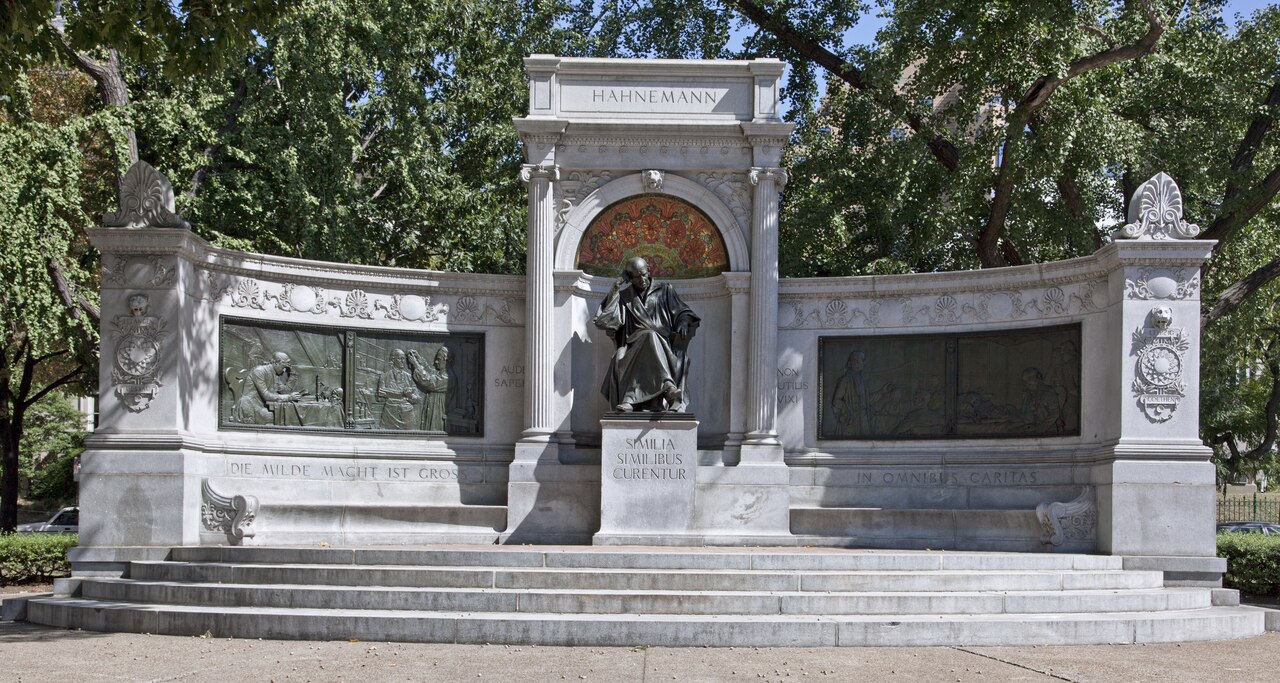
- Samuel Hahnemann Monument (1896) – Erected in Washington, D.C., this monument honours the founder of homeopathy. The central bronze figure portrays Hahnemann in a contemplative pose, while the surrounding bas‑relief panels illustrate his medical principles. The monument’s restrained neoclassical aesthetic reflects the dignity accorded to scientific pioneers in the late nineteenth century.
- Nathan Bedford Forrest Monument (1905) – Situated in Nashville, Tennessee, this work commemorates the Confederate cavalry commander. The bronze equestrian statue presents Forrest in a commanding pose, mounted on a horse that appears in mid‑stride. Although the monument has been the subject of contemporary debate, it remains a testament to Niehaus’s ability to render dynamic movement in bronze.
- Apotheosis of St. Louis (1904) – This allegorical sculpture occupies a prominent place in the St. Louis City Hall. The composition features a winged figure representing the city’s spirit, rising above a group of figures that symbolize commerce, education and industry. The work’s dramatic vertical thrust showcases Niehaus’s talent for creating monuments that engage viewers from multiple sightlines.
- John Paul Jones Memorial (1912) – Located in the United States Naval Academy in Annapolis, Maryland, the memorial honours the Revolutionary‑War naval hero. The bronze figure of Jones stands on a granite plinth, his gaze directed toward the horizon, embodying resolve and maritime daring. The piece reflects Niehaus’s capacity to capture the heroic ethos of American military figures.
These works, together with numerous lesser‑known commissions, illustrate a career devoted to the public articulation of American history through the language of classical sculpture.
Influence and legacy Charles Henry Niehaus occupies a distinctive place in the canon of American sculpture. By the early twentieth century he had become one of the most sought‑after sculptors for civic monuments, a role that placed him at the centre of the nation’s visual memory. His adherence to neoclassical principles provided a visual continuity that linked the United States to the democratic ideals of ancient Greece and Rome, a symbolic association that resonated with patrons and the public alike.
Niehaus’s influence extended to younger sculptors who apprenticed in his studio or observed his public commissions. His emphasis on rigorous anatomical study, combined with an ability to translate narrative content into static form, set a benchmark for monumental sculpture in the United States. Moreover, his participation in professional organisations such as the National Academy of Design helped shape the standards of academic training for American sculptors during a period when the country was defining its own artistic identity.
In contemporary scholarship, Niehaus is recognised not only for the aesthetic qualities of his monuments but also for the way his works embody the social and political values of their time. The reinterpretation of pieces such as the Nathan Bedford Forrest Monument highlights the evolving discourse around public memory and the role of art in that conversation. Nonetheless, the technical mastery and compositional clarity evident in his oeuvre continue to be studied by art‑history students and conservators alike.
Overall, Charles Henry Niehaus’s legacy endures through the physical presence of his monuments across the United States and through the continued relevance of his approach to public sculpture—one that balances classical form, narrative intent and civic purpose.
Influence and legacy (Repeated heading removed; content merged above.)
Frequently asked questions
Who was Charles Henry Niehaus?
Charles Henry Niehaus (1855–1935) was an American sculptor best known for his large public monuments that combined neoclassical style with American historical subjects.
What artistic style or movement is Niehaus associated with?
Niehaus worked within a neoclassical idiom, aligning with the American Renaissance tradition of using classical forms to celebrate civic virtues.
What are his most famous works?
His most celebrated monuments include the Trenton Battle Monument (1893), Samuel Hahnemann Monument (1896), Nathan Bedford Forrest Monument (1905), Apotheosis of St. Louis (1904) and the John Paul Jones Memorial (1912).
Why does Niehaus matter in art history?
He helped define the visual language of American public monuments in the late nineteenth and early twentieth centuries, influencing both the aesthetics of civic sculpture and the way national history is commemorated.
How can one recognise a Niehaus sculpture?
Niehaus’s work is characterised by idealised, well‑proportioned figures, a polished finish, classical drapery, and the frequent pairing of allegorical symbols with realistic portraiture.