Maurits Niekerk
1871 – 1940
In short
Maurits Niekerk (1871–1940) was a Dutch Impressionist painter of Jewish ancestry who worked mainly in Belgium and later in Paris. He is known for works such as a 1900 painting, Female Nude (1913) and Flowers (1925), and his art reflects the light‑filled, colour‑rich style of late‑19th‑century Impressionism.
Notable works
_-_Museum_Boijmans_Van_Beuningen.jpg)
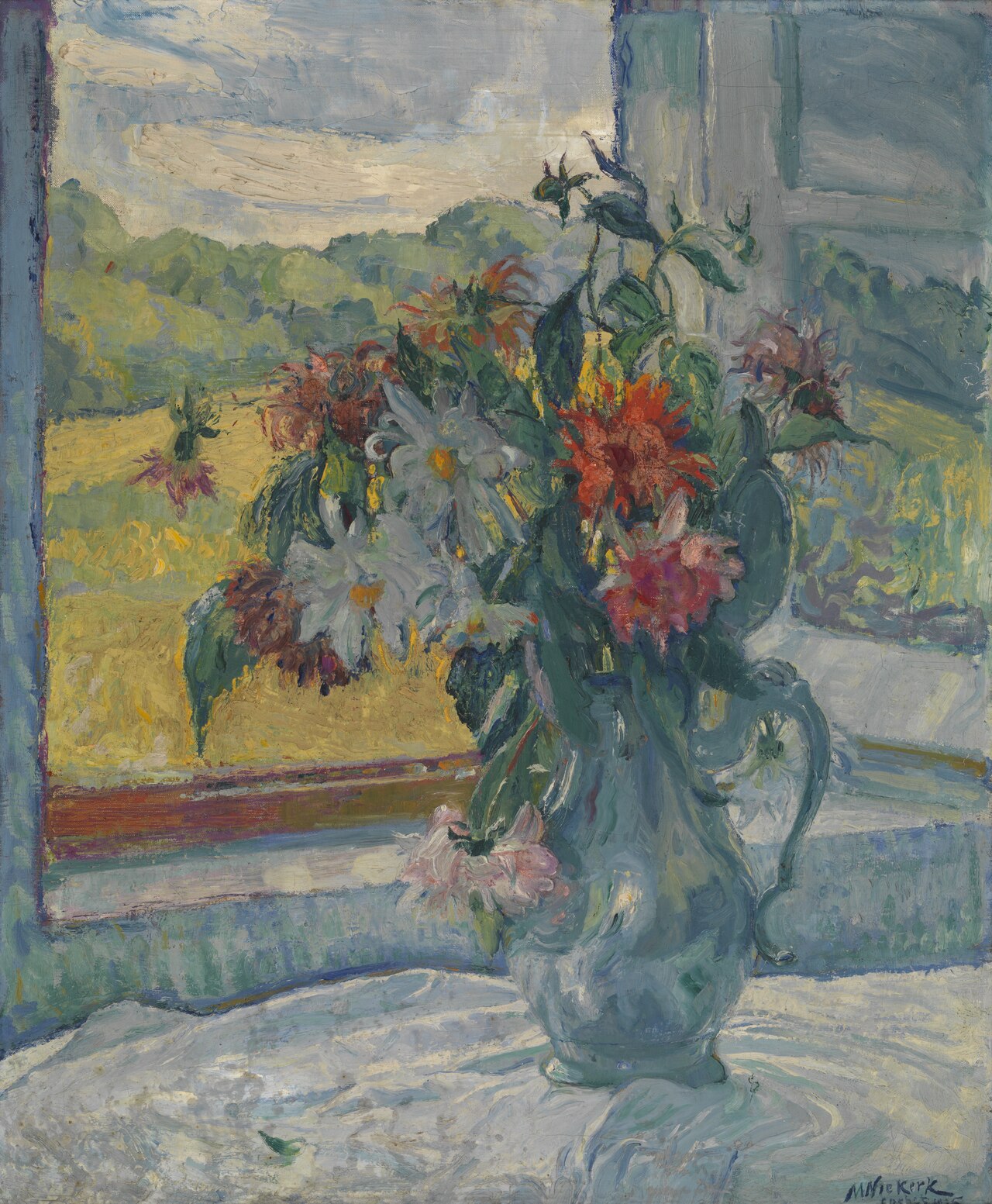
_-_Museum_Boijmans_Van_Beuningen.jpg)
Early life Maurits Joseph Niekerk was born in 1871 in Amsterdam, the capital of the Kingdom of the Netherlands. He came from a family of modest means with a Jewish background; his parents were part of the small but vibrant Jewish community that had settled in the city during the nineteenth century. Niekerk showed an early aptitude for drawing, copying prints and sketches he found in local bookshops. In the early 1890s he enrolled at the Rijksacademie van Beeldende Kunsten, where he received a formal grounding in academic drawing and composition. The academy’s curriculum, while rooted in classical techniques, exposed students to the new artistic currents spreading from Paris, and Niekerk became intrigued by the loose brushwork and colour experiments of the Impressionists.
Career and style After completing his studies, Niekerk moved to Belgium, a decision motivated both by the country’s thriving artistic circles and by the relative openness of its art market to foreign talent. He settled first in Brussels and later in Antwerp, where he joined a circle of painters who were adapting French Impressionism to the cooler, more diffused northern light. During this period he painted a number of cityscapes and rural scenes that display the hallmark Impressionist preoccupation with atmosphere: fleeting weather effects, the play of sunlight on water, and the subtle modulation of colour. By the turn of the century, Niekerk had begun exhibiting his work in Belgian salons, gaining modest recognition for his ability to capture light without sacrificing structural clarity.
The outbreak of World War I prompted Niekerk to relocate to Paris, where he lived until his death in 1940. In Paris he encountered a broader range of modernist influences, yet he remained fundamentally committed to the Impressionist idiom. His palette grew brighter, and his compositions became more intimate, focusing increasingly on interior subjects and single figures rather than expansive landscapes. Throughout his career he maintained a balance between the observational rigor of his Dutch training and the emotive, sensory qualities championed by the French Impressionists.
Signature techniques Niekerk’s work is distinguished by several technical traits that consistently appear across his oeuvre:
* Loose, broken brushwork – He applied paint in short, overlapping strokes that suggest rather than delineate form, allowing the viewer’s eye to blend colours optically. * Plein‑air observation – Even when painting interiors, Niekerk often worked from direct observation, capturing the way natural light filtered through windows onto objects and skin. * Layered glazing – He employed thin, translucent layers of colour over a more opaque underpainting, creating depth and a luminous quality especially evident in his depictions of skin tones and flower petals. * Limited but vibrant palette – His colour choices frequently revolved around a core set of pigments—cadmium yellow, vermilion, ultramarine, and earth tones—combined to produce a wide range of hues while preserving harmony. * Emphasis on atmospheric perspective – In landscape and cityscape works, he rendered distant elements with reduced contrast and cooler tones, reinforcing the sense of space and depth.
These techniques, while common among Impressionists, were applied with a personal restraint that gave Niekerk’s paintings a calm, contemplative mood.
Major works
### Painting (1900) The 1900 work, simply titled *Painting* in many catalogues, is an early example of Niekerk’s engagement with the urban environment of Antwerp. The canvas depicts a bustling canal lined with merchant houses, their façades bathed in the hazy light of an overcast afternoon. The composition is anchored by a narrow river that leads the eye toward the vanishing point, while the broken brushwork suggests the movement of water and the bustle of pedestrians. Critics have noted the subtle colour shifts—soft blues and greys juxtaposed with warm ochres—that convey the atmospheric conditions of a northern port city.
### Female Nude (1913) Created during his Parisian period, *Female Nude* (1913) marks a shift toward more intimate, interior subjects. The painting presents a reclining female figure illuminated by a single shaft of daylight streaming through a curtained window. Niekerk’s handling of skin tones is particularly noteworthy: he layered thin glazes of pink and ochre over a muted underpainting, achieving a delicate translucency that captures the softness of flesh. The background is rendered with minimal detail, allowing the viewer to focus on the interplay of light and shadow on the body. The work exemplifies his mature style—balanced composition, refined colour harmony, and a quiet sensuality.
### Flowers (1925) *Flowers* (1925) is a still‑life that showcases Niekerk’s mastery of colour and texture. A vase of mixed blossoms—tulips, roses, and wildflowers—occupies the centre of the canvas, each petal rendered with a distinct brushstroke that conveys both form and the fleeting quality of the moment. The background is a muted, earthy tone that accentuates the vibrancy of the blossoms. The painting’s brilliance lies in its ability to capture the tactile qualities of petals and leaves while maintaining the overall atmospheric softness that defines his approach. It remains one of his most frequently reproduced works in Dutch Impressionist collections.
Influence and legacy Maurits Niekerk occupies a modest yet significant niche in the history of Dutch Impressionism. While he never achieved the fame of contemporaries such as Vincent van Gogh or Piet Mondrian, his body of work provides valuable insight into the cross‑border artistic exchanges between the Netherlands, Belgium, and France at the turn of the twentieth century. His commitment to an Impressionist visual language, combined with a personal restraint, helped to sustain the movement’s relevance in the face of rapidly emerging avant‑garde styles.
Niekerk’s paintings are held in several European public collections, notably the Royal Museum of Fine Arts in Antwerp and the Musée du Luxembourg in Paris. Scholars cite his works as exemplars of how Dutch artists adapted French Impressionist techniques to northern light conditions, thereby enriching the broader European narrative of the period. Moreover, his Jewish heritage and the itinerant nature of his career have attracted interest from researchers exploring the cultural mobility of Jewish artists in pre‑World War II Europe.
In recent decades, exhibitions focusing on lesser‑known Impressionists have revived interest in Niekerk, positioning him as a bridge between the Dutch Golden Age tradition of meticulous observation and the modernist emphasis on perception. His legacy endures in the continued study of his technique, the preservation of his works in museum collections, and the inspiration he offers to contemporary painters seeking to balance realism with atmospheric expression.
---
Overall, Maurits Niekerk’s art remains a testament to the enduring power of light, colour, and quiet observation within the Impressionist canon.
Frequently asked questions
Who was Maurits Niekerk?
Maurits Niekerk (1871–1940) was a Dutch Impressionist painter of Jewish ancestry who worked mainly in Belgium and later in Paris, known for works such as a 1900 cityscape, Female Nude (1913) and Flowers (1925).
What artistic style or movement is he associated with?
He is generally classified as an Impressionist, employing the movement’s characteristic light‑focused brushwork, colour harmony and plein‑air observation.
What are his most famous works?
His most frequently cited pieces are the early cityscape titled *Painting* (1900), the interior figure study *Female Nude* (1913), and the still‑life *Flowers* (1925).
Why does Maurits Niekerk matter in art history?
Niekerk illustrates how Dutch artists adapted French Impressionism to northern light, and his cross‑national career highlights the cultural exchange between the Netherlands, Belgium and France in the early twentieth century.
How can I recognise a Maurits Niekerk painting?
Look for loose, broken brushstrokes, a restrained yet vibrant palette, careful rendering of light on surfaces, and a calm, atmospheric mood that often centres on everyday scenes or intimate interiors.