Charles de Groux
1825 – 1870
In short
Charles de Groux (1825–1870) was a Belgian painter, engraver and illustrator recognised as the first Belgian social realist, noted for his empathetic depictions of the disadvantaged and for influencing later Realist artists in Belgium.
Notable works
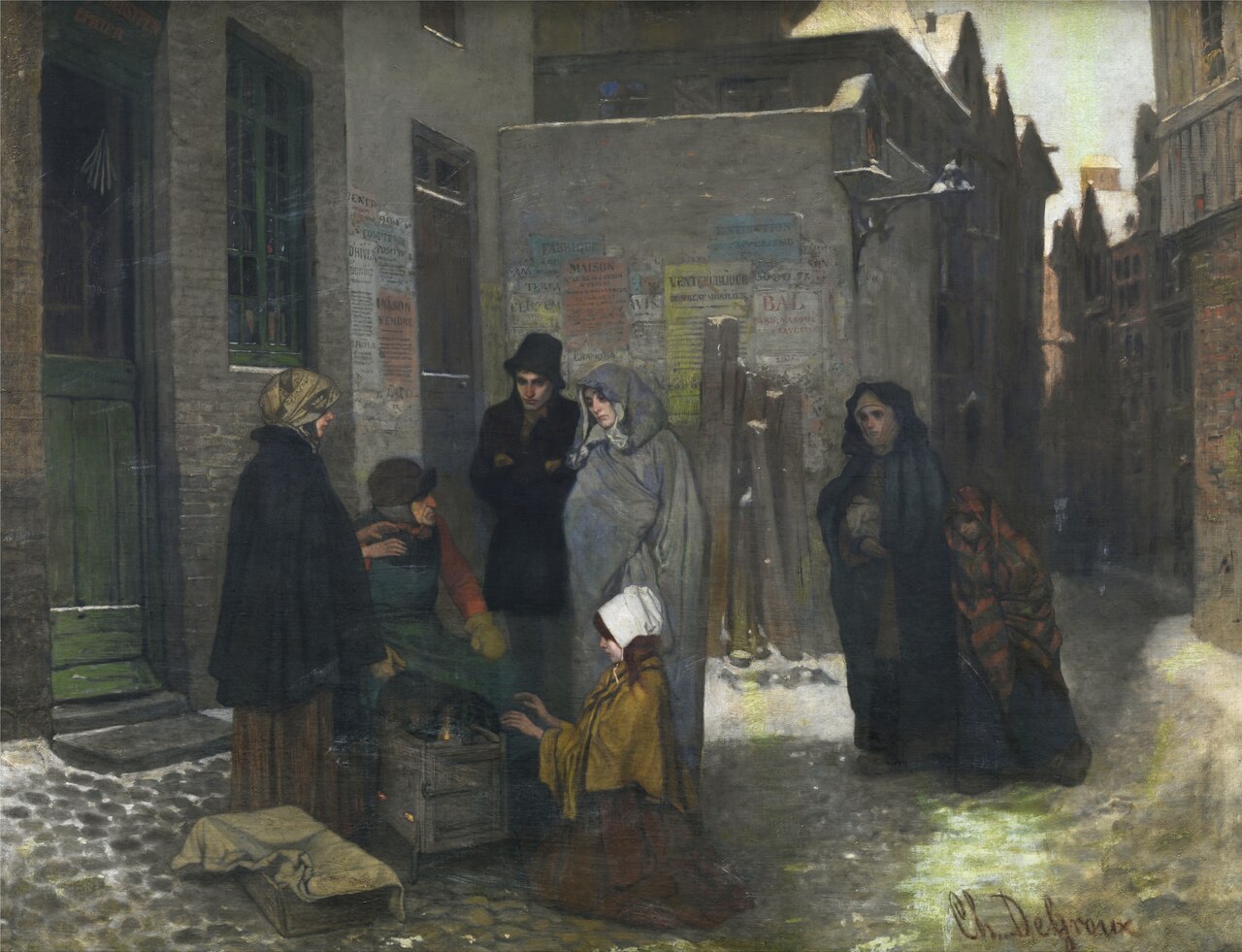


Early life Charles de Groux was born in 1825 in the border town of Comines, then part of the French region but soon to be incorporated into Belgium. His family moved to Belgium when he was a child, and he grew up in a milieu that straddled French and Flemish cultural influences. Little is known about his formal education, but archival records indicate that he entered a local drawing school in his teenage years, where he received grounding in academic drawing and the fundamentals of engraving.
Career and style De Groux began his professional career in the early 1840s, initially working as an illustrator for newspapers and as a lithographer for commercial prints. By the mid‑1850s he had turned to oil painting, drawn to the everyday lives of the lower classes. His style merged the meticulous draftsmanship of academic training with a compassionate, almost documentary eye for social conditions. He favoured muted palettes, strong chiaroscuro, and a compositional focus that placed ordinary people at the centre of the narrative, rather than treating them as background figures. This approach positioned him as a pioneer of Belgian social realism, predating the more widely known Realist painters Constantin Meunier and Eugène Laermans.
Signature techniques De Groux’s technique was characterised by a careful handling of line and texture, honed through his background in engraving. In his paintings he often employed a thin underpainting of earth tones to establish mood before applying richer colour layers. He used a limited brushwork that suggested form without excessive detail, allowing viewers to fill in the emotional context. His prints display cross‑hatching and stippling that convey the gritty surfaces of his subjects—whether the worn cloth of a peasant or the soot‑stained walls of a workshop. These methods reinforced the sense of realism and empathy that defined his oeuvre.
Major works - **Le moulin à café en Scène d'hiver** – The exact date of this work is unclear, but it is frequently cited among de Groux’s early canvases. The painting depicts a winter scene outside a coffee mill, where laborers huddle against the cold, their breath visible in the crisp air. The composition is anchored by the stark geometry of the mill’s roof, while the muted blues and greys convey a palpable chill. - **The gleaners (1856)** – This canvas is a hallmark of de Groux’s social focus. It shows a group of women and children sifting through a field after harvest, their faces marked by fatigue yet also by quiet dignity. The artist’s use of light falling on the gathered stalks highlights the contrast between the abundance of the field and the scarcity faced by the gleaners. - **Portrait of the artist's mother on her deathbed (1862)** – In this intimate portrait, de Groux captures a personal moment of grief. The composition is restrained, with the mother lying on a modest bed, surrounded by muted furnishings. The subtle rendering of the mother’s frailty and the soft illumination create a poignant atmosphere that transcends mere representation.
Influence and legacy Charles de Groux’s commitment to depicting the lives of the marginalised laid the groundwork for a distinctly Belgian strand of Realism. His emphasis on social commentary through visual art inspired subsequent generations, most notably Constantin Meunier, whose industrial scenes echo de Groux’s concern for labourers, and Eugène Laermans, whose darker tonalities recall de Groux’s empathetic realism. Although his name is less recognisable today than some of his followers, his works remain pivotal in the study of 19th‑century Belgian art, illustrating the transition from Romantic idealisation to a more grounded, socially aware aesthetic. Contemporary exhibitions of Belgian art frequently include de Groux to demonstrate the early roots of social realism in the region.
Frequently asked questions
Who was Charles de Groux?
Charles de Groux (1825–1870) was a Belgian painter, engraver and illustrator, regarded as the first Belgian social realist.
What artistic style or movement is he associated with?
He is associated with social realism, a precursor to the later Belgian Realist movement.
What are his most famous works?
His most cited works include *Le moulin à café en Scène d'hiver*, *The gleaners* (1856), and *Portrait of the artist's mother on her deathbed* (1862).
Why is Charles de Groux important in art history?
He introduced a compassionate, documentary approach to painting the poor and working class, influencing later Belgian Realist artists such as Constantin Meunier and Eugène Laermans.
How can I recognise a painting by Charles de Groux?
Look for muted colour palettes, strong chiaroscuro, a focus on everyday labourers, and a finely drawn, slightly etched quality that reflects his background in engraving.