Carlo Antonio Tavella
1668 – 1738
In short
Carlo Antonio Tavella (1668–1738) was an Italian Baroque painter born in Milan who spent most of his career in Genoa, creating religious and landscape paintings noted for dramatic lighting and fluid composition.
Notable works
_-_Jonah_and_the_Whale_-_BHC0881_-_Royal_Museums_Greenwich.jpg)

_-_Snowy_Landscape_-_B.M.306_-_Bowes_Museum.jpg)

Early life Carlo Antonio Tavella was born in Milan in 1668, a period when the city was part of the Duchy of Milan and a hub for artistic exchange between northern and central Italy. Details of his family background are scarce, but contemporary records indicate that he was exposed to the rich visual culture of Milan’s churches and private collections from an early age. Training for artists in the late seventeenth century typically involved apprenticeships with established masters, and it is likely that Tavella began his artistic education under a local workshop that adhered to the prevailing Baroque idiom. The vibrant religious art of the Counter‑Reformation, with its emphasis on emotional intensity and dramatic chiaroscuro, would have formed the core of his formative influences.
Career and style By the early eighteenth century Tavella had relocated to Genoa, a thriving port city whose patronage network included wealthy merchants, ecclesiastical institutions, and the ducal court. In Genoa he found a market for both devotional canvases and secular subjects, allowing him to develop a versatile portfolio. His style reflects the broader Italian Baroque movement, characterised by vigorous movement, strong contrasts of light and dark, and a keen interest in narrative drama. Tavella’s compositions often place figures in dynamic poses within architecturally complex settings, a hallmark of the Genoese Baroque school that drew inspiration from both Roman and Flemish models. While specific documentation of his workshop is limited, it is clear that he operated within a collaborative environment where artists exchanged ideas and occasionally shared assistants.
Signature techniques Tavella’s paintings are distinguished by several recurring technical approaches. First, he employed a pronounced use of chiaroscuro, modelling figures with deep shadows that heighten three‑dimensionality and reinforce emotional tension. Second, his brushwork balances tight modelling in focal areas with looser, more atmospheric handling in background elements, especially in landscape scenes. This duality creates a sense of depth while retaining a lively surface quality. Third, Tavella favoured a palette of warm earth tones—ochres, burnt siennas, and deep reds—punctuated by cooler blues and greens in sky or foliage, a colour scheme that enhances the dramatic lighting. Finally, his compositions often incorporate a diagonal thrust, guiding the viewer’s eye across the canvas and amplifying narrative momentum.
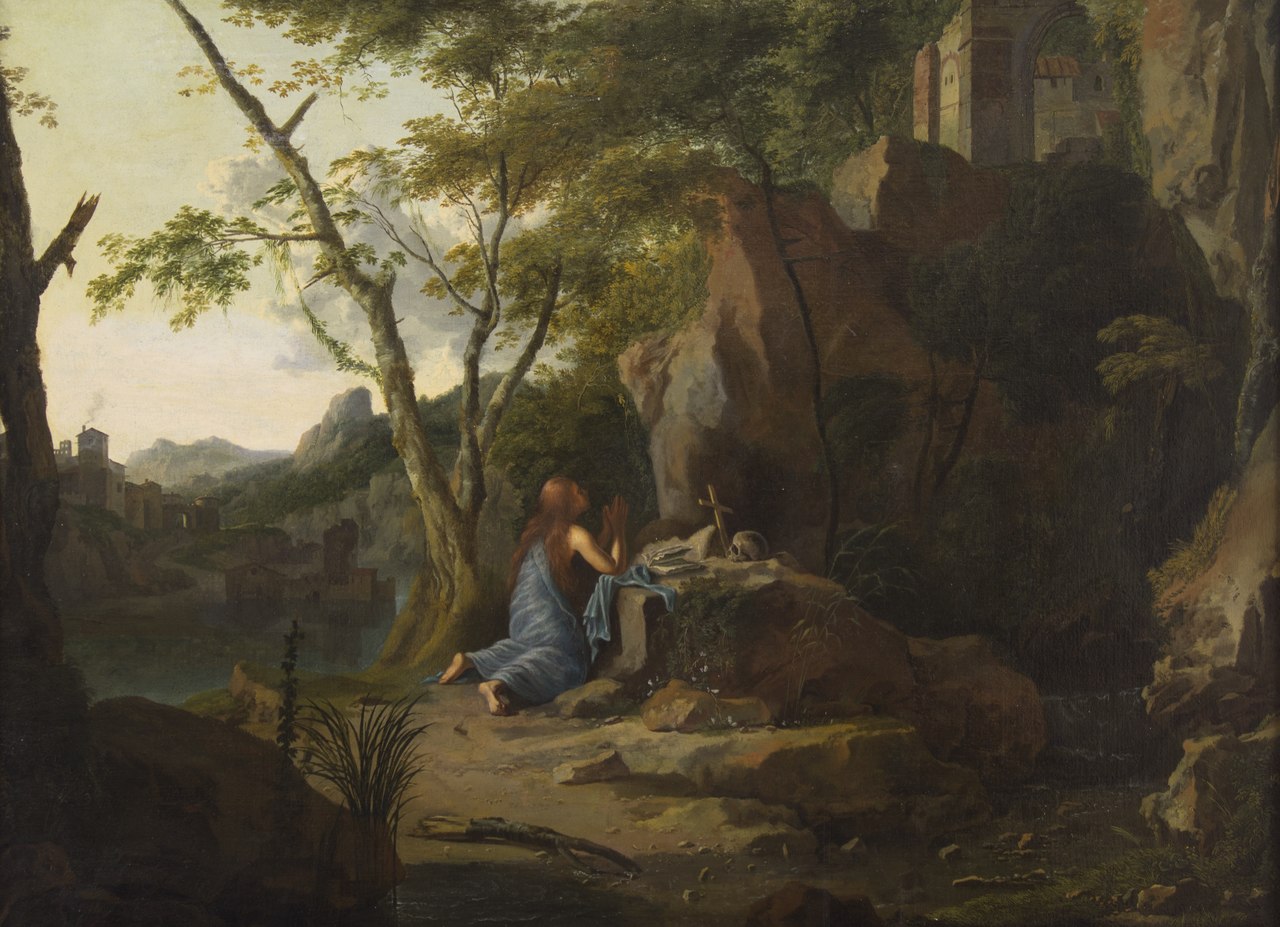
Major works Among Tavella’s attributed works, *Jonah and the Whale* (dated 1650) stands out for its complex iconography and dramatic use of light. The early date, which predates the artist’s birth, suggests the work may be a later copy of an earlier composition or a misdated piece, a situation not uncommon in Baroque catalogues. *The Rest on the Flight into Egypt* (1720) exemplifies Tavella’s mature period, showcasing a tender moment rendered with luminous sky and a tranquil landscape that frames the holy family. The composition’s calm atmosphere contrasts with the emotional intensity typical of his earlier religious scenes. *The Repentance of Mary Magdalene* demonstrates his skill in portraying penitence; the figure is bathed in a soft, almost divine glow that underscores her spiritual transformation. In *Snowy Landscape*, Tavella departs from overtly religious subjects, presenting a serene winter vista where subtle tonal variations convey the chill of the scene while retaining his characteristic chiaroscuro. Finally, *Zenobia*—a historical subject drawn from classical sources—reveals his ability to handle narrative drama outside strictly biblical themes, employing a dramatic pose and a richly detailed setting that align with Baroque storytelling conventions.
Influence and legacy Carlo Antonio Tavelli’s work contributed to the diffusion of Baroque aesthetics in northern Italy, particularly within Genoa’s artistic circles. Though not as widely known as some of his contemporaries, his paintings illustrate the regional adaptation of Baroque principles, merging the dramatic flair of Roman masters with the decorative sensibilities of the Ligurian coast. His landscapes, in particular, anticipate a modest shift toward naturalistic observation that would later inform the emergence of the Rococo and early Neoclassical styles. Modern scholarship regards Tavella as a competent practitioner whose oeuvre offers insight into the artistic networks of early eighteenth‑century Italy. His surviving works continue to be studied for their technical proficiency and as exemplars of the cross‑cultural artistic exchanges that defined the Baroque period.
Frequently asked questions
Who was Carlo Antonio Tavella?
Carlo Antonio Tavella was an Italian Baroque painter (1668–1738) born in Milan who worked primarily in Genoa, producing religious and landscape paintings.
What artistic movement or style is Tavella associated with?
He is associated with the Baroque movement, characterised by dramatic lighting, dynamic composition, and emotive narrative.
What are the most famous works by Tavella?
Among his notable works are *Jonah and the Whale*, *The Rest on the Flight into Egypt* (1720), *The Repentance of Mary Magdalene*, *Snowy Landscape*, and *Zenobia*.
Why is Carlo Antonio Tavella important in art history?
Tavella exemplifies the regional adaptation of Baroque art in Genoa, bridging religious and secular subjects and influencing later developments in landscape painting.
How can one recognise a painting by Tavella?
His paintings typically feature strong chiaroscuro, a warm earthy palette, dynamic diagonal compositions, and a blend of tightly modelled figures with looser, atmospheric backgrounds.