Blaise Alexandre Desgoffe
1830 – 1901
In short
Blaise Alexandre Desgoffe (1830–1901) was a French painter renowned for his meticulously rendered still‑life paintings. Born and died in Paris, he continued a family tradition of art, being the nephew of Alexandre Desgoffe and the father of painter Jules Desgoffe.
Notable works


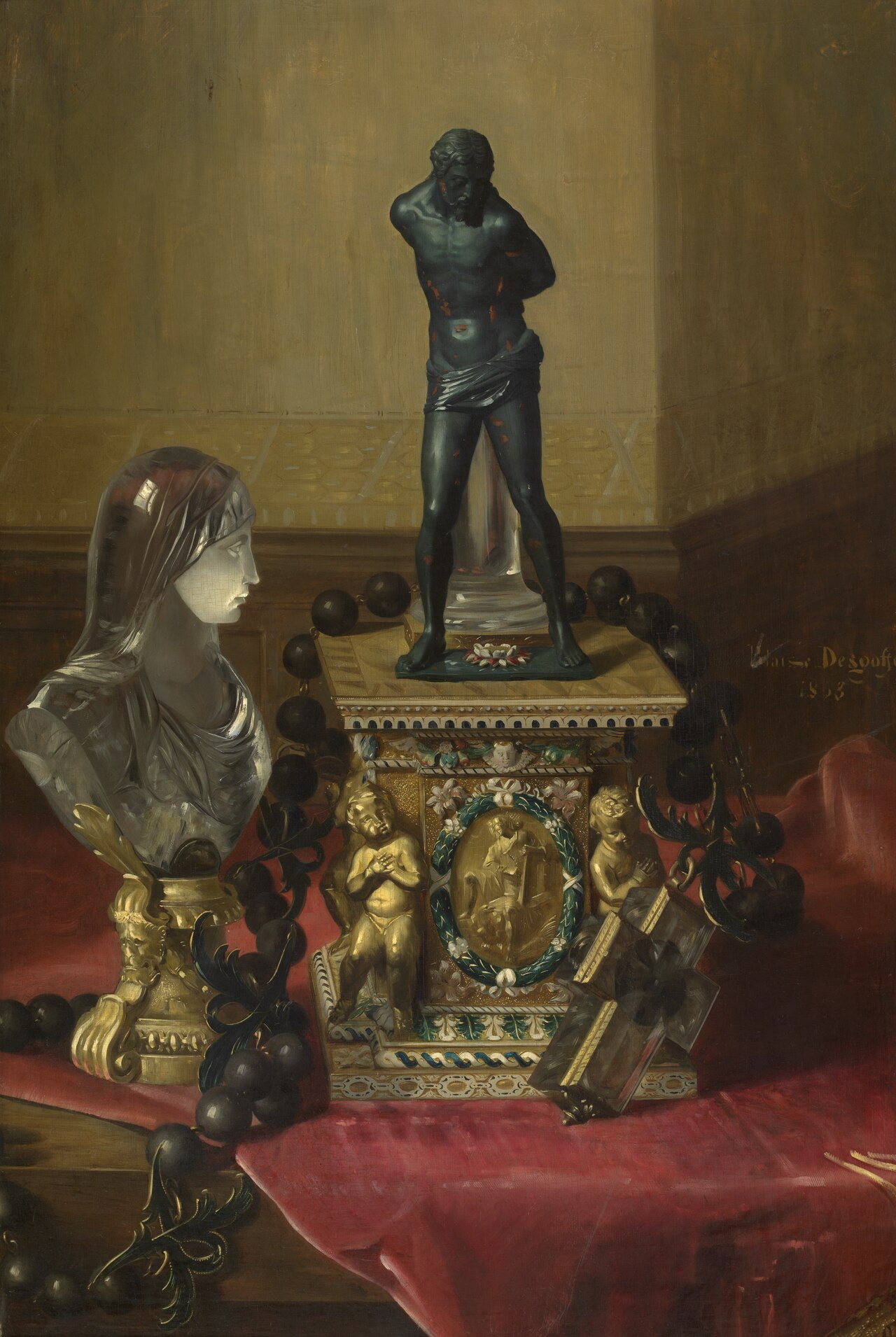

Early life Blaise Alexandre Desgoffe was born in Paris in 1830 into a family already engaged with the visual arts. His uncle, Alexandre Desgoffe, was an established painter, and the younger Blaise grew up surrounded by discussions of technique, composition and the market for art in the capital. The Paris of his youth was a bustling centre for artistic training, with the École des Beaux‑Arts offering rigorous academic instruction. While specific records of his formal education are scarce, it is reasonable to infer that he benefited from the same academic foundations as many of his contemporaries, mastering drawing, anatomy and the study of classical models before turning his focus to the specialised genre of still‑life painting.
Career and style Desgoffe established himself in the mid‑nineteenth century as a specialist in still‑life, a genre that had long been prized for its capacity to showcase technical virtuosity. Working at a time when French art was dominated by the shifting tides of Romanticism, Realism and the early stirrings of Impressionism, Desgoffe chose a path that aligned more closely with the academic tradition of precise, labour‑intensive rendering. His paintings display a calm, ordered composition in which everyday objects—fruit, glassware, metal, and occasionally architectural fragments—are arranged with a sense of balance and quiet dignity.
His style is characterised by a high level of finish, a careful modulation of light, and an emphasis on texture. Desgoffe often employed a restrained colour palette, allowing the natural hues of his subjects to dominate the visual field. The surfaces of his fruit are rendered with a subtle sheen that conveys both the freshness of the produce and the painter’s control of colour and tone. The glassware in his compositions—particularly Venetian glass—receives meticulous attention to reflectivity, capturing the play of light in a manner that suggests both realism and a hint of the decorative.
Signature techniques Desgoffe’s technical approach combined several practices that were typical of the French academic tradition, yet he applied them with a personal consistency that became his hallmark. He began with a carefully drawn under‑drawing, often using charcoal or a light ink wash to map out the placement of each object. This stage ensured proportional accuracy and allowed for the precise rendering of shadow and highlight that would follow.
He then built up the painting in layers, starting with a thin underpainting (a "grisaille" in muted tones) to establish the tonal structure. Subsequent layers added colour, with glazes of translucent oil that created depth and a luminous quality, especially in the depiction of glass and fruit skins. The final stages involved the meticulous polishing of edges and the sharpening of details, a process that could take weeks for a single canvas. His brushwork was largely invisible, favouring a smooth, almost enamel‑like surface that eliminated any suggestion of painterly gesture.
Major works Desgoffe’s oeuvre includes a series of still‑lifes that exemplify his dedication to precision and his interest in the interplay of light and material.
- Fruit Still Life (1857) – One of his earliest dated works, this painting presents a simple yet elegant arrangement of assorted fruit on a dark table. The composition balances warm tones of ripe peaches and apples against cooler shadows, demonstrating his early mastery of colour modulation.
- Still Life with Fruit and Venetian Glass on a Table (1866) – This canvas is notable for its inclusion of a Venetian glass goblet, whose reflective surface captures the surrounding light. The glass serves as a focal point, drawing the viewer’s eye across the composition and highlighting Desgoffe’s skill in rendering transparency.
- Objects of Art from the Louvre (1874) – In this work, Desgoffe turns his gaze toward the museum itself, arranging decorative objects that could be found within the Louvre’s collection. The painting functions as a meta‑still‑life, reflecting both the artist’s reverence for the museum and his ability to depict a variety of textures—marble, bronze, and painted ceramics.
- At the Louvre (1868) – Similar in theme to the previous piece, this canvas presents a more expansive view of museum interiors, integrating architectural elements with the still‑life objects placed upon a table. The work underscores his interest in situating everyday items within culturally significant spaces.
- Still Life with Fruit, Glass of Wine (1863) – Here, a glass of wine glints beside a selection of fruit, offering a subtle narrative of consumption and leisure. The painting’s delicate handling of the liquid’s refraction and the fruit’s skin exemplifies his technical prowess.
These works collectively illustrate Desgoffe’s consistent focus on the quiet dignity of ordinary objects, rendered with an almost scientific exactness that nonetheless retains a sense of atmospheric warmth.
Influence and legacy While Desgoffe never aligned himself with a specific avant‑garde movement, his paintings contributed to the sustained appreciation of still‑life as a legitimate academic genre in nineteenth‑century France. By emphasizing meticulous finish and a restrained aesthetic, he offered a counterpoint to the more expressive tendencies of his Romantic and Realist peers. His commitment to technical excellence influenced younger artists who sought to master the genre, including his own son, Jules Desgoffe, who continued the family tradition into the early twentieth century.
In contemporary art‑history scholarship, Blaise Alexandre Desgoffe is recognised as a bridge between the Dutch Golden Age still‑life tradition and the French academic school. His works are frequently cited in studies of nineteenth‑century French decorative painting and are held in several museum collections, where they serve as exemplars of the period’s attention to materiality and light. Though his name may not be as widely known as some of his more flamboyant contemporaries, his paintings remain valuable resources for understanding the technical standards and aesthetic values that underpinned French academic art in the decades preceding Impressionism.
Overall, Desgoffe’s legacy rests on his ability to elevate the seemingly mundane into objects of quiet beauty, inviting viewers to contemplate the visual poetry inherent in everyday materials.
Frequently asked questions
Who was Blaise Alexandre Desgoffe?
Blaise Alexandre Desgoffe (1830–1901) was a French painter from Paris known for his meticulously rendered still‑life paintings.
What style or movement is Desgoffe associated with?
He worked within the French academic tradition, focusing on precise, highly finished still‑life compositions rather than aligning with a specific avant‑garde movement.
What are his most famous works?
His best‑known paintings include *Fruit Still Life* (1857), *Still Life with Fruit and Venetian Glass on a Table* (1866), *Objects of Art from the Louvre* (1874), *At the Louvre* (1868) and *Still Life with Fruit, Glass of Wine* (1863).
Why does Desgoffe matter in art history?
Desgoffe exemplifies the nineteenth‑century French academic approach to still‑life, preserving a high level of technical skill and influencing later artists, including his son Jules, while providing a link between Dutch still‑life traditions and French decorative painting.
How can I recognise a Desgoffe painting?
Look for a smooth, enamel‑like surface, precise rendering of fruit and glass, subtle lighting that highlights texture, and a calm, balanced composition that often features everyday objects placed in a dignified, almost scholarly manner.