Auguste-Xavier Leprince
1799 – 1826
In short
Auguste‑Xavier Leprince (1799–1826) was a French painter who achieved fame as a teenager and worked for royal patrons such as the Duchesse de Berry and Charles X. He ran a Parisian atelier, taught several younger artists, and produced a small but notable body of genre and landscape paintings before his career was cut short by his early death at twenty‑seven.
Notable works


.jpg)
Early life
Auguste‑Xavier Leprince was born in Paris in 1799, the son of a modest merchant family. From a very young age he displayed an extraordinary aptitude for drawing, and by the age of twelve he was already producing sketches that attracted the attention of local artists. His precocious talent was recognised publicly when, at seventeen, he exhibited a small genre scene at the Paris Salon and received favourable reviews. This early acclaim secured him a place among the promising young artists of the post‑Revolutionary era and opened the door to aristocratic patronage.
Career and style
Leprince’s career accelerated rapidly after his teenage breakthrough. He was taken under the wing of the Duchesse de Berry, who commissioned intimate interior scenes, and later attracted the patronage of King Charles X and the antiquarian Alexandre du Sommerard. In his twenties he established his own atelier in the heart of Paris, where he taught his two younger brothers, Robert‑Léopold and Pierre‑Gustave, as well as the future painters Eugène Lepoittevin and Nicolas Alexandre Barbier. Although his work does not fit neatly into a single contemporary movement, it reflects the eclectic tastes of the Restoration period, blending genre painting, landscape, and occasional Orientalist motifs. Leprince favoured a narrative realism that captured everyday life with a lightness of touch, while his landscapes reveal a sensitivity to atmosphere reminiscent of the early Romantic school.
Signature techniques
Leprince’s paintings are distinguished by a clear, luminous palette and a deft handling of light that often highlights the central figures against softer backgrounds. He employed a fine, almost filigree brushstroke for details such as fabrics, foliage, and architectural elements, allowing textures to emerge without overwhelming the composition. His compositional structures frequently use a diagonal axis that guides the viewer’s eye across the canvas, creating a sense of movement. In addition, he made frequent use of chiaroscuro to model forms and to suggest depth, particularly in interior scenes where candlelight or windows provide natural illumination. These technical choices contribute to a harmonious balance between narrative content and visual elegance.
Major works
- Landscape Susten, Switzerland (1824) – This oil depicts the dramatic Alpine pass of Susten, rendered with a sweeping sky and rugged peaks. Leprince captures the sublime quality of the high mountain landscape, employing a cool colour scheme that emphasizes the crisp air and distant horizons.
- Man in Oriental Costume in the Artist’s Studio (1823) – A striking example of his occasional Orientalist interest, this work shows a figure dressed in richly patterned robes positioned within a cluttered studio. The painting juxtaposes exotic attire with the familiar surroundings of a Parisian atelier, highlighting Leprince’s curiosity about foreign cultures.
- A Shepherd and a Rider on a Country Lane (1823) – In this bucolic scene, a shepherd accompanied by a horse‑ridden traveller walks along a winding lane bordered by trees. The composition balances the serenity of rural life with a subtle narrative tension, as the two figures appear to be on the verge of an encounter.
- Embarquement de bestiaux sur le "Passager" dans le port de Honfleur (1823) – This maritime genre piece records the loading of livestock onto the vessel *Passager* in the bustling port of Honfleur. Leprince’s attention to the bustling activity of the dock, the interplay of shadow and water, and the realistic rendering of animals demonstrates his skill in capturing everyday commercial scenes.
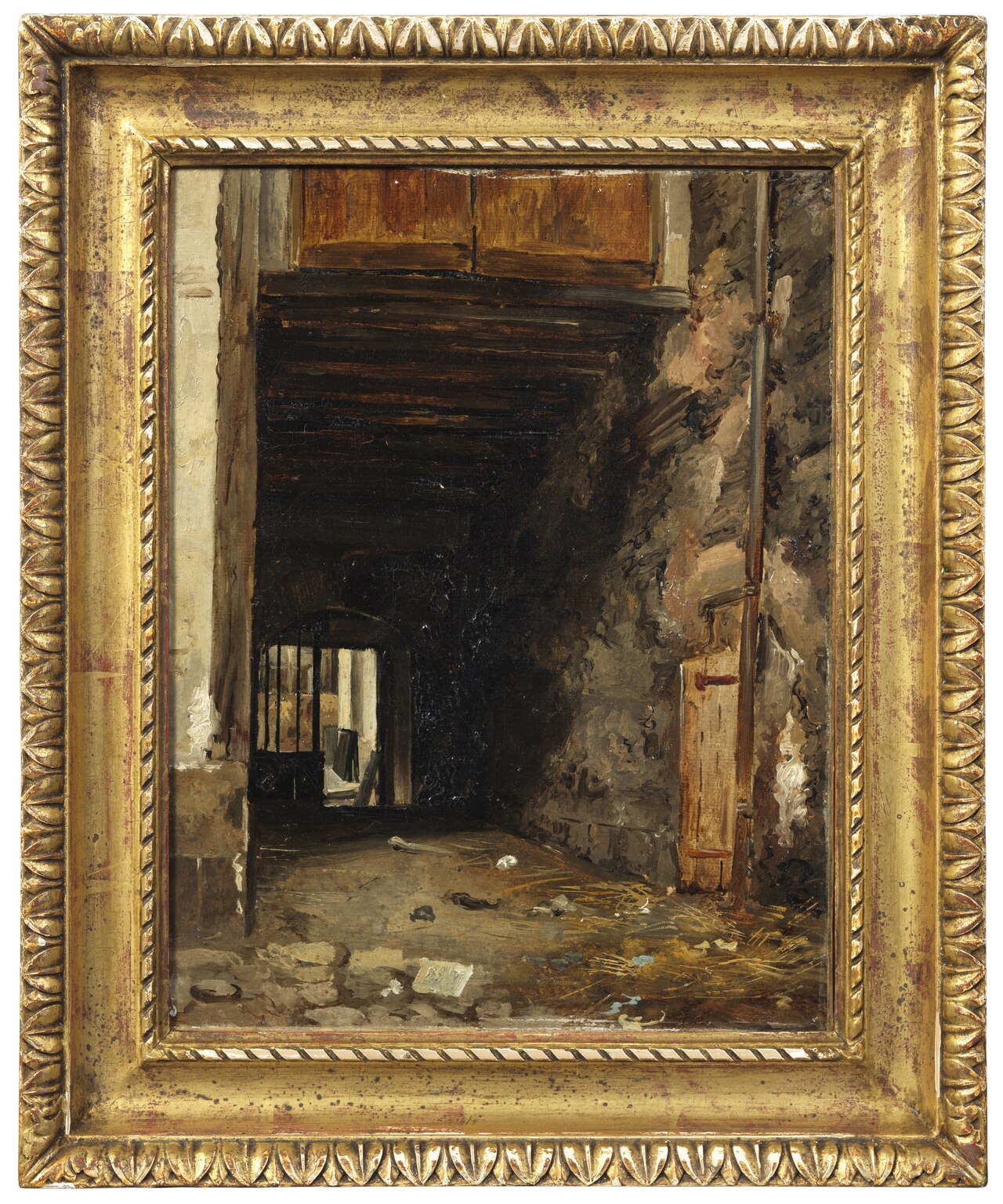
- The Entrance of a Courtyard (1820) – One of his earlier works, this painting presents a quiet courtyard framed by stone arches, with a subtle play of sunlight across the paving stones. The work is notable for its tranquil atmosphere and careful rendering of architectural detail, reflecting Leprince’s interest in interior space and perspective.
Influence and legacy
Leprince’s sudden death in Nice in 1826, at the age of twenty‑seven, cut short a career that many contemporaries believed would have reached great heights. Despite his brief lifespan, his influence persisted through the artists he taught and the patrons he served. His younger brothers continued to work in his style, while pupils such as Eugène Lepoittevin carried forward his emphasis on narrative realism. Art historians regard Leprince as a bridge between the late‑Rococo genre tradition and the emerging Romantic sensibility, noting how his works balance detailed observation with an emotional resonance that foreshadows later 19th‑century developments. Today his paintings are valued for their technical finesse, their documentation of early Restoration cultural life, and their role in the evolution of French genre painting.
Frequently asked questions
Who was Auguste‑Xavier Leprince?
Auguste‑Xavier Leprince was a French painter born in Paris in 1799, known for his genre scenes and landscapes, and celebrated for achieving fame as a teenager before his early death in 1826.
What artistic style or movement is Leprince associated with?
Leprince does not belong to a single defined movement; his work blends genre painting, early Romantic landscape elements, and occasional Orientalist motifs, reflecting the eclectic tastes of the French Restoration period.
What are his most famous works?
His most recognised paintings include *Landscape Susten, Switzerland* (1824), *Man in Oriental Costume in the Artist’s Studio* (1823), *A Shepherd and a Rider on a Country Lane* (1823), *Embarquement de bestiaux sur le "Passager" dans le port de Honfleur* (1823) and *The Entrance of a Courtyard* (1820).
Why is Leprince important in art history?
He exemplifies the transition from Rococo genre painting to early Romantic realism, taught several notable artists, and his brief but brilliant output offers valuable insight into early‑19th‑century French visual culture.
How can I recognise a Leprince painting?
Look for a luminous palette, fine brushwork that renders textures delicately, balanced compositions often using a diagonal axis, and a clear narrative focus that blends everyday subjects with atmospheric light.