Auguste Toulmouche
1829 – 1890
In short
Auguste Toulmouche (1829–1890) was a French painter noted for elegant genre scenes of well‑to‑do Parisian women in domestic interiors.
Notable works



Early life Auguste Toulmouche was born in 1829 in Nantes, a port city in western France. Little is recorded about his family background, but his upbringing in a region with a thriving commercial life gave him early exposure to the bourgeois culture that would later dominate his canvases. He moved to Paris as a young man to pursue artistic training, enrolling in the ateliers that catered to the academic tradition of the French Salon. His formative years coincided with the rise of Realist and early Impressionist tendencies, yet Toulmouche remained firmly rooted in the polished, detail‑rich style favoured by the Salon juries.
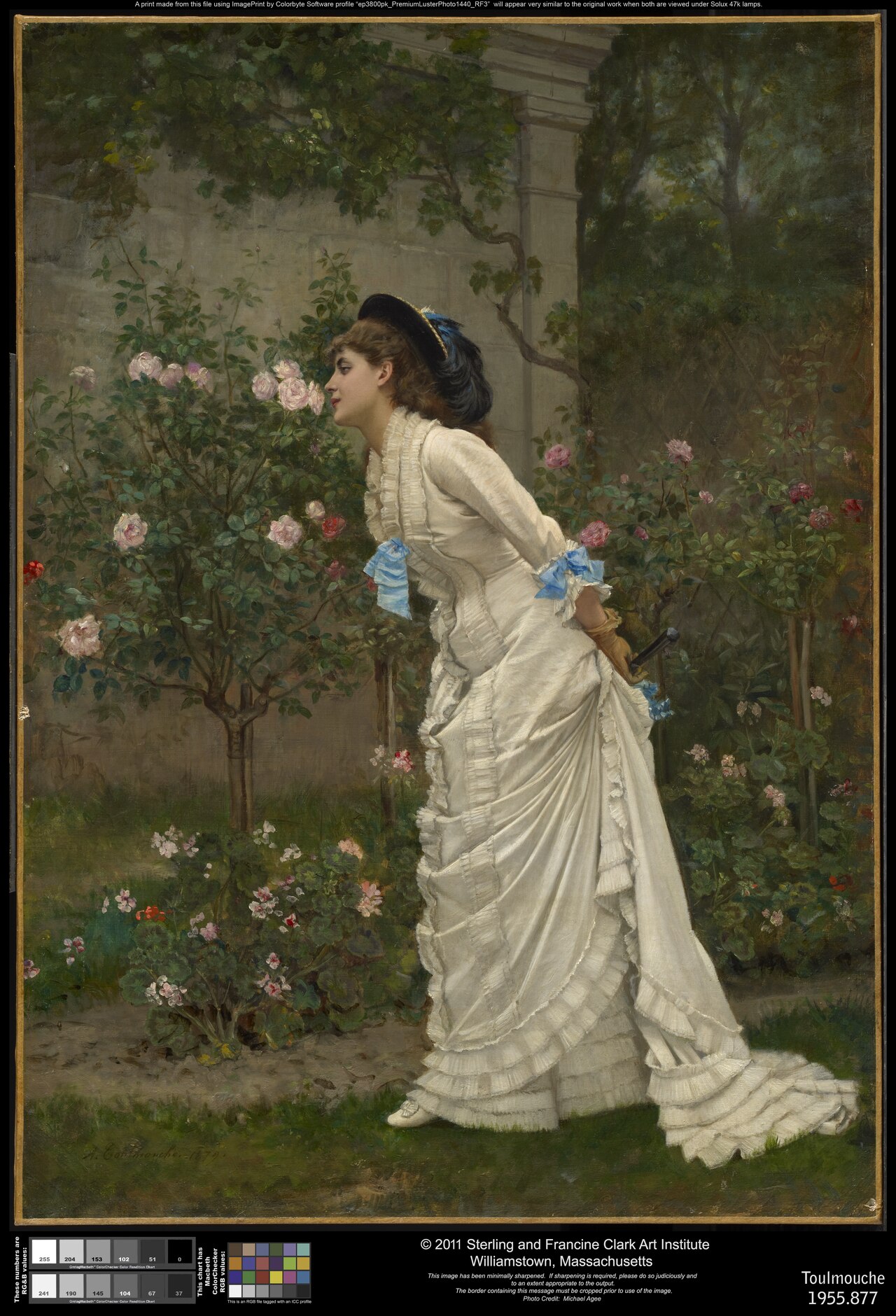
Career and style By the 1850s Toulmouche had begun to exhibit at the Paris Salon, where his works were praised for their technical finish and the tasteful depiction of contemporary interiors. He positioned himself within the genre‑painting tradition, focusing on intimate domestic scenes rather than grand historical narratives. His subjects are typically upper‑middle‑class women engaged in everyday activities—reading, arranging flowers, or preparing for social occasions. The compositions exude a sense of refinement: the figures are rendered with smooth, almost porcelain‑like skin tones, and the surrounding furnishings are rendered with meticulous attention to texture and pattern.
Toulmouche’s style reflects the influence of academic painters such as William-Adolphe Bouguereau and Alexandre Cabanel, yet his work also bears the decorative sensibility of the emerging Rococo revival that appealed to the Parisian elite. He avoided the loose brushwork and radical colour experiments of the Impressionists, preferring a controlled palette of soft pastels and muted earth tones that enhance the sense of quiet elegance. Throughout his career he maintained a consistent visual language, making his paintings instantly recognisable to contemporary collectors.
Signature techniques Toulmouche employed several technical approaches that set his work apart. His brushwork is characteristically fine and layered, allowing for a smooth surface that eliminates visible strokes. This technique, often described as “silk‑like,” creates a luminous quality on the skin of his figures. Light is handled with subtle gradations; he frequently uses a diffused illumination that seems to emanate from an unseen window, casting gentle shadows that model the forms without harsh contrast.
Colour harmony is another hallmark. Toulmouche favoured a restrained palette dominated by creams, pale blues, and soft pinks, punctuated by occasional accents of richer hues in textiles or floral arrangements. These accents draw the eye to focal points within the composition. He also paid particular attention to the rendering of fabrics, using delicate stippling and fine hatching to suggest the texture of silk, lace, and brocade.
Compositionally, his paintings often employ a balanced, almost symmetrical arrangement, with the principal figure placed centrally or slightly off‑centre, framed by decorative elements such as mirrors, vases, or architectural mouldings. This creates a sense of order that mirrors the social stability of his subjects.
Major works Among Toulmouche’s most frequently cited pieces is **The Reluctant Bride** (1866). The painting depicts a young woman standing before a mirror, her expression a mixture of anticipation and hesitation as she contemplates her upcoming marriage. The careful rendering of the mirror’s reflective surface and the intricate detailing of the bridal dress exemplify his meticulous technique.
The Kiss (1870) presents a tender moment between a couple in a softly lit interior. The subtle interplay of light on the figures’ faces, combined with the delicate handling of the surrounding décor, underscores Toulmouche’s ability to convey intimacy without sacrificing compositional clarity.
In Reading Lesson (1865), a mother instructs a child in a book, the scene bathed in a warm, natural light that filters through a window. The work highlights his interest in educational and moral themes, common in genre painting of the period.
Woman and Roses (1879) shows a solitary female figure arranging a bouquet of roses on a vanity table. The composition is dominated by the lush reds of the flowers, which contrast with the muted tones of the surrounding space, drawing attention to the tactile quality of the petals.
Finally, Vanity (1889), one of his later works, returns to the motif of a woman admiring herself in a mirror. The painting reflects a matured handling of light and a deeper psychological nuance, suggesting a contemplation of self‑image that anticipates later Symbolist concerns.
These works collectively illustrate Toulmouche’s consistent focus on domesticity, elegance, and the nuanced portrayal of female subjects within the context of 19th‑century Parisian society.
Influence and legacy Although Toulmouche never achieved the fame of contemporaries such as Manet or Monet, his paintings were popular with the Parisian bourgeoisie and were regularly displayed at the Salon throughout the latter half of the 19th century. His meticulous approach reinforced the standards of academic genre painting at a time when the art world was increasingly divided between traditionalists and avant‑garde innovators.
His influence is most evident in the work of later French portraitists who continued to value smooth finishes and refined domestic subjects. Artists who catered to the same clientele—such as Henri Gervex and William-Adolphe Bouguereau’s younger followers—adopted similar compositional strategies and colour palettes. Moreover, his paintings provide contemporary scholars with a valuable visual record of middle‑class interior décor, fashion, and social customs in the decades preceding the Belle Époque.
In recent decades, Toulmouche’s oeuvre has been re‑examined within the broader context of gender studies and the representation of women in 19th‑century art. His depictions, while idealised, offer insight into the expectations placed upon women of his era, making his work a point of reference for historians analysing the intersection of art, domesticity, and class.
Overall, Auguste Toulmouche remains a representative figure of the academic genre tradition, embodying the aesthetic values and social aspirations of his time while preserving a visual legacy that continues to inform art historical discourse.
Frequently asked questions
Who was Auguste Toulmouche?
Auguste Toulmouche (1829–1890) was a French painter noted for his polished genre scenes of well‑to‑do Parisian women in domestic interiors.
What style or movement is he associated with?
He worked within the academic genre‑painting tradition, producing elegant, detail‑rich interiors that reflect the tastes of the mid‑19th‑century French bourgeoisie.
What are his most famous works?
His best‑known paintings include *The Reluctant Bride* (1866), *The Kiss* (1870), *Reading Lesson* (1865), *Woman and Roses* (1879) and *Vanity* (1889).
Why does Toulmouche matter in art history?
He exemplifies the academic genre style that dominated the Salon, offering a visual record of middle‑class domestic life and influencing later French portraitists who continued the polished aesthetic.
How can I recognise a Toulmouche painting?
Look for smooth, almost porcelain‑like skin tones, a restrained pastel palette, meticulous rendering of fabrics and furnishings, and scenes of upper‑middle‑class women engaged in quiet, domestic activities.