Auguste Étienne François Mayer
1805 – 1890
In short
Auguste Étienne François Mayer (1805–1890) was a French painter and lithographer from Brest who specialised in marine subjects, documenting naval battles and Arctic voyages; he exhibited at the Paris Salon from 1824 to 1869.
Notable works



.jpg)
Early life Auguste Étienne François Mayer was born in 1805 in the port city of Brest, France, a location that would shape his lifelong fascination with the sea. His family belonged to the local maritime community, giving the young Mayer daily exposure to ships, sailors, and the rhythms of harbour life. He received a basic education in the local schools before enrolling in the École des Beaux‑Arts in Paris, where he was instructed in drawing, oil painting, and the emerging technique of lithography. The rigorous academic training he received there, combined with his personal experience of the Breton coastline, laid the foundation for a career devoted to marine art.
Career and style Mayer returned to Brest after his studies, but he soon established a presence in the Parisian art world. In 1824, at the age of nineteen, he exhibited his first oil painting at the Paris Salon, a prestigious venue that would become a regular platform for his work until 1869. His early Salon pieces already displayed a meticulous attention to the anatomy of ships and the play of light on water, qualities that would define his style. While Mayer was not formally aligned with any avant‑garde movement, his work reflects the academic realism of the period, enriched by a personal enthusiasm for naval technology and exploration.
Throughout the 1830s and 1840s Mayer received commissions from the French Navy and scientific societies to document contemporary naval engagements and scientific expeditions. His paintings combine documentary precision with a Romantic sense of drama, often portraying battles at the moment of impact or Arctic landscapes bathed in stark, cold light. He also produced a substantial body of lithographs, which allowed his images to reach a wider audience and contributed to the popular visual culture of maritime adventure.
Signature techniques Mayer’s technical repertoire rested on three pillars: careful draughtsmanship, layered oil glazing, and lithographic reproduction. In oil, he built up the surface with thin, translucent glazes that captured the subtle colour shifts of sea‑foam, sky, and hull varnish. This method gave his ships a luminous, almost metallic quality. His handling of atmospheric perspective—softening distant vessels and icebergs while keeping foreground details crisp—helped to convey depth in expansive seascapes.
In lithography, Mayer employed fine line work to render intricate rigging and cannon arrangements, a skill honed during his early training. He often used the medium to produce series of prints that illustrated scientific reports, making complex nautical information accessible to scholars and the public alike. His ability to translate the three‑dimensionality of ships onto a flat lithographic stone is a hallmark of his practice.
Major works Mayer’s oeuvre includes several works that have become reference points for 19th‑century marine art. **"Combat glorieux du vaisseau le Bucentaure contre trois vaisseaux anglais" (1836)** depicts the French flagship Bucentaure engaging three British ships, a scene rendered with dramatic chiaroscuro to highlight the smoke and fire of battle. The composition balances narrative intensity with an exacting representation of the vessels’ silhouettes.
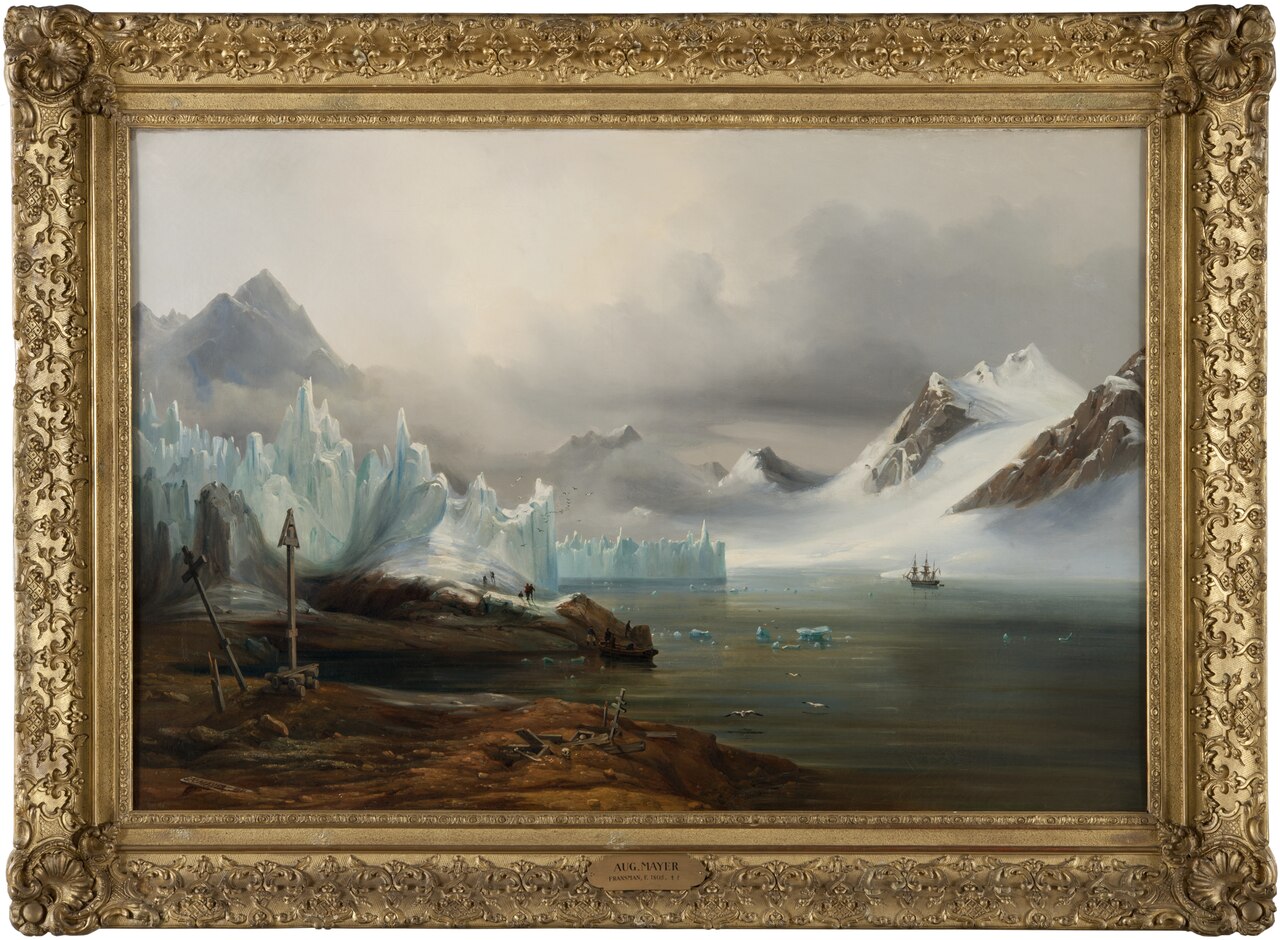
"The French Corvette 'La Recherche' Close to Bear Island, Svalbard, August 7 1838" records a scientific expedition in the high Arctic. Mayer captures the stark whiteness of the ice floes against a pale sky, while the corvette’s hull is rendered with crisp detail, emphasizing the vessel’s role as a platform for discovery.
"Evening of the Battle of Navarino" (1840) portrays the decisive naval engagement of the Greek War of Independence. Here Mayer’s skill in depicting multiple ships and the play of firelight across the water demonstrates his capacity to manage complex, multi‑figure compositions.
"Auguste Mayer - L'abordage du vaisseau Lord Nelson de 50 canons de 18 par le corsaire bordelais La Bellone de 32 canons de 8" (1872) shows a daring boarding action by the French privateer La Bellone against Lord Nelson’s vessel. The work, painted late in Mayer’s career, reflects a matured palette and a heightened sense of narrative tension.
"View from Spitzbergen" is an Arctic landscape that forgoes human activity in favour of a pure depiction of ice, sky, and distant mountains. The piece underscores Mayer’s versatility, extending his maritime interest into pure landscape.
These works collectively illustrate Mayer’s commitment to historical accuracy, his fascination with naval technology, and his ability to infuse documentary scenes with emotional resonance.
Influence and legacy Auguste Mayer’s contribution to marine art lies in his synthesis of academic realism with the burgeoning public appetite for naval adventure and scientific exploration. By consistently exhibiting at the Paris Salon for over four decades, he helped legitise marine painting as a serious genre within the French Academy. His lithographs, widely circulated among scientific societies, provided visual documentation that complemented written reports, thereby influencing the way the public imagined Arctic voyages and naval warfare.
Later French marine painters such as Léon Gaucherel and Jean Antoine Théodore Girard drew upon Mayer’s meticulous ship studies and atmospheric handling of sea and sky. Though he never achieved the fame of contemporaries like Eugène Delacroix, Mayer’s works remain valuable resources for historians of naval technology and Arctic exploration. Museums in Brest and Paris retain several of his paintings and prints, and his images continue to appear in specialised publications on 19th‑century naval history.
In the digital age, Mayer’s paintings are frequently used in online databases and educational platforms as clear visual references for specific battles and expeditions. His balanced approach—combining factual precision with artistic sensibility—makes his work an enduring exemplar of how art can serve both aesthetic and documentary purposes.
Frequently asked questions
Who was Auguste Étienne François Mayer?
He was a French painter and lithographer (1805–1890) from Brest who specialised in marine subjects, especially naval battles and Arctic voyages.
What artistic style or movement is Mayer associated with?
Mayer worked in an academic realist style, focusing on accurate depictions of ships and sea, without being tied to a specific avant‑garde movement.
What are his most famous works?
Key works include "Combat glorieux du vaisseau le Bucentaure contre trois vaisseaux anglais" (1836), "Evening of the Battle of Navarino" (1840), and the Arctic scenes of "The French Corvette 'La Recherche' Close to Bear Island" (1838) and "View from Spitzbergen".
Why is Mayer important in art history?
He legitimised marine painting within the French academic tradition, provided visual documentation of 19th‑century naval and scientific expeditions, and influenced later marine artists.
How can I recognise a painting by Mayer?
Look for meticulous ship details, layered oil glazes that give a luminous sheen to hulls, precise lithographic line work, and a balance of documentary accuracy with dramatic lighting.