Antoine Plamondon
1804 – 1895
In short
Antoine Plamondon (1804–1895) was a Canadian painter from Quebec, best known for his portraiture and religious commissions for churches in the Quebec City region. After an apprenticeship in Paris, he returned to Canada where he built a prolific career that spanned more than six decades.
Notable works



Early life Antoine‑Sébastien Plamondon was born in 1804 in the small settlement of L'Ancienne‑Lorette, a community situated on the north shore of the St. Lawrence River near Quebec City. Little is recorded about his family background, but the region's strong Catholic tradition and its burgeoning francophone culture would shape his artistic sensibilities. As a youth, Plamondon displayed a talent for drawing that attracted the attention of local patrons, enabling him to pursue formal training abroad—a rare opportunity for a Canadian artist in the early nineteenth century.
Career and style In the early 1820s Plamondon travelled to France, where he spent four years studying in Paris. He worked under the guidance of portraitists such as Jean‑Baptiste Paulin Guérin, absorbing the academic conventions of the French Academy while also encountering the emerging Romantic tendencies of the period. Upon his return to Quebec around the mid‑1820s, he established a workshop in Quebec City and quickly became the go‑to portraitist for the province’s elite families. His style combined the precise draftsmanship of his Parisian training with a gentle realism that captured the dignity and modesty of his sitters.
In addition to portraiture, Plamondon accepted a steady stream of commissions from the Catholic Church. He produced altarpieces, devotional panels, and murals for a range of parishes, often integrating the soft chiaroscuro and muted colour palettes favoured by French religious painters. Although he never aligned himself with a specific avant‑garde movement, his work reflects the transitional moment between the Neoclassical rigor of the early nineteenth century and the more emotive sensibilities that would dominate later Romantic religious art.
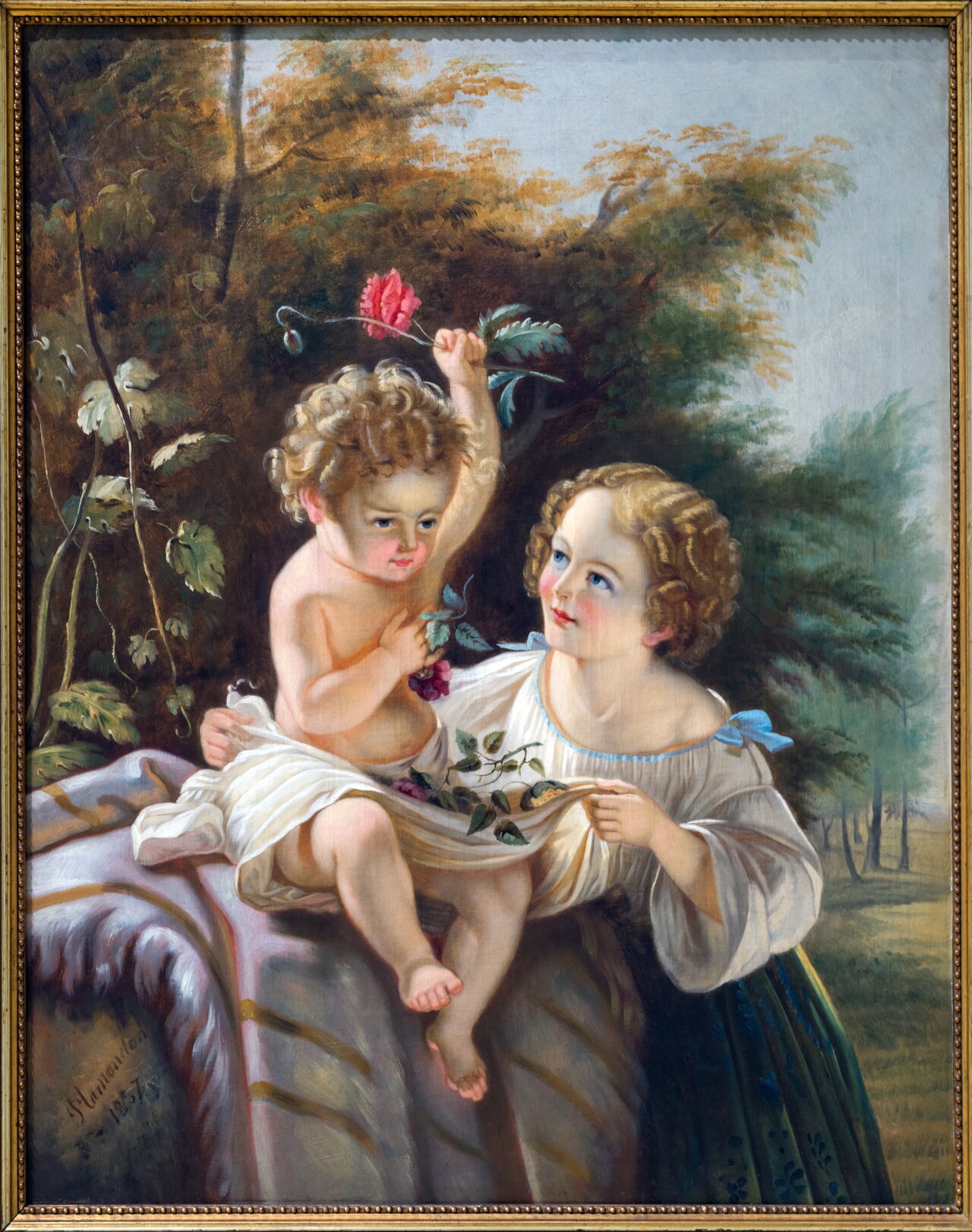
Signature techniques Plamondon’s paintings are recognisable by several technical hallmarks. First, he employed a layered glazing technique, applying thin, translucent layers of oil over an underpainting to achieve depth and luminosity, particularly in flesh tones. Second, his handling of light is subtle; he favoured diffused illumination that avoids dramatic contrasts, giving his subjects a calm, almost contemplative presence. Third, he often rendered garments with fine, almost tactile brushwork, allowing the texture of silk, wool or fur to emerge without overwhelming the composition. Finally, his compositional arrangements display a balanced symmetry, a legacy of his academic training, with the principal figure typically centred and surrounded by secondary elements that support the narrative without competing for attention.
Major works Among Plamondon’s most frequently cited pieces are several portraits that document Quebec’s social milieu. "Julie Papineau (née Bruneau) and her Daughter Ezilda" (1836) showcases his ability to render intimate familial bonds; the delicate modelling of the mother’s face and the tender interaction with her child exemplify his nuanced approach to portraiture. "Madame Joseph Laurin, née Marie‑Louise Dalaire" (1839) further demonstrates his skill in portraying the elegance of the provincial bourgeoisie, with meticulous attention to the lacework of her dress and the subdued background that directs focus to her expression.
The portrait "Abigail Towne" (1840) reflects Plamondon’s adaptation of Anglo‑American portrait conventions, suggesting his awareness of trans‑Atlantic artistic currents. "Les Petits Jardiniers" (1857) departs from strict portraiture to depict a group of children engaged in gardening, highlighting his capacity to capture everyday scenes with a gentle narrative tone. "The Pigeon‑Hunt" (1853) is a genre painting that places figures within a dynamic outdoor setting, illustrating his versatility beyond the studio.
In the religious sphere, Plamondon supplied numerous altarpieces for churches surrounding Quebec City. While specific titles are less documented, the surviving works display his characteristic restraint and reverence, employing muted palettes and serene facial expressions that align with the devotional needs of the congregations.
Influence and legacy Antoine Plamondon’s long career contributed significantly to the visual culture of nineteenth‑century Quebec. By bridging French academic training with local artistic demands, he helped establish a distinct Canadian portrait tradition that persisted well into the late nineteenth century. His religious commissions reinforced the visual identity of many parish churches, many of which still retain his work as focal points of worship.
Later Quebec artists, such as William Brymner and the members of the Group of Seven, would move toward more modernist expressions, yet they inherited a foundation of disciplined technique and a respect for regional subjects that Plamondon exemplified. Today, his paintings are valued both as historical documents of Quebec’s social elite and as examples of early Canadian academic art. Collections in museums across Canada, as well as numerous ecclesiastical holdings, continue to preserve and exhibit his oeuvre, ensuring that his contribution to Canadian art history remains recognised.
Overall, Plamondon stands as a pivotal figure who melded European academic influences with the emerging cultural identity of a young Canada, leaving a body of work that offers insight into the aesthetic and societal values of his era.
Frequently asked questions
Who was Antoine Plamondon?
Antoine Plamondon (1804–1895) was a Canadian painter from Quebec, renowned for his portraiture and religious paintings commissioned by churches in and around Quebec City.
What artistic style or movement is he associated with?
He worked within the academic tradition of early‑19th‑century French painting, blending Neoclassical precision with a subtle Romantic sensibility, without aligning to a specific avant‑garde movement.
What are his most famous works?
Key works include the portraits "Julie Papineau and her Daughter Ezilda" (1836), "Madame Joseph Laurin" (1839), "Abigail Towne" (1840), the genre scenes "Les Petits Jardiniers" (1857) and "The Pigeon‑Hunt" (1853).
Why is Antoine Plamondon important in art history?
He helped establish a distinct Canadian portrait tradition, supplied important religious art for Quebec churches, and bridged European academic training with local cultural expression.
How can one recognise an Antoine Plamondon painting?
His works are marked by soft, diffused lighting, layered glazing for luminous flesh tones, meticulous rendering of textiles, and a balanced, symmetrical composition that conveys calm dignity.