Antoine Monnoyer
1671 – 1747
In short
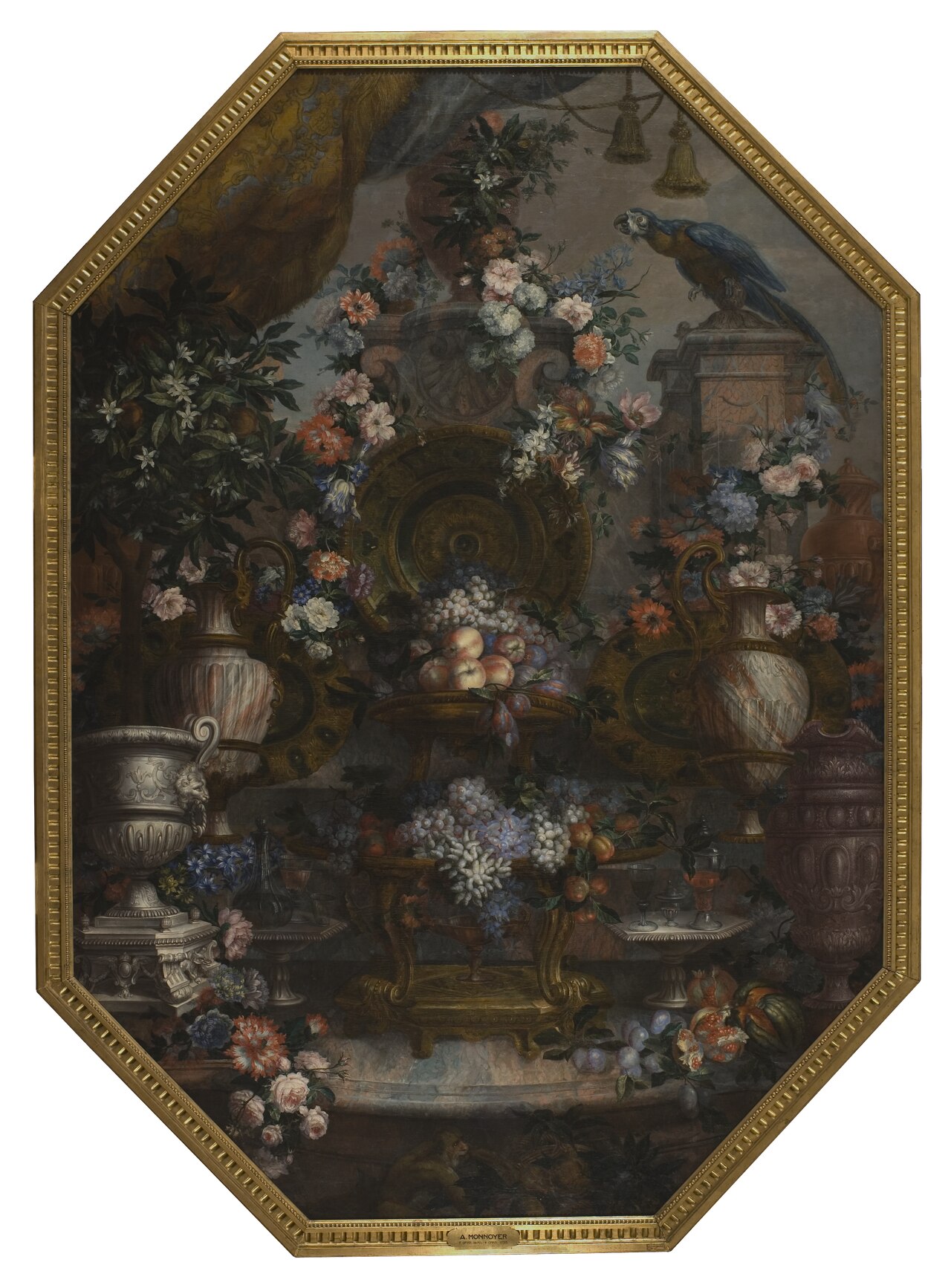
Antoine Monnoyer (1671–1747) was a French painter renowned for his elaborate still‑life compositions featuring flowers, fruit, and exotic fauna. Working in the early‑18th‑century French tradition, he produced a series of celebrated works such as Large Flowerpiece with Precious Urns (1733) and Still Life with Flowers, Fruits, a Parrot and a Monkey (1695).
Notable works
_-_Flowerpiece_with_Parrots_-_NM_795_-_Nationalmuseum.jpg)


Early life Antoine Monnoyer was born in Paris in 1671, at a time when the French capital was a vibrant centre for artistic production. Little is recorded about his family background, but the prevalence of still‑life painting in Paris during the late 17th century suggests that he would have been exposed to the genre from an early age. Training for painters in this period typically involved apprenticeship in a master’s workshop, and Monnoyer likely received his foundational instruction within such a setting, learning the technical skills required for rendering texture, light, and colour.
Career and style Monnoyer’s professional activity spanned the last three decades of the 17th century and the first half of the 18th, a period when French still‑life painting was increasingly influenced by the Dutch and Flemish schools. His canvases are characterised by a lavish arrangement of botanicals and fruit, often combined with ornamental objects such as vases, urns, and sometimes exotic animals like parrots and monkeys. The compositions balance a sense of natural abundance with a cultivated elegance, reflecting the tastes of a French aristocracy that prized decorative art for both private enjoyment and public display.
The overall style of Monnoyer’s work aligns with the late Baroque sensibility that favoured dramatic contrasts of light and shadow, yet his palette tends toward a refined, luminous quality. He employed a careful modulation of colour to differentiate between the delicate petals of roses, the glossy skins of ripe fruit, and the iridescent plumage of birds. This nuanced handling of surface effects situates him among the more sophisticated practitioners of French still‑life, even if his name remains less widely known than some of his contemporaries.
Signature techniques Monnoyer’s technique is distinguished by several recurring methods:
1. Layered glazing – He built depth by applying thin, translucent layers of oil paint, allowing underlying tones to shine through and creating a subtle glow on petals and fruit skins. 2. Precise stippling – Minute brushstrokes are used to suggest the texture of fur, feathers, and the sheen of porcelain, giving his subjects a tactile realism. 3. Strategic lighting – A single, often unseen light source illuminates the central elements of the composition, producing a chiaroscuro effect that accentuates volume and three‑dimensionality. 4. Complex arrangements – Monnoyer favoured asymmetrical groupings that guide the viewer’s eye across the canvas, employing diagonal lines created by stems, branches, and the curvature of vases. 5. Use of symbolic objects – Items such as precious urns, exotic birds, and small mammals were not merely decorative; they conveyed themes of wealth, exploration, and the transience of life, echoing the moral undertones common in still‑life painting.
Major works Monnoyer’s oeuvre, though not extensive, includes several pieces that exemplify his compositional skill and thematic interests.
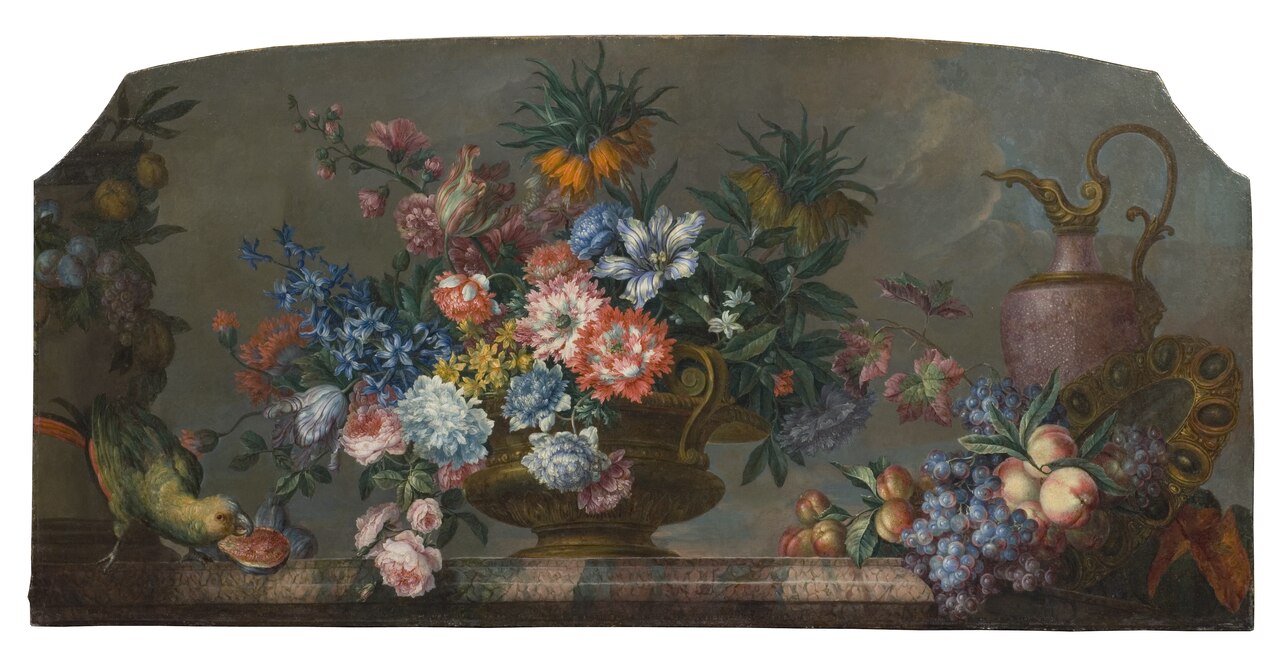
- Large Flowerpiece with Precious Urns (1733) – This late work showcases an opulent display of blossoms surrounding two ornately decorated urns. The contrast between the soft, natural forms of the flowers and the hard, reflective surfaces of the urns creates a dialogue between nature and luxury. - Flowerpiece with Parrots – In this canvas, a pair of vividly coloured parrots perches among a profusion of roses and lilies. The birds’ bright plumage provides a striking focal point, while the surrounding flora is rendered with delicate brushwork that emphasizes their fragility. - Flowerpiece with Vases and a Parrot – Here, Monnoyer combines ceramic vessels with a single parrot, arranging the elements in a balanced yet dynamic composition. The vase’s polished glaze reflects light, mirroring the sheen on the bird’s feathers. - Still Life with Flowers, Fruits, a Parrot and a Monkey (1695) – One of his earliest documented works, this painting juxtaposes a lush bouquet with ripe fruit, a perched parrot, and a curious monkey. The inclusion of the primate adds a narrative element, suggesting the exotic curiosities collected by wealthy patrons. - Vase of Flowers (1715) – A more restrained piece, this work centres on a single vase brimming with a variety of blossoms. The simplicity of the arrangement highlights Monnoyer’s mastery of colour harmony and his ability to convey texture through subtle brushstrokes.
Each of these works demonstrates Monnoyer’s consistent fascination with the interplay of colour, light, and material, as well as his capacity to embed symbolic meaning within decorative scenes.
Influence and legacy Although Antoine Monnoyer never achieved the fame of contemporaries such as Jean-Baptiste Chardin, his paintings contribute valuable insight into the development of French still‑life during a period of cross‑national artistic exchange. His meticulous rendering of botanical detail anticipates the later interests of French naturalist painters in the 18th century, while his inclusion of exotic fauna reflects the growing fascination with global exploration.
Monnoyer’s works are held in several French regional collections, and they continue to be referenced by scholars examining the diffusion of Dutch still‑life techniques into French artistic practice. By preserving the decorative yet intellectual qualities of the genre, he helped sustain a tradition that would influence decorative arts, garden design, and even the emergence of the Rococo aesthetic. Today, his paintings are appreciated both for their aesthetic richness and for the way they encapsulate the cultural values of early‑modern France.
--- In sum, Antoine Monnoyer stands as a representative figure of the French still‑life movement, whose careful compositions and refined technique offer a window into the visual culture of his era.
Frequently asked questions
Who was Antoine Monnoyer?
Antoine Monnoyer (1671–1747) was a French painter known for elaborate still‑life paintings that combine flowers, fruit, and exotic animals.
What artistic style or movement is he associated with?
He worked within the French Baroque still‑life tradition, drawing on Dutch and Flemish influences while developing a distinctly refined, luminous approach.
What are his most famous works?
His best‑known paintings include Large Flowerpiece with Precious Urns (1733), Still Life with Flowers, Fruits, a Parrot and a Monkey (1695), and Vase of Flowers (1715).
Why is Antoine Monnoyer important in art history?
Monnoyer exemplifies the high‑quality French still‑life of the early 18th century, bridging Dutch techniques with French decorative taste and influencing later naturalist painters.
How can I recognise a painting by Antoine Monnoyer?
Look for meticulously rendered flowers and fruit, a subtle glazing technique that creates a soft glow, and the occasional inclusion of exotic birds or small mammals within a balanced, asymmetrical composition.