Anne Vallayer-Coster
1744 – 1818
In short
Anne Vallayer-Coster (1744–1818) was a French painter renowned for her sophisticated still‑life compositions. She gained early acclaim, entering the Académie Royale de Peinture et de Sculpture in 1770, and remained an influential figure in French art through the late eighteenth century.
Notable works

.jpg)


Early life Anne Vallayer‑Coster was born in Paris in 1744 into a family that supported her artistic ambitions. From a young age she displayed a talent for drawing, and her parents arranged for her to study under established artists in the capital. Paris in the mid‑eighteenth century offered a vibrant artistic environment, with the Académie Royale providing a formal route for aspiring painters. Vallayer‑Coster benefitted from this system, receiving rigorous training that emphasized drawing from life, composition, and the study of classical models.
Career and style Vallayer‑Coster’s professional breakthrough came when she was admitted to the Académie Royale de Peinture et de Sculpture in 1770, at the age of twenty‑six. This was a remarkable achievement for a woman at a time when the Académie admitted very few female members. Her acceptance was based largely on the strength of her still‑life work, a genre that allowed her to demonstrate mastery of texture, colour, and the play of light.
Her style is characterised by a meticulous observation of material qualities—whether the translucency of shells, the sheen of metal, or the delicate flesh of fruit. She combined a disciplined compositional structure with a sensibility that celebrated the decorative potential of everyday objects. While she worked within the conventions of the French academic tradition, her paintings often display a subtle inventiveness that anticipates the more expressive still‑life approaches of the early nineteenth century.
Signature techniques Vallayer‑Coster employed several techniques that became hallmarks of her work. She favoured a precise underdrawing, using fine charcoal or lead to map out the arrangement of objects before applying paint. This preparatory stage ensured a balanced distribution of forms and a harmonious colour palette. In the painting process, she layered thin glazes of oil to achieve depth, particularly in rendering the reflective surfaces of metalware and the iridescence of shells. Light is rendered with a controlled, almost diffused quality, allowing the objects to appear both solid and luminous.
Her handling of botanical and marine subjects shows a keen eye for botanical accuracy, reflecting the contemporary interest in natural history. She often included a limited but rich colour scheme—deep reds, warm ochres, and cool blues—creating a sense of unity across disparate elements. The careful modulation of shadows contributes to a three‑dimensional effect that makes the still‑life appear as a tangible arrangement rather than a flat decorative panel.
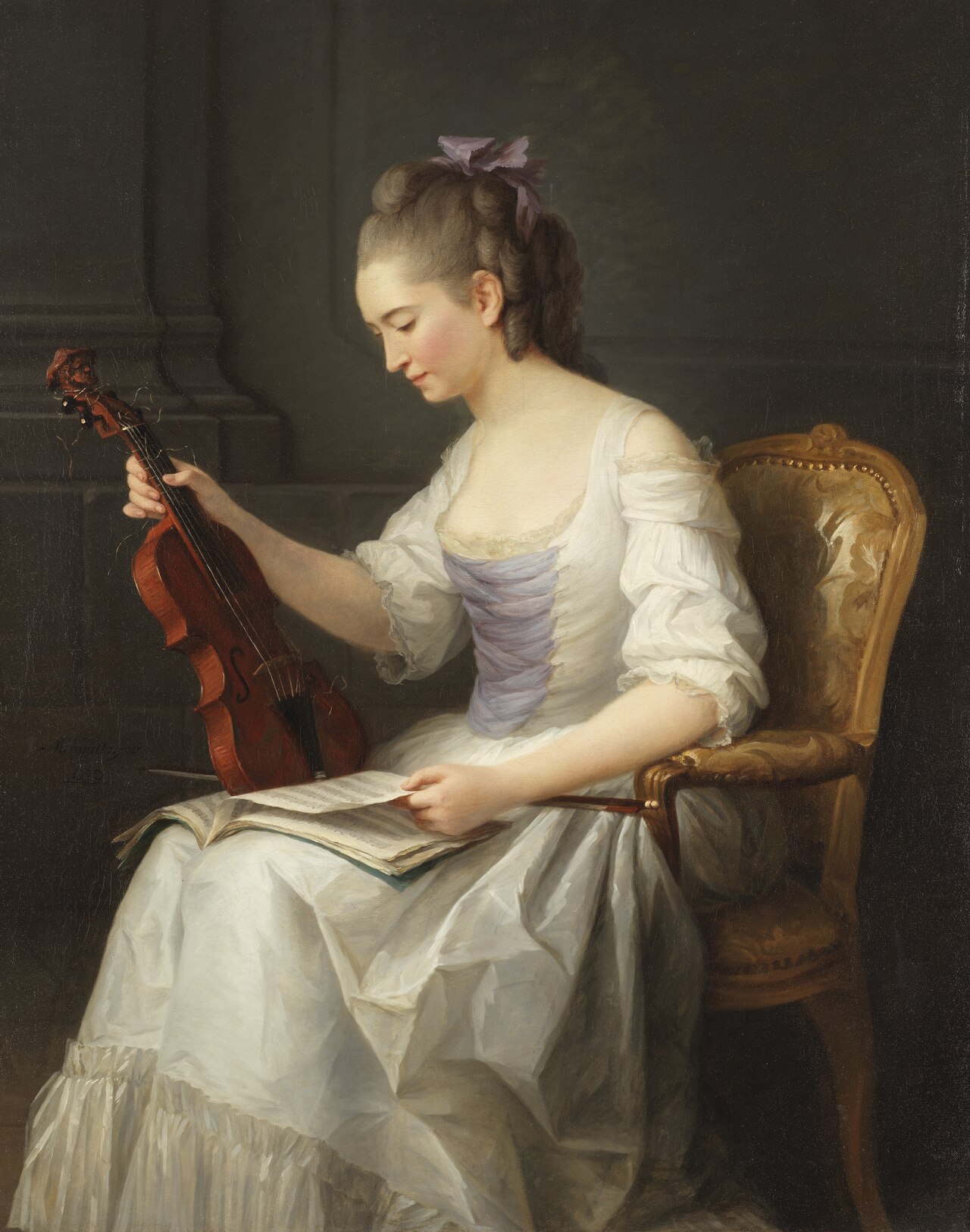
Major works - **Portrait of a Violinist (1773)** – Though primarily a still‑life specialist, Vallayer‑Coster demonstrated versatility in this portrait. The work captures a musician with a restrained elegance, focusing on the texture of the violin and the subtle expression of the sitter. The composition balances the figure with surrounding objects, hinting at the artist’s broader interest in the interplay between portraiture and still‑life.
- Basket with Grapes (1774) – This painting exemplifies her skill in rendering fruit with convincing texture. The grapes are depicted with a range of tones, from deep violet to golden yellow, each grape showing its own translucency. The basket’s woven structure is rendered with fine linear strokes, creating a tactile sense that invites the viewer to imagine the weight of the fruit.
- Vase of Flowers and Conch Shell (1780) – A vibrant arrangement that juxtaposes delicate blossoms with the hard, sculptural form of a conch shell. The vase, often rendered in a polished ceramic surface, reflects light and frames the floral elements. The work illustrates her capacity to integrate organic and inorganic forms within a harmonious whole.
- Attributes of Painting, Sculpture and Architecture (1769) – This allegorical composition presents symbolic objects associated with the three artistic disciplines. The precise rendering of tools—such as a palette, a sculptor’s chisel, and an architect’s compass—demonstrates her academic training and her ability to convey complex ideas through a clear visual language.
- Still‑Life with Tuft of Marine Plants, Shells and Corals (1769) – One of her earliest surviving works, it showcases a fascination with marine specimens that were popular in French scientific collections of the period. The delicate rendering of seaweed, the glossy sheen of shells, and the intricate texture of coral fragments attest to her observational acuity and her skill in translating natural forms onto canvas.
Influence and legacy Anne Vallayer‑Coster’s reputation rested on her technical proficiency and her capacity to elevate still‑life painting to a status comparable with history painting, the most prestigious genre of the Académie. Her admission to the Académie Royale paved the way for later women artists, demonstrating that talent could overcome institutional barriers. Though she did not align herself with a specific avant‑garde movement, her careful treatment of material and her compositional clarity influenced subsequent generations of still‑life painters in France and beyond.
In the nineteenth century, her works were collected by connoisseurs who admired the refined execution and the subtle emotional resonance of her compositions. Modern scholarship has re‑evaluated her contribution, positioning her as a pivotal figure who bridged the Rococo’s decorative sensibility and the emerging Neoclassical emphasis on order. Her paintings continue to be exhibited in major museums, where they serve as exemplars of eighteenth‑century French academic art and as testimony to the artistic possibilities available to women in a historically male‑dominated field.
Today, Vallayer‑Coster is recognised not only for the beauty of her still‑life canvases but also for the precedent she set for women seeking professional artistic recognition. Her legacy endures in the continued study of her technique, the preservation of her works, and the inspiration she provides to artists who explore the richness of everyday objects through a disciplined yet inventive visual approach.
Frequently asked questions
Who was Anne Vallayer‑Coster?
Anne Vallayer‑Coster (1744–1818) was a French painter celebrated for her sophisticated still‑life paintings and for being one of the few women admitted to the Académie Royale in 1770.
What style or movement is she associated with?
She worked within the French academic tradition, employing a precise, highly finished style that combined Rococo decorative flair with emerging Neoclassical order.
What are her most famous works?
Key works include *Portrait of a Violinist* (1773), *Basket with Grapes* (1774), *Vase of Flowers and Conch Shell* (1780), *Attributes of Painting, Sculpture and Architecture* (1769), and *Still‑Life with Tuft of Marine Plants, Shells and Corals* (1769).
Why is she important in art history?
She demonstrated that still‑life could achieve the highest academic esteem, broke gender barriers by joining the Académie, and influenced later generations of French still‑life painters.
How can I recognise an Anne Vallayer‑Coster painting?
Look for meticulous detail, especially in the rendering of textures such as shells, fruit skins, and metal, a balanced composition with a restrained colour palette, and a subtle, diffused light that gives objects a luminous, three‑dimensional quality.